A meeting with Medusa: here
am I in an almost too-close-for-comfort encounter with Greek mythology's most
(in)famous gorgon – notice how I am taking good care not to look her in the
eye... This is Ray Harryhausen's
original model of Medusa, as featured in his star-studded fantasy movie Clash
of the Titans (1981) and on public display for almost four months during
2018 as part of Valence House Museum's 'Dinosaurs, Harryhausen and Me'
exhibition, organised by Alan Friswell, official model restorer to the Ray & Diana Harryhausen
Foundation (photo © Dr Karl Shuker)
It's not every day that you are able to
come face to face with some true Hollywood legends, but I did precisely that on
29 March 2018, when I visited Valence House Museum in Dagenham, Essex, just
outside London, England. My reason for visiting was to see a wonderful
exhibition entitled 'Dinosaurs,
Harryhausen and Me', which featured a sizeable number of the iconic,
world-famous dinosaur and monster models created by the legendary special-effects
genius Ray Harryhausen and appearing in a number of his celebrated stop-motion
science fiction and fantasy movies, including Jason and the Argonauts
(hydra, two fighting skeletons), The Valley of Gwangi (Gwangi, Styracosaurus,
Eohippus, Ornithomimus, Lope), Clash of the Titans
(Pegasus, Medusa, Bubo the living mechanical owl), Mysterious Island
(giant ammonite/nautiloid mollusc), One Million Years BC (Ceratosaurus),
and First Men in the Moon (Grand/Prime Lunar – the big-brained leader of
the moon-ruling insectoid Selenites).
The 'Me' in the exhibition's title is
none other than a longstanding Facebook friend of mine, expert model maker Alan
Friswell, who was personally appointed by Ray to restore all of his priceless
models, because some had suffered damage and wear during the 40+ years since
they had originally been made. Alan also very kindly made for me a wonderful full-sized
Feejee mermaid that I greatly treasure – thanks Al!
(Left) Holding my
spectacular Feejee mermaid made for me by Alan Friswell; (Right) Alan himself
with my mermaid on the day that he presented it to me when we met at Dagenham
in 2010 – thanks again, Al! (photos © Dr Karl Shuker)
As Alan is local to Dagenham, the Museum
was very keen to stage the exhibition, which proved extremely popular, and it
was an absolute delight for me to view at first hand so many of the awesome
creations that captivated me on screen when I first saw their films as a youth
and which still do when I rewatch them today. A selection of framed artworks
produced by Ray was also on display here, together with some of Alan's own
stunning models. Alan is to be heartily congratulated upon organising such a
captivating and thoroughly unique exhibition in England, which was open from 10
March to 30 June 2018, and even had free entry. So for lifelong Harryhausen and
monster movie fans like me, it was a truly unmissable experience – highly recommended!!
Moreover, as a fan, rather than simply
sharing on social media some of the photographs that I snapped of the amazing
items featured in this exhibition I thought that it would be interesting and
entertaining to annotate them with various fascinating facts and snippets of
pertinent information relating to each one that I've collected and conserved
down through the years, so here goes:
EL DIABLO
The original model of El
Diablo, the diminutive prehistoric dawn horse or Eohippus from The
Valley of Gwangi (photo © Dr Karl Shuker)
This is my all-time personal favourite of
all of Ray's many marvellous creations – El Diablo, the little prehistoric Eohippus
that features in Ray's spellbinding Western/sci-fi movie The Valley of
Gwangi (1969). The stupefied reaction of the movie's scientist character,
Prof. Bromley (played superbly by the highly-respected English character actor
Laurence Naismith) upon seeing El Diablo, and referring to him as the greatest
scientific discovery of the age, was a major cryptozoological incitement to me
at the tender age when I first viewed this fantastic movie. Click here
to view the classic footage that introduces El Diablo in it.
Incidentally, although when I was a child
this ancestral equid (from the early Eocene, c.50 million years ago) was indeed
referred to zoologically by the iconic name Eohippus ('dawn horse'), it
was subsequently renamed Hyracotherium (a much duller, far less
evocative monicker, in my opinion), due to the strict, inflexible rules of
nomenclatural precedence (it appeared that the latter name had been assigned to
it prior to Eohippus). Happily, however, it is now Eohippus once
more, because the genus Hyracotherium has lately been shown to be a
paraphyletic hotchpotch, an artificial assemblage of various unrelated forms.
So, welcome back, little dawn horse, you've been greatly missed!
GWANGI
Gwangi, the theropod
dinosaur model that thrilled and terrified movie-goers in equal measure when it
starred in The Valley of Gwangi (photo © Dr Karl Shuker)
Although Gwangi was officially described
as a Jurassic Allosaurus, Ray Harryhausen freely confessed that he had
also been inspired by the latter dinosaur's Cretaceous descendant Tyrannosaurus
rex when designing its model, combining elements from both forms to create
a truly terrifying theropod that wreaked havoc and mayhem when hauled out of
its prehistoric valley enclave into the modern-day realm of humanity.
Ray was famed for the incredibly
life-like, realistic appearance of his creations when seen on screen, due in no
small way to the myriad of small but highly individualistic behavioural nuances
with which he imbued all of them. For me, this is epitomised by the scene from The
Valley of Gwangi in which a friendly performing circus elephant is suddenly
confronted, attacked, and mercilessly slaughtered by a rampaging, newly-escaped
Gwangi. Despite knowing full well that the elephant, just like Gwangi, was
actually a stop-motion model, not a real elephant, it was thanks to Ray's
genius in animating it so realistically that when I viewed this film for the
first time as a teenager I was thoroughly traumatised by its savage death at
the claws and teeth of Gwangi, and even today I always find that particular
scene difficult to watch. Testament, indeed, to Ray's astonishing cinematic
skills! If you care to watch it, click here
– but don’t expect me to!
ORNITHOMIMUS AND STYRACOSAURUS
Ray's Ornithomimus plus
El Diablo (top) and Styracosaurus (bottom) models from The Valley of
Gwangi (photos © Dr Karl Shuker)
El Diablo and Gwangi are not the only
prehistoric creatures featuring in The Valley of Gwangi. In addition to
a pterosaur (almost obligatory in a movie of this nature), there are also an Ornithomimus
and a Styracosaurus. Relatively small and fast-running in bipedal mode,
the Ornithomimus ('bird-mimic') is being swiftly pursued by an
astonished trio of cowboys on horseback within the mysterious valley when abruptly
the hitherto-concealed Gwangi bursts into view, leans down, neatly snaps up the
hapless bird-mimic dinosaur in its great jaws, and begins feeding upon its
still-twitching body. Not surprisingly, the cowboys duly choose discretion as
the better part of valour, and ride away very swiftly in the opposite direction
– although one of them does turn around briefly and fires a couple of
ill-advised shots in the great reptile's direction, before racing off again
when a menacing, totally-uninjured Gwangi makes it abundantly clear that it
does not take kindly to its meal being disrupted in such an impolite manner!
Click here
to view this tense, electrifying scene.
The Styracosaurus, conversely, is
made of sterner stuff, because when it is attacked by Gwangi a little later in
the film, it soon puts its long and very formidable sharply-pointed snout-horn
to effective use, fending off Gwangi with fierce thrusts to the latter's underparts
– until cruelly betrayed by a group of cowboys keeping watch from a safe
distance. Planning to capture Gwangi alive for exhibition purposes, they
treacherously collude in its attack upon the Styracosaurus, their leader
Carlos spearing the horned dinosaur in order to weaken it, thereby enabling
Gwangi to overcome its defensive manoeuvres and kill it. Click here
to watch this literally monstrous scene of treachery and tragedy!
GIANT AMMONITE/NAUTILOID
The formidable
many-tentacled giant ammonite/nautiloid mollusc from Mysterious Island
(photo © Dr Karl Shuker)
Loosely based upon the Jules Verne novel The
Mysterious Island (1874), this classic Ray Harryhausen movie from 1961 features
a host of giant mutated creatures as well as some prehistoric survivors. Most
famous of these latter is a terror bird Phorusrhacos (although many
film-goers mistakenly assumed that it was simply a giant chicken!), but also
present is this awesome giant ammonite (or nautiloid, according to some
sources). Another of my favourite if lesser-known Harryhausen creations, this
gargantuan marine mollusc appears near the end of the film and furiously
battles the heroes during their valiant attempt to escape the island by raising
from the deep a sunken but otherwise seaworthy pirate ship. Click here
to view the dramatic underwater scene in which it appears.
At one time or another, virtually every
major taxonomic group of prehistoric animals has been cited as a possible
identity for some cryptid, but as far as I'm aware no such mystery beast has ever
been likened to a living ammonite or a living fossil-type nautiloid. Today, the
nautiloids are represented solely by the handful of pearly (chambered) nautilus
species. As for the ammonites: constituting a discrete subclass within the
molluscan class Cephalopoda (containing today's octopuses, true squids,
cuttlefishes, nautiluses, and vampire squid), the ammonites were once a
dominant group within the prevailing marine fauna, but their last
representatives died out during the mass extinction at the end of the
Cretaceous, c.66 million years ago…didn't they?
GRAND/PRIME LUNAR
Grand (aka Prime) Lunar, the
insectoid Selenites' big-brained leader, ensconced upon a crystal throne, from First
Men in the Moon (photo © Dr Karl Shuker)
Based upon the eponymous sci-fi novel by
H.G. Wells from 1901, in which some eccentric Victorian-era English scientists successfully
travel to the moon (i.e. many decades before America's real-life Apollo
missions), this delightful British movie from 1964 features some of Ray's most
distinctive creations, including giant caterpillar-like mooncalves, and the
insectoid ruling lunar race, the Selenites, whose leader is the grotesquely
big-brained Grand (aka Prime) Lunar. Click here
to view them in an original 1960s trailer for this film.
The concluding section of the movie shows
the purported first-ever manned landing on the moon, in 1964, by a team of UN
scientists, only for them to discover that the English scientists had long ago
beaten them to it, and had left their leader, Prof. Cavor, behind there at his
request. He now was dead, but so too was the entire Selenite civilisation,
victims of the common cold viruses that Cavor had inadvertently brought with
him from Earth. Needless to say, this closely echoes the famous denouement in
an earlier H.G. Wells novel, The War of the Worlds, in which the
seemingly unstoppable Martians invading Earth are ultimately overcome not by
the might of humanity, but rather by our planet's tiniest inhabitants, the
viruses, against which the Martians have no defence.
PEGASUS
Ray's beautiful model of
the legendary winged horse Pegasus that appears in Clash of the Titans (photo
© Dr Karl Shuker)
Ray's last but also his technically greatest
film was Clash of the Titans (1981), a breathtaking mythological melange
of a movie in which strands and characters from a number of different classical
legends are deftly woven together to create a thrilling storyline that loosely centres
upon the dramatic saga of the Greek hero Perseus and his daring rescue of the
princess Andromeda from a horrific sea monster. The winged horse Pegasus,
ridden here by Perseus during his ultimately successful bid to save Andromeda,
didn't actually feature in the original version of this particular legend –
instead, Perseus had been equipped with winged sandals presented to him by
Hermes, whereas Pegasus had borne an entirely different hero, Bellerophon,
during his battle with the monstrous Chimaera. Nevertheless, Pegasus's
inclusion provides a truly scintillating additional spark of movie magic to
what is already a spellbinding, highly suspenseful tale of monsters and
mystery, and which even incorporates a Nordic interloper in the shape of the
Kraken, no less – or at least its name, which is understandable, given that the
Greek sea monster's original name, Cetus (from which 'cetacean' is derived, the
formal zoological term for all whales, dolphins, and porpoises), would
certainly have been far less dramatic or memorable to movie-goers.
Ray was once asked where he had derived
his inspiration for choreographing and animating Pegasus in flight, as it
seemed so natural, so realistic. In reply, he revealed that he had consulted what
he personally considered to be the finest source in existence relating to such
matters – namely, the idyllic scene from Walt Disney's immortal animated film Fantasia
(1940) that features a phalanx of winged horses flying through the sky before
spiralling downwards to land gracefully upon a pastel-hued lake like a flock of
equine swans (click here to
view this enchanting scene – one of my all-time favourite animated sequences,
set to the lyrical theme arising midway through the third movement of
Beethoven's Pastoral Symphony). Additionally, click here
to view a short documentary segment featuring Ray talking about how Pegasus was
designed for realistic flight, and also including some excerpts from Clash
of the Titans featuring the winged steed in action.
BUBO
Bubo, the living mechanical
owl with metallic plumage from Clash of the Titans (photo © Dr Karl
Shuker)
Also appearing in Clash of the Titans
is Bubo, a living mechanical owl created from brass and iron by the fire god
Hephaestus as a metallic replica of the real Bubo, the wise pet owl of Athena,
goddess of knowledge and wisdom. Its function, as dictated by Zeus, the supreme
Greek god and also father of Perseus, is to lead Perseus to the Graeae or Grey
Sisters (aka the Stygian Witches), who, albeit only with great reluctance, will
tell him how to defeat the Kraken. Click here
to view Bubo's somewhat less than dignified debut in the company of Perseus,
when he unwarily perches upon a dead branch and unceremoniously crashes to the
ground (Bubo, that is – not Perseus!).
Ray's Bubo model was intricately
constructed by him from golden and silver-coloured metal, and was
radio-controlled when in the presence of the movie's actors and actresses – a
dazzling cast list of thespians that include such celebrated stars of stage and
screen as Sir Laurence Olivier (Zeus), Claire Bloom (Hera), Maggie Smith (the
sea goddess Thetis), Ursula Andress (Aphrodite), Sian Phillips (Queen
Cassiopeia), and the then still-upcoming actor Harry Hamlin as Perseus.
MEDUSA
A petrifying (in every
sense) portrayal of Medusa the gorgon – Ray's terrifying model that features in
Clash of the Titans (photo © Dr Karl Shuker)
The Stygian Witches inform Perseus that
the Kraken can only be killed with the head of the gorgon Medusa, whose
dreadful eyes even when dead would instantly turn to stone any living thing
that gazed directly at them. So it becomes Perseus's quest to seek out and slay
Medusa, but it will be no easy task, given that he can look at her only
indirectly, via her mirrored reflection on the surface of his highly-polished
shield.
In the original Greek myth, Medusa was
once an inordinately beautiful maiden before being transformed into her now-monstrous
snake-haired, petrifying form by Athena after Medusa had been assaulted by
Poseidon in Athena's temple, an act that the goddess deemed to be a defilement
of her earthly abode (despite the fact that Medusa had been the innocent party!).
Nevertheless, Medusa retains her comely body and lissom legs. Ray, however,
considered that for her to be an effective on-screen monster, Medusa needed to
be much more frightening in form, and so in the extremely detailed bronze model
that he constructed he replaced her traditional human lower torso and legs with
the limbless body of a giant serpent, and even added at the tip of its tail a
large vibrating rattle as famously borne by rattlesnakes, as well as equipping
her with a bow and quiver of deadly arrows to shoot at anyone entering her
temple hideaway who was skilful enough to evade her lethal stare. Click here
to view the nightmarish battle between Perseus and Medusa staged within the
sinister torch-lit semi-darkness of the temple's silent, shadowy interior. And
click here
to read a ShukerNature blog article of mine concerning not only Medusa herself but
also a host of real-life gorgon-dubbed creatures from the past and the present.
HYDRA
Ray's spectacular
seven-headed, twin-tailed hydra model that is utilised in Jason and the
Argonauts (photo © Dr Karl Shuker)
Ray's ingenuity for improvisation and
adaptation was by no means limited to his vision of how Medusa should appear on
screen. Other notable examples include his two-headed roc in The 7th
Voyage of Sinbad (1958) and his giant horn-skulled troglodyte in Sinbad
and the Eye of the Tiger (1977). Moreover, in Jason and the Argonauts
(1963), one of the Greek hero Jason's many monstrous antagonists encountered
during his quest for the fabled Golden Fleece is the multi-headed hydra that in
classical Greek mythology was actually confronted by Heracles instead, its
eventual defeat being the second of his twelve great labours (click here
for further details on ShukerNature). In that latter legend, the hydra was
generally described as nine-headed, but Ray considered that it would be too
difficult to animate effectively nine independent heads and necks via stop-motion
techniques, so he reduced its quota to seven. Possibly to compensate for this,
however, he provided it with a bifurcated tail.
In this movie, the hydra guards the tree
upon which the glittering Golden Fleece is suspended, whereas in the original
Greek myth it was guarded by a never-sleeping single-headed dragon as well as
by a herd of brass-hoofed bulls that breathed fire and whose teeth if planted
in the ground would transform into an army of soldiers. Ray skilfully utilised
this latter characteristic, with the teeth of the hydra if planted in the
ground transforming into an army of deathless fighting skeletons. Click here
to view Jason's epic battle with the multi-headed hydra. And don’t forget to
check out my Eclectarium blog article here
concerning the history of another iconic monster from this same movie – Talos,
the giant bronze statue that disconcertingly comes to life and relentlessly
pursues Jason and his fellow Argonauts as they desperately strive to escape his
lethal metallic clutches (click here to
view this decidedly eerie scene).
FIGHTING SKELETONS
Two fighting skeletons that
appeared in Jason and the Argonauts (photos © Dr Karl Shuker)
One of Ray's most celebrated accomplishments
in stop-motion animation was undoubtedly his bringing to the screen those
spectacular scenes featuring armies of fighting skeletons, raised up from the
ground as deathless warriors to strike terror – as well as any weapons that
they are brandishing! – into the hearts of their mortal opponents. They appear
most famously in Jason and the Argonauts (1963), when King Aeëtes sows
into the ground the teeth of the hydra newly slain by Jason; after Aeëtes then
prays to Hecate, goddess of witchcraft, a company of seven weapon-armed living
skeletons – 'the Children of Hydra's Teeth' – rises up out of the ground and
furiously attacks Jason and two companions. After a prolonged battle in which
both of his companions are killed by them, Jason successfully escapes their
clutches by leaping into the sea where he is rescued by the Argonauts aboard
their vessel.
In his fascinating book, Film Fantasy
Scrapbook (1981), in which he provided numerous behind-the-scenes
recollections and inside information for each of his movies, Ray Harryhausen
made the following very insightful comments concerning what he referred to as
the Skeleton Sequence in Jason and the Argonauts: "Technically, it
was unprecedented in the sphere of fantasy filming. When one pauses to
contemplate that there were seven skeletons fighting three men, with each
skeleton having five appendages to move in each frame of film, this means that
an unprecedented 35 animated movements had to be synchronized with three live
actors' movements; so one can readily see why it took four and a half months to
record the sequence for the screen". Click here to view the fruits of
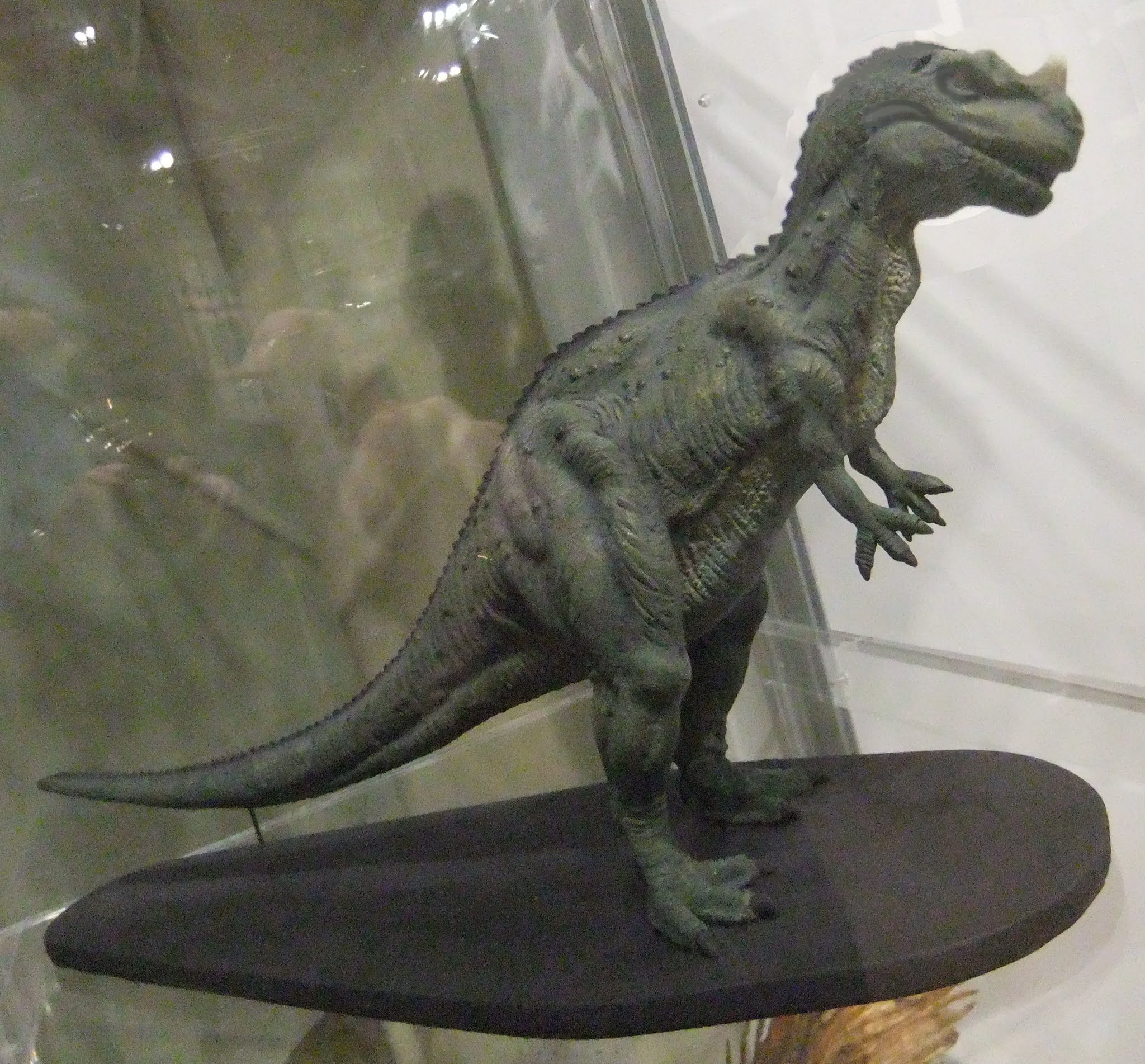
Ray's Herculean labours in creating this extraordinary scene.
CERATOSAURUS
Ray's model of the
horn-snouted Ceratosaurus from One Million Years BC (photo © Dr
Karl Shuker)
In real life, Ceratosaurus was a
theropod dinosaur from the Late Jurassic Period, approximately 150 million
years ago. In Ray's British-made movie One Million Years BC, conversely,
released in 1966, it co-exists with primitive cave-dwelling humans (including Loana,
a very voluptuous cave-woman played by none other than Raquel Welch), as do
many other officially long-vanished prehistoric beasts, such as pterosaurs, Brontosaurus,
Allosaurus, and the gargantuan sea turtle Archelon. Yet although
chronologically incongruous, as with all of Ray's movies the monsters are truly
marvellous, but perhaps the single most memorable scene is a lengthy set-piece
battle between a Ceratosaurus and a Triceratops, which the latter
eventually wins, leaving behind the severely stunned but still breathing Ceratosaurus
lying prone and gasping upon the ground. For increased dramatic effect, the Ceratosaurus
is about twice as big as it would have been in real life. Click here
to watch their gladiatorial conflict!
In another extremely memorable scene from
this same movie (click here to
view it), Loana is abducted by a very big pterosaur, specifically a Pteranodon,
carrying her aloft in its talons to its nest into which it is just about to
drop her in order for its hungry offspring to devour her when it is itself attacked
by another pterosaur, this time a giant Rhamphorhynchus. During the
resulting mid-air melée between these two mighty flying reptiles (click here
to view it), Loana is inadvertently dropped by her original abductor, falling
wounded but still alive into the sea as the pterosaurs fly away, still locked
together in mortal combat.
MODELS BY ALAN FRISWELL, AND ORIGINAL
ARTWORKS BY RAY
Two displayed models created
by Alan Friswell – a Rhamphorhynchus pterosaur and a Tenontosaurus
dinosaur (models © Alan Friswell; photo © Dr Karl Shuker)
In addition to those of Ray, some models produced
by Alan Friswell were also displayed in the exhibition. One of these was a Rhamphorhynchus
pterosaur, which, as I have learnt from Alan, was one of his earliest stop-motion
creations. Another, made by Alan about 15 years ago, was a very impressive Tenontosaurus
– a herbivorous ornithopod dinosaur from the Early Cretaceous, related to (and
also morphologically reminiscent of) the more famous Iguanodon, and
which browsed upon ferns and shrubs. And a third model, one of Alan's
specialities, was a superb full-sized Feejee mermaid.
Also on display was a model of the boy
Lope from The Valley of Gwangi, and which is of especial significance,
because this was the model originally given by Ray to Alan to work upon as a
test of his restoration skills, which in turn so impressed him that he duly
gave Alan the position of official restorer of all of his models.
The model of Lope (photo ©
Dr Karl Shuker)
Speaking of which: the very detailed,
annulated shell of the earlier-mentioned giant ammonite/nautiloid mollusc on
display here was actually made by Alan, upon Ray's request, because the
original had been lost many years previously.
So too had the Grand Lunar's crystal
throne, and once more upon Ray's request Alan had manufactured a replacement,
as well as creating a sturdier replica of Grand Lunar himself – and again it is
actually Alan's versions of these latter two models that are on display,
because although the original Grand Lunar still exists, it is far too fragile
to be transported anywhere.
Alan Friswell's self-made
Feejee mermaid (model © Alan Friswell; photo © Dr Karl Shuker)
Also present in the exhibition was a
framed selection of Ray's original artworks, produced by him as preparatory and
guide illustrations for various of his movies.
Four of my favourite examples, seen here,
show a cowboy chasing the Ornithomimus in The Valley of Gwangi;
training El Diablo the Eohippus to be a circus performer in the same
movie; an escaped Gwangi rampaging in the city; and Medusa confronting a couple
of would-be slayers inside her temple hideaway from Clash of the Titans.
Four original artworks by
Ray Harryhausen (photo © Dr Karl Shuker)
AND FINALLY…
Many years ago, I was delighted to obtain
Ray's autograph framed alongside a photograph of him posing with his Medusa
model from Clash of the Titans. Never did I ever imagine that one day I
too would be photographed alongside it. Truly an example, albeit a highly
unexpected one for me, of the great Circle of Life?
This awesome exhibition at Valence House
Museum enabled me to encounter both at first hand and at close hand some of Ray
Harryhausen's most extraordinary creations that by virtue of his spellbinding
stop-motion skills he was able to conjure forth in the living state on screen –
a veritable magician of the movies, no less, infused with the power to
resurrect dinosaurs, reanimate skeletons, and breathe tangible vitality into an
entire menagerie of monsters that had never previously thrived outside the
confines of human imagination. Click here
to view coverage of this exhibition on the official website of The Ray & Diana Harryhausen Foundation.
The upper side (top) and
under side (bottom) of Valence House Museum's official flyer for this
exhibition (© Valence House Museum – reproduced here on a strictly non-commercial
Fair Use basis for educational/review purposes only)
NB – Except for the Feejee mermaids and
Alan Friswell's other models, all models and artworks depicted above in my
photographs for this ShukerNature review article are © The Ray & Diana Harryhausen Foundation.
About 17 years ago, I was most surprised
but also very delighted to see – and purchase – at a movie memorabilia collector's
fair held in England a sizeable plastic replica of the savage cyclopoid centaur
created by Ray that battles Sinbad and also a griffin in the second of his
three Sinbad-themed fantasy movies, The Golden Voyage of Sinbad (1973).
Click here to
view this monumental battle.
My replica of the cyclopoid
centaur from The Golden Voyage of Sinbad (photo © Dr Karl Shuker)
In addition, I've seen photographs of a
splendid large-scale model of the winged homunculus from The Golden Voyage
of Sinbad, as well as of an equally eye-catching one of the ymir, a
giant reptilian alien life-form from 20 Million Miles to Earth (1957).
Unfortunately, however, I've never seen any actual examples of either of these models
anywhere.
Last but definitely not least in this
Harryhausen celebration: here is a photograph of my above-mentioned framed autograph
of Ray:
My framed autograph of the
late, truly great Ray Harryhausen (1920-2013), featuring alongside him in the
accompanying illustration Medusa in full model form and also as a larger-scale
head/shoulders model, as well as Bubo, Gwangi's Styracosaurus opponent,
one of Jason's living skeleton foes, and the evil, accursed half-man/half-beast
Prince Calibos from Clash of the Titans (photo © Dr Karl Shuker)
A version of this article previously appeared on my ShukerNature blog - please click here to view it.
And to view a complete listing of all of my
Shuker In MovieLand blog's other film reviews and articles (each one instantly
accessible via a direct clickable link), please click HERE!