Dr Karl Shuker's Official Website - http://www.karlshuker.com/index.htm

IMPORTANT:
To view a complete, regularly-updated listing of my Shuker In MovieLand blog's articles (each one instantly clickable), please click HERE!

IMPORTANT:

To view a complete, regularly-updated listing of my ShukerNature blog's articles (each one instantly clickable), please click HERE!

IMPORTANT:
To view a complete, regularly-updated listing of my RebelBikerDude's AI Biker Art's thematic text & picture galleties (each one instantly clickable), please click HERE!

IMPORTANT:
To view a complete, regularly-updated listing of my Starsteeds blog's poetry and other lyrical writings (each one instantly clickable), please click HERE!

IMPORTANT:
To view a complete, regularly-updated listing of my Eclectarium blog's articles (each one instantly clickable), please click HERE!


Search This Blog


Showing posts with label Peter Weller. Show all posts

Friday, December 1, 2023

A PORTABLE DOOR, AND SO MUCH MORE! A SCINTILLATING SIX-PACK OF SCI FI/FANTASY MOVIE MINI-REVIEWS

 
Official DVDs of The Portable Door and The Specials, plus publicity poster for Didn't Y9u Hear? (© Jeffrey Walker/Stan/Sky/MEP Capital/Arclight Films International/The Jim Henson Company/Story Bridge Films/MGM+/Madman Entertainment) / (© Craig Mazin/Brillstein-Grey Entertainment/Mindfire Entertainment/Fluid Entertainment/Regent Entertainment) / (© Skip Sherwood/A.N.E.) – all three pictures reproduced here on a strictly non-commercial Fair Use basis for educational/review purposes only)

So many movies on my list to review, so little time in which to review them, at least via a full-length, detailed coverage, but here is a selection of mini-reviews surveying half a dozen of the more unusual, offbeat science fiction and fantasy movies watched by me in 2023.


The original hardback edition of Tom Holt's 2003 novel The Portable Door (© Tom Holt/Orbit Books – reproduced here on a strictly non-commercial Fair Use basis for educational/review purposes only)

THE PORTABLE DOOR

On 6 August 2023, my movie watch was the recently-released fantasy film The Portable Door. Directed by Jeffrey Walker, and released in 2023 by MGM+ and Madman Entertainment, The Portable Door is all about a couple of young interns, Paul Carpenter (played by Patrick Gibson) and Sophie Pettinger (Sophie Wilde), newly employed at a long-established but exceedingly mysterious London-based company, J.W. Wells and Co, whose apparent purpose is to magically arrange coincidences for their clients, but whose real intention is something much darker, as the two interns soon find out.

And at the heart of it all is the eponymous portable door, which looks deceptively like a white fleecy towel. But when a person holds it up vertically, says "Knock Knock", and then specifies outloud a location that they'd like to visit, the towel instantly becomes a full-sized door – and as soon as the person opens it and steps through, they find themselves in their desired location. The company's current CEO, Humphrey Wells, has lost this incredible artefact, and sets Paul on a quest to find it, but when he does, all manner of danger awaits.

Starring Christoph Waltz as the deviously dastardly Humphrey, and Sam Neill as his acerbic middle manager Dennis Tanner, with Neill's character in particular not being at all who – or even what – he seems, The Portable Door is already a modern fantasy movie classic (and is based upon a 2003 bestselling Tom Holt novel of the same title), with dazzling sets and design decor, not to mention bedazzling special effects, plus the Jim Henson Company's ever-vibrant creature contributions. In short, it is a movie well worth watching, definitely! But, to quote the late great Larry Grayson, always be sure to "shut that door!" – because whoever closes the portable door, keeps the portable door! To experience its magic for yourself, be sure to click here to watch an official trailer for The Portable Door on YouTube.


Rob Lowe as super-hero The Weevil, from The Specials (© Craig Mazin/Brillstein-Grey Entertainment/Mindfire Entertainment/Fluid Entertainment/Regent Entertainment – reproduced here on a strictly non-commercial Fair Use basis for educational/review purposes only)

THE SPECIALS

On 28 September 2023, I watched The Specials – no, not the British ska group, but the 2000 American super-hero comedy movie directed by Craig Mazin and starring Rob Lowe. Here, the Specials are a 6th (or even 7th)-rate super-hero combo who have to be satisfied with taking on all the dross missions that none of the more elite super-hero groups can be bothered with. In addition, they have to deal with much dissent from their own members, much of it caused by the egotistical nature of their leader, the Great Strobe. And as if all of this were not demeaning enough: just when they seem finally about to hit the big time via the launching of an official Specials range of action figures, it all goes disastrously wrong yet again, thanks to the much-anticipated figures being revealed at the launch party to have been put together from oddments left over from previous super-hero figures, so that they don’t even resemble their respective Specials characters.

Sadly, however, this is one of those movies that thinks it is a lot funnier and smarter than it actually is, with many of its jokes falling flat, and its slapstick spoilt by attempts to present it as coolly ironic when in reality it is neither. Rob Lowe does what he can with his character, The Weevil – the most charismatic Special and supposedly invested with insect powers but which we never actually see (indeed, except for a single, very short group scene near the movie's finale, we scarcely see any of these super-heroes' super powers!). But ultimately even he cuts and runs, literally, deserting the Specials for the Crusaders, a much more respectable, and respected, super-hero group – and who can blame him?

To be honest, I felt like doing the same, at least as far as cutting and running was concerned, and long before the movie drew to a close too, but I gamely stayed with it, albeit as much out of morbid curiosity to discover how it would end than for any other reason. And how did it end? It just did, no bang, not even a whimper, just a rolling of credits. So there you go, as indeed did they. Please click here to view an official trailer for The Specials on YouTube, or even here to watch for free the entire movie on there, if you're truly so inclined.


Publicity poster for Fluke (© Carlo Carlei/Rocket Pictures/MGM Pictures – reproduced here on a strictly non-commercial Fair Use basis for educational/review purposes only)

FLUKE

Many years ago I read the James Herbert novel Fluke, first published in 1977, which unlike his other works is not a horror story. Instead, it is a very touching, unusual fantasy all about reincarnation, and is narrated by a dog named Fluke who gradually realises as the story progresses that he was a man in a previous life, with a wife and child, but who somehow died and has now been reincarnated in his present canine form. As flashbacks to his previous human life intensify, Fluke decides to seek out his former family, and begins to suspect that his human death resulted from foul play, so he plans to avenge himself upon his killer and thereby save his family. Then, of course, out of nowhere comes the massive end-of-novel twist... I thoroughly enjoyed this novel, and have therefore long planned to view the 1995 movie version of it, also called Fluke, which I finally did on 25 November 2023.

The movie follows much the same plot as the novel, including the twist ending – except that its twist ending differs somewhat from the book's version. That is to say, the original twist is there, but a second, totally new one has been tagged onto it. So there was I, fully expecting to know how the movie ended, when this new, double-twist appeared and totally threw me! Having said that, both versions work well, but the movie's ending is certainly more family-oriented than the novel's, as this is definitely a family film. Indeed, it features what must surely be the cutest dog on the cinematic planet, a gorgeous russet-coated canine thespian named Comet, starring as Fluke, who narrates throughout the film via his thoughts. These are voiced by Matthew Modine, who also appears on-screen, playing Fluke's previous human counterpart, a workaholic inventor/businessman named Tom Johnson, as seen within Fluke's flashbacks of his former life.

Additionally starring Nancy Travis (as Tom's wife, Carol), Eric Stoltz (as his business partner, Jeff), Max Pemeranc (as his young son, Brian), and the voice of Samuel L. Jackson (speaking the thoughts of Rumbo, the older dog who looks after Fluke during his time as a stray), Fluke is an engrossing, beautifully-filmed movie, with a very emotive soundtrack that will definitely pull on the heartstrings. Speaking of which: here is a serious caveat re watching this film. If you have lost someone very dear to you, whether recently or a long while ago, please approach this movie with caution – it will trigger memories that tear your heart apart, truly. In short, Fluke is a lovely, heartwarming film but is also genuinely heartbreaking for anybody whose grief for a lost loved one remains within them, so be warned. Please click here to view an official – and very evocative – trailer for Fluke on YouTube.


Publicity photo-still of Gary Busey as James in Didn't You Hear? (© Skip Sherwood/A.N.E. – reproduced here on a strictly non-commercial Fair Use basis for educational/review purposes only)

DIDN'T YOU HEAR?

On 4 August 2023, my movie watch was a much-anticipated but ultimately tedious beyond all measure semi-fantasy flick entitled Didn't You Hear? It was released to a handful of cinemas in 1970, but did not receive a major release until 1983, via video, which was still far too early for such boring dross in my view. I've seen some abysmal movies in my time, but this one ranks very high in any such listing, at least imho.

Directed and produced by Skip Sherwood, Didn't You Hear? stars a very young Dennis Christopher as largely friendless high school student Kevin (his only true friend is James, played by an equally youthful Gary Busey in his first major film role), who spends most of the movie within a fantasy daydream in which he is the captain of a pirate ship, crewed by James and a bunch of fellow students who are his friends in this daydream but view him with disdain in real life at school. They all spend the film engaging in crushingly dull, puerile, pretentious philosophizing, and conducting infantile pirate games in the manner more expected of 4-5-year olds. As for this movie's unusual title – this proves to be the brief but devastating reply received by Kevin from another high school student in response to the extremely fraught question that he urgently asks her right at the very end.

The first of two saving graces for Didn't You Hear? is its hauntingly beautiful title song (click here to listen to it on YouTube), sung wistfully by Tom Muncrief (who also wrote its lyrics, with its melody by Mort Garson), together with an early electronic score performed on Moog synthesizers and subsequently released as an album. And its only other saving grace? I was able to watch this film for free on YouTube (click here if you wish to do so too), after having sought it out unsuccessfully on video for ages. Sometimes it's good to fail. Please click here to simply view an official trailer for Didn't You Hear? on YouTube.


My official UK DVD for Peter Pan (2003) (© P.J. Hogan/Revolution Studios/Red Wagon Entertainment/Allied Stars Ltd/Universal Pictures/Columbia TriStar Pictures/ – reproduced here on a strictly non-commercial Fair Use basis for educational/review purposes only)

PETER PAN (2003)

My film watch on 31 May 2023 was the delightful family fantasy movie Peter Pan, which was directed by P.J. Hogan and released in 2003 by Universal Pictures and Columbia TriStar Pictures. Apart from presenting a change of fate for the Lost Boys at the very end, this film is by far the most faithful live-action big-screen adaptation of J.M. Barrie's original play and novel re the boy who never grew up that I've ever seen

Jeremy Sumpter as the title character is a veritable wood sprite in human form with a cheeky grin and a cocky yet also somewhat insecure demeanour at times that totally brings to life Barrie's verbal description of the ambivalent Peter. Moreover, despite being a 14-year-old teenager at the time of filming, he only looks about 8 or 9, again in keeping with the Barrie original. The special effects and settings are quite exquisite, Tinker Bell is all glitter and glow, and much more malicious than the 1953 Disney version, so once again is as portrayed in print by Barrie. Also, far more feral than Disney's chocolate-box-sweet versions are the mermaids, who, as Peter warns Wendy (Rachel Hurd-Wood), enjoy drowning unsuspecting visitors that draw too near to them. Other well-known stars appearing in Neverland include Jason Isaacs as the oleaginously evil Captain Hook and Richard Briers as Hook's feeble-minded first-mate Mr Smee.

On a poignant note, this film's executive producer was none other than Egyptian-born tycoon and former Harrods owner Mohamed Al-Fayed, and the film is dedicated to his late son Dodi (who had been executive producer of an earlier, 1991-released Peter Pan-themed movie, Hook, as it so happens). When aged just 42, Dodi was tragically killed with Princess Diana, aged only 36, during that fateful paparazzi-pursuing car chase through a Paris road tunnel on 31 August 1997. In a real sense, therefore, they remain ever young, never growing up into advanced years – so this movie is a very apt, fitting tribute to both of them. Please click here to view an official trailer for Peter Pan on YouTube.


Official USA DVD for The Adventures of  Buckaroo Banzai Across the 8th Dimension (© W.D. Richter/Sherwood Productions/20th Century Fox – reproduced here on a strictly non-commercial Fair Use basis for educational/review purposes only)

THE ADVENTURES OF BUCKAROO BANZAI ACROSS THE 8TH DIMENSION

On 30 November 2023, I watched for the very first time the cult sci fi movie The Adventures of Buckaroo Banzai Across the 8th Dimension (or Buckaroo Banzai, for short), directed by W.D. Richter, and starring Peter Weller in the title role. It came out in 1984, which means that it's taken me almost 40 years to watch it – let's just say, it will take me even longer before I ever watch it again! What a totally incomprehensible, tedious pile of piffle, a veritable tower of tosh, in fact! And that's taking into account the fact that I'd actually read a detailed plot summary for it beforehand (on the sound advice of a fellow movie fan who knew that I was about to view it); had I not done so, I doubt that it would have made any sense to me at all. Halfway through, I took a 20-minute break to revitalise my stultified brain, only to discover when I returned that the second half was even more abstruse than the first!

Its opaque/crazy plot was something to do with a mad scientist (played by John Lithgow) breaking through into another dimension, where some good aliens had trapped some bad aliens, and causing the latter to escape into Earth's dimension, where our hero the scientific genius & rockstar Dr Buckararoo Banzai and his gang now have to remove them post haste, before the good aliens do it for them - by nuking our entire planet! Or something like that... It also features Jeff Goldblum as a scientist/physician who dresses up as a cowboy throughout for reasons that passed me by amidst the all-too-frequently mumbled, garbled dialogue.

To be fair, Peter Weller does his best with what he's been given, but the best thing about this movie imho is the very eyecatching front cover on its DVD. Speaking of which: I'd actually been planning to buy said DVD for my collection, but now, having finally watched and thereby discovered the nature of this movie (and for free, on the Internet Archive website), that is SO not going to happen! Please click here to view an official trailer for Buckaroo Banzai on YouTube – assuming you really want to, that is...

My New English Library 1981 paperback reprint of James Herbert's fantasy novel Fluke (© James Herbert's Estate/New English Library – reproduced here on a strictly non-commercial Fair Use basis for educational/review purposes only)

Monday, December 19, 2022

NIGHT TRAIN TO VENICE (aka TRAIN TO HELL) – OR, THE CURIOUS CASE OF TWO MOVIES IN ONE!

 
Official DVDs for Night Train To Venice and Train To Hell (© Carlo U. Quinterio/International Video Pictures – reproduced here on a strictly non-commercial Fair Use basis for educational/review purposes only)

Last night I started by watching one movie but ended by watching two – except that they were both the same movie, but different. Confused? So was I, and here's why!

Directed by Carlo U. Quinterio, and released in 1995 by International Video Pictures, the movie in question has been released with two different titles – Night Train To Venice (its original title) and Train To Hell – but as I was soon to discover to my great surprise, that is by no means the only difference appertaining to it.

 
I owned this movie on DVD under its Train To Hell title, which I duly watched, but its plot was so ambiguous, with so many loose threads and unexplained subplots, that it made very little sense, so that by the end of its 70-minute running time I was thoroughly exasperated. In fact, the only good thing about it for me was that it contained some interesting songs, so after spotting their titles and performers in the end credits I then went onto YouTube in the hope of tracing them to download onto my iPod as MP3s.

In fact, it didn’t take me long to find the entire movie on there, and free to watch too, but this time it was entitled Night Train To Venice. So I began scanning through it to locate the songs – and in so doing I made a remarkable discovery.

To begin with, this version on YouTube was a full 28 minutes longer in running time than my Train To Hell version on DVD was, and I swiftly realised, from the very first scene onwards, that it contained a considerable amount of footage absent from my Train To Hell version, but not just any old footage. On the contrary, the editing or, to be more accurate, abridgement, of this latter version had been very selective, so much so that I decided to watch the movie all over again, but this time the longer Night Train To Venice YouTube version.

It turned out that the extra footage in Night Train To Venice explained many of the unexplained subplots and ambiguities present in Train To Hell. Moreover, the Night Train To Venice version also actually omitted certain superfluous, repetitive segments present in the latter, such as numerous external shots of the train on its overnight journey, as well as reducing the play length of some of the songs.

 
So when you take all of this into account, Night Train To Venice is in essence even lengthier than Train To Hell by more than its extra 28 minutes running time would suggest. Or, to put it another way, had the external train shots, the full song versions, and also some minor examples of additional dialogue (clearly out-takes from the Night Train To Venice version) not been inserted into Train To Hell, evidently in an attempt to conceal where significant footage had been expressly deleted and also to pad its total length out a little, this latter cut's running time would have been even less than 70 minutes.

Keeping all of the above in mind, let me now present a detailed coverage of this bizarrely divergent movie's plot (as presented for the most part in the much more comprehensive Night Train To Venice cut), and, in particular, reveal why the many, greatly selective edits in Train To Hell made it and Night Train To Venice so dramatically different from each other. Naturally this plot retelling will contain significant SPOILERS, so if you don't want to read them, go no further!


Our story begins in an ornate library where young Scottish writer Martin Gimmle (played by an equally youthful Hugh Grant in one of his earliest leading film roles) is phoning a Venetian publisher, Inferno Editions, who have shown an interest in his newly-completed book on modern-day Neo-Nazi uprisings, to confirm that he will be arriving in Venice the next day to meet with them, journeying there via an overnight train journey on the Orient Express. The well-spoken Inferno Editions representative on the other end of the phone line confirms to Martin that they will be waiting for him.

What the blithely-unsuspecting Martin does not realize, however, but the movie's viewers do, is that the supposed person in publishing whom he has been speaking to on the phone is actually a leather-jacketed skinhead with a very large winged skull and crossbones tattoo on one hand… Martin is clearly being lured into a trap, a very dangerous one.


Moreover, the telephone conversation scene is intercut with shots of Neo-Nazi skinheads savagely accosting someone – but only in the Night Train To Venice version (in Train To Hell, these are replaced with additional phone dialogue by Martin and shots of the library's interior). Indeed, as I was soon to discover, despite the main theme of the movie turning out to be Martin being actively pursued both on the train and in Venice by vengeful Neo-Nazi skinheads – and their ferocious doberman dogs (it is revealed that Martin has a major fear of dogs) – due to his book's exposé of their activities, in Train To Hell almost every scene featuring the skins engaged in violence has been excised, with only two absolutely crucial scenes remaining (one on the train, the other in Venice).

The result, preposterously, is that with Train To Hell we have a movie that is supposedly about Neo-Nazi skinhead violence but in which such violence is conspicuous only by its almost complete absence – as is, therefore, the principal plot thrust of the entire movie!


Anyway, Martin clambers aboard the Orient Express just as it is pulling away from the platform, and upon which a disguised skinhead named Udo (Robinson Reichel) has purposefully secreted himself and bribed one of the train's ticket-collector conductors to permit him to share Martin's single-person compartment, much to Martin's chagrin once he finds out.

Udo's gentlemanly attire had recently been acquired when he and four other skins had viciously attacked a man in one of the railway station's toilets and stripped him of his clothing (all of which is of course missing from Train To Hell). Udo has also stolen some keys from the conductor that enable his skin comrades to board the train in secret and gain full access throughout.

Once he is on the train, Martin swiftly encounters the two other lead characters of this film. One is a youthful actress named Vera (played by Tahnee Welch, daughter of iconic actress Raquel) who is travelling home to Venice with her young daughter Pia (Rachel Rice). Vera soon becomes the love interest for Martin, especially after he helps her look for Pia who has temporarily gone missing aboard the train.

The other lead character, the one who actually finds Pia and returns her unharmed to Vera, is pivotal to the movie on account of his enigmatic, malevolent, and seemingly supernatural ability to visualize and influence the content not only of a person's dreams but also, at least in the interlinked example of Martin and Vera, their entire lives, and is the reason why I chose to purchase and watch this mystifying film in the first place. (Click here, incidentally, to access my review of Shadow Hours, another intriguing movie with a comparably ambivalent lead character, this time played by Peter Weller.)


Credited only as the Stranger, and unequivocally strange throughout, he is played by the one and only Malcolm McDowell, who is nothing if not well-versed in portraying enigmatic, malevolent and, if not supernatural, certainly iconoclastic, characters, and he does not disappoint here – or at least he does not disappoint in Night Train To Venice. In Train To Hell, conversely, his role and appearances are greatly truncated, replaced instead, and somewhat bizarrely, with very odd-looking slow-motion shots of his threatening, glacially blue-eyed stare, but which are played at their normal speed in Night Train To Venice.

In the latter, lengthier movie version, the Stranger is shown to be a veritable Phantom of the Opera, complete with Venetian mask (although not worn by him when on the train, as unlike the Phantom he is not disfigured), inasmuch as he has held Vera in thrall right from a youngster, guiding her to become an actress.


Moreover, after one embarrassing occasion when she forgot her lines as Juliet in a stage performance of Romeo and Juliet and was loudly heckled by the audience, he tells her that if she is to succeed, she needs a great love. The movie then cuts directly to a scene featuring Martin, clearly revealing, therefore, where this plot is going, except in Train To Hell, that is, in which this entire scene is missing!

So too is a scene in which the Stranger talks in further detail to Vera about this necessity, and also reveals that he was once the mentor of another traveller aboard the train – an older, much more famous Russian actress/dancer named Tatjana (Evelyn Opela) who has also played Juliet in her time. Consequently, a key subplot, revealing both The Stranger's Phantomesque influencing power and also a principal reason behind Vera's attraction to Martin, is never unmasked (so to speak!) in Train To Hell.


Also aboard the train is a drag queen singer named Pedro (Samy Langs), who performs a couple of songs in a cabaret act for the other passengers – or attempts to. After singing Edith Piaf's immortal chanson 'La Vie En Rose' to rapturous applause at the end, he launches into 'Mon Méc Á Moi', but only completes one verse before the skinhead gang bursts in on the scene, creating havoc, with one of the skins hurling foul insults at Pedro before throwing a dish of trifle or some such foodstuff directly in his face, causing him to flee the scene in tears, taking refuge in a toilet to wipe the mess off his face. The Stranger then appears, tells Pedro that he has something to do, and we then see him lacing a couple of glasses of champagne that he promptly gives to an unaware Vera and Martin, ostensibly to thank them for their appreciation of his performance, before walking away.

The above paragraph describes what you will have seen if you were watching Night Train To Venice. But if you were watching Train To Hell, there is no interruption to Pedro's second song by the skinheads. Instead, it is sung through in its entirety, though Pedro is not seen singing it beyond the first verse, the remainder of it being accompanied by a montage of segments featuring Martin and Vera dancing, an obligatory external train sequence, and so on. Nor will you see Pedro spiking their drinks afterwards- which leads us to another significantly divergent scene.


In Night Train To Venice, the Stranger sips champagne while staring directly at Martin, who is doing the same and returning the Stranger's gaze. Suddenly, Martin experiences a frightening, surreal dream or fevered hallucination, featuring savage doberman dogs, plus a series of sinister boy choristers dressed in white who walk down a series of steps, each holding a candle, amid a majestic heavenly chorus, and two angelic figures in white, a woman and a young boy, watching the proceedings (these two figures appear at key junctures throughout the movie but their presence and purpose are never explained). All in all, this scene looks very like a sub-standard Jim Steinman music video – or it would if it was included in Train To Hell, but – surprise, surprise – it's not.

Before the train journey is over, the four skinheads not only kill their fellow skin Udo (though I'm still not sure why) but also the hapless conductor, whom they throw out of the train through an opened window. They also confront Martin with similarly murderous intent, but he escapes into Vera's compartment, locking himself inside and spending the rest of the journey in a much more enjoyable, intimate manner with her instead. By now, I'm sure that you won't be remotely shocked to learn that much of the above-described skinhead aggression is missing from Train To Hell, with only a brief version of their altercation with Martin still present.


Arriving in Venice, Vera invites Martin to stay with her in her somewhat palatial home, which he gladly accepts. During their canal journey there, we are treated to some spectacular views of Venice. and it also happens to be Carnival time there, so all manner of exotically-dressed Commedia dell'arte-themed Venetians adorned in colourful, exquisite masquerade masks are visible, yielding a lengthy yet visually splendorous scene in Night Train To Venice, but only a greatly shortened one in Train To Hell.

Having now reached his ultimate destination, Venice, Martin loses no time in keeping his appointment with Inferno Editions, and sets off to meet with them, only to discover to his considerable shock that their offices are empty and derelict. Going inside, Martin finds the few items still remaining there covered in dust (including the telephone from where he'd supposed the original call to him at the library had been made), all evidently long-abandoned. Then he spies some footprints in the dust on the floor that look fresh, but canine, leading to an upstairs room, which he approaches with great trepidation.

Cautiously opening the door, Martin sees four dobermans inside, devouring great chunks of raw meat, or flesh. The total horror in his eyes, intense even allowing for the presence of the dogs, indicates that the origin of the meat, or flesh, may be human. And indeed, Martin also spots some clothes hanging up next to the dogs that look just like those that the skinhead Udo had been wearing directly before his four supposed compatriots had murdered him on the train. Consequently, Martin swiftly runs back down the stairs, only for the selfsame quartet of skinheads to arrive in a van, their evil plan to lure him here with the phone-call having succeeded, as he finally realizes this terrible truth, and the horrific situation that he is now in, especially as the skinheads are also the owners of the four flesh-eating dobermans that begin chasing him after a fifth skin blows on a whistle.

However, there is a motorbike parked outside, so Martin leaps onto it and rides speedily away, hotly pursued by the cursing skins in their van. Suddenly a lorry appears, which Martin is able to swerve round in his flight, but the skins are not so lucky, crashing headlong into it, with both lorry and van bursting into flames and exploding, killing the lorry driver and all of the skins. As this scene is absolutely crucial to the story, it appears in both versions of the movie, including the momentous climax to it, which, I feel, reveals the true nature of the Stranger.

 
Throughout the movie, he appears inexplicably wherever Vera and (especially) Martin are, so it will come as no surprise to see him standing close by where the lorry and van collide, but which Martin succeeds in evading, albeit only narrowly. What will come as a surprise, however, or at least it did to me, is what happens next.

Suddenly, with a powerful sweeping gesture, the Stranger points his horned devil-headed walking cane directly at Martin as he speeds by, and although it makes no physical contact with either, both Martin and the bike instantly crash to the ground, rendering Martin unconscious with facial and other injuries. It was at this point when in my mind it became undeniable that the Stranger genuinely is a supernatural, diabolical entity, determined not to allow Martin to escape unscathed (in hindsight, an early hint supporting this identity for him is presented via the name of the Venetian publisher supposedly interested in Martin's book – Inferno Editions).


Martin is rushed to hospital (presumably some onlookers or passers-by alerted an ambulance) where he is operated upon. One of the doctors informs a greatly-concerned Vera that the operation was a success. However, the immense trauma that Martin suffered has afflicted him with total amnesia. He has no memory whatsoever of his own life, nor of Vera, who is now a total stranger to him, and as a result is someone he no longer finds himself physically attracted to. Worse still, we then discover that nothing has changed for him a year later, though he has continued to live with Vera in her Venetian home.

One evening, however, while out for a walk alone, Martin experiences a brief but vivid flashback, in which he remembers stumbling one night in Germany upon a feral gang of Neo-Nazi skinheads chanting Nazi slogans around a bonfire and attacking some Jewish youngsters. Keeping himself carefully concealed, he watched the terrifying scene in mounting horror, but then a vehicle drove up, and who should step out of it but a man that Night Train To Venice's viewers will instantly recognize as the Stranger, giving the leader of the skins a big attaché case filled with money, to the delight of the gang.


The suggestion, therefore, is that the Stranger is funding their activities, which would in turn give him an additional reason for persecuting Martin. Needless to say, however, viewers of Train To Hell will be unable to draw any such conclusions, because this entire scene is missing from that version of the movie.

The end of the movie comes quickly and unexpectedly. The day after his flashback, Martin is sitting with Vera outside at a café near Vera's three-storey house, still deeply depressed at being unable to recall his previous life (other than that one short flashback), when a flock of white doves, common in Venice, suddenly flies up in front of him, as if in alarm. Looking up towards where they'd been, Martin is horrified to see Pia walking along the narrow ledge of the balcony outside the third storey of Vera's home where Pia lives.

This event has been foreshadowed throughout the movie with several scenes showing Pia's predilection for attempting such feats of balance, but at which she had always been successful. Now, she is doing the same yet again, but in a much more dangerous location this time, and to make matters worse she is also clutching a large heavy doll given to her by Vera back when they were on the train together a year previously.

In Train To Hell, we then see Pia simply losing her balance and falling downwards, with her fall partly broken by a canopy, and with Martin, underneath it, catching her safely after chasing there immediately once he'd spotted her on the balcony. In Night Train To Venice, however, we are shown the reason why she lost her balance and fell.

One of the skinheads' dobermans had somehow found its way up onto the third-storey balcony and had made a lunge at Pia's doll, snatching it out of her hand and running off with it, which caused Pia to overbalance and lose her footing, tumbling off the balcony ledge and plummeting downward – to be caught, mercifully, by Martin when she plunges through the canopy.

As this was such a vital part of the scene, why was the doberman's actions entirely omitted from Train To Hell. Once again, it makes no sense to do so, whereas it would have made a great deal of sense, and in every sense, to have retained it.

With Pia safe once more, Martin, Pia, and Vera, who had chased after him, collectively embrace, and then, with no clue as to when (if ever) Martin regains his memory, the movie ends, albeit as ever in two different ways.

In Night Train To Venice, the movie's theme song plays it out, accompanied by some tasteful soft-focus snippets of Martin and Vera making love, for the first time since he had lost his memory, and then the end credits roll.


In Train To Hell, conversely, many of the beautiful panoramic shots of Venice that had been excised from the scene when Martin and Vera first arrive there off the train are now presented (scene-shuffling to keep a semblance of a cohesive if not a coherent storyline occurs a lot in Train To Hell, as you'll discover if you watch both versions), with only a very brief series of amorous snippets included directly before the screen goes black and the end credits roll.

So there you have it, the somewhat torturous, disentangled tale of two movies that in reality are one and the same, but with one of them so butchered that it is scarcely recognizable or comprehensible.


Since watching both versions, I've read a fair few viewer reviews online, most of them highly dismissive. However, it is clear that quite a number of them are based solely upon Train To Hell, because of their mentions of the numerous external train shots and the bizarre slo-mo shots of the Stranger's frigid facial glares, neither of which occur in Night Train To Venice, as already mentioned. Bearing in mind how the many significant cuts to Train To Hell have rendered the plot all but indecipherable, it is little wonder, therefore, why such reviews are so derogative.

True, the plot is far from lucid throughout in Night Train To Venice either, but by and large the latter version does make much more sense and thus is far more enjoyable. In addition, the scenes of Venice and its Carnival pomp are absolutely gorgeous – I've been to Venice, so they brought back many happy memories for me.


What puzzles me is why such a severely redacted version as Train To Hell was ever made in the first place. One might assume that the removal of all the skinhead violence and Neo-Nazi coverage was to ensure that a blander version of this movie existed, one that could therefore gain a less prohibitive age-rating than the uncut, uncompromising Night Train To Venice, which carries an 18 rating here in the UK.
 
But no, to my amazement I noticed that my official DVD of Train To Hell also carries an 18 rating! So, like much else concerning Train To Hell, its rating remains a mystery.


Incidentally, if you're wondering why I haven't said anything about the performances of the actors and actresses in this dual-version movie, the simple reason is that there isn't much to say. Grant and Welch play their roles adequately enough, as do its other stars.
 
But thanks to his investing his character with truly manic, soul-searing, laser-like stares and glares, not to mention his rictus grins and grimaces, this was always going to be McDowell's movie, and so it proved to be.
 

One more thing: the motorbike that Martin steals to make his getaway upon was a classic black-and-gold four-cylinder beauty - none other than a Honda CB500 Four, in fact, which I have always coveted but never owned.

So when I saw the splendid example in this movie purposefully destroyed in order to produce the scene in which the Stranger blasts Martin off it, causing both him and the bike to crash very forcibly to the ground, I could have cried, literally!

 
Martin's classic but ill-fated stolen getaway Honda CB500 Four motorbike as featured in both versions of this movie (© Carlo U. Quinterio/International Video Pictures – reproduced here on a strictly non-commercial Fair Use basis for educational/review purposes only)
 
In conclusion, if you're going to watch this movie, be sure that the version you watch is Night Train To Venice, which I do recommend, if only for its oddity value and its sumptuous scenes of Venice (and despite Hugh Grant claiming in a 2002 radio interview that it's the worst movie he has ever made!).

Give Train To Hell a very wide berth – unless you want to listen to its songs in full, its only redeeming feature (other than its colours being a little more vibrant than in Night Train To Venice), and the sole reason why I have decided to retain its DVD in my collection, rather than discarding it, as I'd originally planned to do after watching Night Train To Venice.

Speaking of which: if you want to watch Night Train To Venice in its entirety and free of charge to boot, you can currently do so on YouTube if you click here.

To view a complete chronological listing of all of my Shuker In MovieLand blog's other film reviews and articles (each one instantly accessible via a direct clickable link), please click HERE, and please click HERE to view a complete fully-clickable alphabetical listing of them.

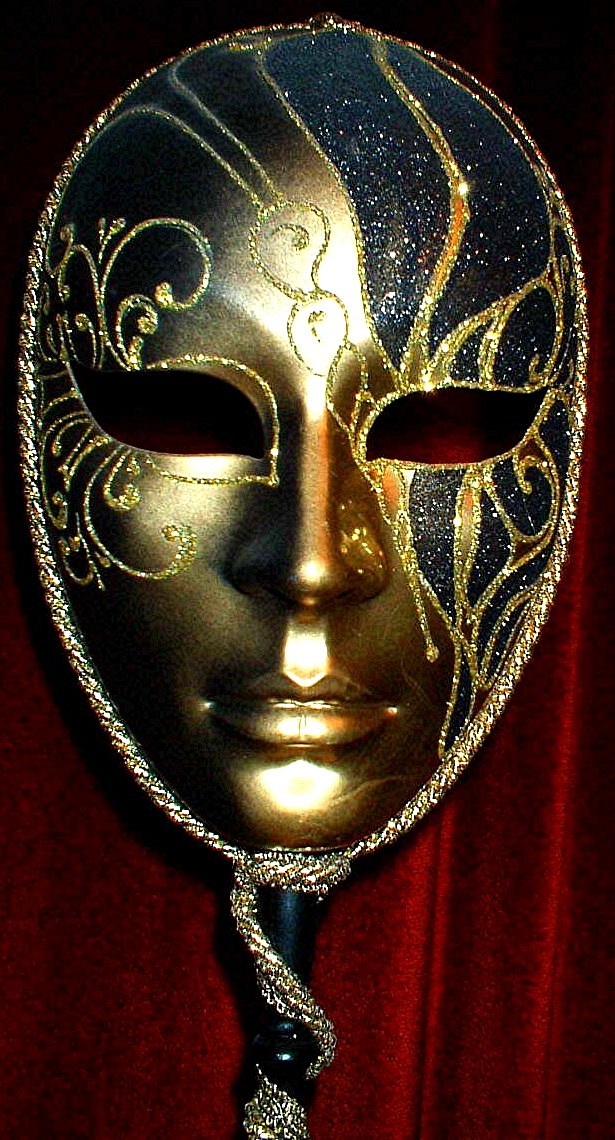
NB – All of the Venetian masquerade masks portrayed here are from my personal collection, and all of the photographs of them included here are © Dr Karl Shuker.

 
Who is that masked man?? (© Dr Karl Shuker)