Dr Karl Shuker's Official Website - http://www.karlshuker.com/index.htm

IMPORTANT:
To view a complete, regularly-updated listing of my Shuker In MovieLand blog's articles (each one instantly clickable), please click HERE!

IMPORTANT:

To view a complete, regularly-updated listing of my ShukerNature blog's articles (each one instantly clickable), please click HERE!

IMPORTANT:
To view a complete, regularly-updated listing of my RebelBikerDude's AI Biker Art's thematic text & picture galleties (each one instantly clickable), please click HERE!

IMPORTANT:
To view a complete, regularly-updated listing of my Starsteeds blog's poetry and other lyrical writings (each one instantly clickable), please click HERE!

IMPORTANT:
To view a complete, regularly-updated listing of my Eclectarium blog's articles (each one instantly clickable), please click HERE!


Search This Blog


Showing posts with label motorbikes. Show all posts

Friday, December 29, 2023

GEMINI MAN (1976 TV show)

 
Ben Murphy as the bedenimed biker and Intersect special agent Sam Casey, aka the Gemini Man, in Gemini Man (© Michael Caffey/Alan Crosland Jr/Alan J. Levy/Harve Bennett Productions/Universal Television/NBC – reproduced here on a strictly non-commercial Fair Use basis for educational/review purposes only)

Back in the 1970s, I watched virtually every sci-fi show on TV here in the UK, but somehow managed to miss Gemini Man, starring Ben Murphy (already known to me from the excellent comedy Western series Alias Smith and Jones, in which he played outlaw Kid Curry).

Directed by Michael Caffey, Alan Crosland Jr, and Alan J. Levy, originally screened in 1976 by NBC in the States ( by the BBC in the UK), and conceived as a modern-day take on the famous 1897 novel The Invisible Man by H.G. Wells, Gemini Man focuses upon US secret agent/bedenimed biker Sam Casey (played by Ben Murphy) who, following a near-fatal nuclear-related accident that rendered him invisible and life-saving surgery to reverse this dramatic effect, is able with the aid of a special DNA-stabilising wristwatch to remain visible. However, if he presses one of its special buttons, he can become invisible again, for up to 15 minutes every day – but for no more than 15 minutes every day, otherwise he would vanish forever and die.

 
Sam Casey (Ben Murphy) and Dr Abby Lawrence (Katherine Crawford), from Gemini Man (© Michael Caffey/Alan Crosland Jr/Alan J. Levy/Harve Bennett Productions/Universal Television/NBC – reproduced here on a strictly non-commercial Fair Use basis for educational/review purposes only)

Sam is dubbed the Gemini Man by his boss Leonard Driscoll (William Sylvester), and, assisted by brilliant scientist Dr Abby Lawrence (Katherine Crawford) who invented his unique wristwatch, he is now able to undergo extra-special assignments for Intersect, the high-tech US government think tank where they all work, that no ordinary agent, lacking Sam's extraordinary, top-secret ability of invisibility, could possibly hope to accomplish.

I knew about this intriguing show, and had even seen the official Gemini Man hardback annual on sale at Christmas 1976-1977 (a copy of which I recently purchased, in excellent secondhand condition, and only four decades late!), following the show's TV screening earlier that year by the BBC. (Speaking of which: there was also a BBC-authorised Gemini Man colouring book on sale in 1976, not to mention a BBC-authorised Gemini Man fun sticker book, and even a Gemini Man LP album, released by Power Records, but I regret to say that I don't own any of these!)

 
Front and back covers of the Universal City Studios-authorized 1977 Gemini Man annual, and front cover of the BBC-authorised Gemini Man colouring book (© Michael Caffey/Alan Crosland Jr/Alan J. Levy/Harve Bennett Productions/Universal Television/NBC/Universal City Studios, Inc./Brown Watson/BBC – reproduced here on a strictly non-commercial Fair Use basis for educational/review purposes only)

Yet for reasons entirely unknown to me, I never got around to watching any of its single season of eleven 50-minute episodes. Nor even its feature-length pilot episode. Perhaps it clashed with some other series that I or my parents were watching on another TV channel?

Tragically, however, Gemini Man was never repeated in the UK, so I never did get the chance to watch it – until 15 May 2020, that is, when to my surprise and delight I discovered that all eleven episodes of this show (plus the pilot, in which Driscoll is played not by William Sylvester but instead by Richard A. Dysart) were currently available to watch free of charge on YouTube!

 
Cover of the Gemini Man LP record (© Michael Caffey/Alan Crosland Jr/Alan J. Levy/Harve Bennett Productions/Universal Television/NBC/Power Records – reproduced here on a strictly non-commercial Fair Use basis for educational/review purposes only)

So I swiftly downloaded the full set as MP4 files, in case they were subsequently taken down from YouTube, which often happens. Now, after a mere 44 years' delay I could finally view them all, and at my leisure. I'd read that Gemini Man didn't get good reviews at the time (especially not in the States, explaining why only 5 episodes were screened there before the show was cancelled, whereas all eleven were screened in the UK), which almost guaranteed that I'd like it!

I also discovered and downloaded an official Gemini Man TV movie, Riding With Death, released in 1981, which consists of two Gemini Man episodes that had been deftly spliced together. These are Episode 1, entitled 'Smithereens', and Episode 10, entitled 'Buffalo Bill Rides Again', linked by the appearance in both of them (but in no others) of a C&W-singing trucker character named 'Buffalo' Bill Joe Hickens (played by real-life country singer Jim Stafford), who becomes friends with Sam after saving his life during 'Smithereen', with Sam duly returning the favour in 'Buffalo Bill Rides Again'. Interestingly, this movie also utilizes excerpts from a 1970 American science fiction film entitled Colossus: The Forbin Project, which I've reviewed here.

 
'Buffalo' Bill (Jim Stafford) and Sam Casey (Ben Murphy) in the Gemini Man TV movie Riding With Death (© Michael Caffey/Alan Crosland Jr/Alan J. Levy/Harve Bennett Productions/Universal Television/NBC – reproduced here on a strictly non-commercial Fair Use basis for educational/review purposes only)

A couple of days later, on 17 May 2023, I watched the movie-length pilot episode downloaded from YouTube, which proved to be a source of great fun, and great nostalgia, taking me effortlessly back to 1976 when everything felt so much simpler, and nicer. It even drew to a close with a straightforward happy ending – no angst and hang-ups like we find in today's TV shows, instead simply offering some amusing, lighthearted sci fi & spying gimmickry not to be taken seriously, just enjoyed. True, the viewing quality wasn't brilliant but it was serviceable. Consequently, I knew that I was certainly going to enjoy the 11 normal-length episodes now – and sure enough, I did!

Such a shame, then, that Gemini Man has only ever achieved one official home viewing release – namely, a French DVD box set released by Elephant Films, containing the eleven episodes plus the pilot (but not the 1981 movie), with French-language cover descriptions but the original English audio tracks. I spotted three sets for sale on ebay on 19 May 2020, all brand-new but even the cheapest was a hefty £54.99, which I felt unable to justify purchasing, especially as I already had the YouTube versions. So I decided to stick with my downloads, at least for the time being, merci.

 
The French Gemini Man complete DVD box set (© Michael Caffey/Alan Crosland Jr/Alan J. Levy/Harve Bennett Productions/Universal Television/NBC/Elephant Films – reproduced here on a strictly non-commercial Fair Use basis for educational/review purposes only)

Fast forward to 21 May 2020, when after much procrastination during the previous few weeks I finally decided to dip my toes into the unknown waters of online trivia quizzes – but only ones that were free to enter, offered cash prizes, and only required a PayPal account (not bank details) to pay any winnings into. So, I entered one such quiz, and ten minutes later my PayPal account had gained £52.63 in winnings, and my DVD collection had duly gained the complete Gemini Man box set. I could get to like online quizzing! 😀

So there is the story of how I made visible in my world at long last the invisible Gemini Man, but it still seems unbelievable to me that this show was originally screened 47 years ago, when I was only 16. Judging from the associated merchandise that was available for it back then, there were high hopes that this sci fi TV show would be a success. Yet although it wasn't, it deserved to be.

 
Sam Casey (Ben Murphy) with his Intersect boss Leonard Driscoll (William Sylvester) and scientist friend/helper Dr Abby Lawrence (Katherine Crawford) (© Michael Caffey/Alan Crosland Jr/Alan J. Levy/Harve Bennett Productions/Universal Television/NBC/Universal City Studios, Inc. – reproduced here on a strictly non-commercial Fair Use basis for educational/review purposes only)

As noted earlier, all of the eleven 50-minute Gemini Man episodes, plus the feature-length pilot, and the 1981 TV movie Riding With Death, can currently be accessed on YouTube. So, click here, for example, if you'd like to view the pilot, here if you'd like to view the first of the 50-minute episodes, here if you'd like to view Riding With Death, and here if you'd like to call up all of the episodes in a single YouTube listing.

Finally: to view a complete chronological listing of all of my Shuker In MovieLand blog's other film reviews and articles (each one instantly accessible via a direct clickable link), please click HERE, and please click HERE to view a complete fully-clickable alphabetical listing of them.

 
Ben Murphy as Sam Casey, the Gemini Man (© Michael Caffey/Alan Crosland Jr/Alan J. Levy/Harve Bennett Productions/Universal Television/NBC/Universal City Studios, Inc. – reproduced here on a strictly non-commercial Fair Use basis for educational/review purposes only)


Wednesday, February 8, 2023

BLACK LEATHER JACKET

 
Astride my first Honda CX500 motorbike during the early 1990s and  wearing my self-customised black leather jacket (BLJ) that was officially displayed at the Walsall Leather Museum's BLJ Exhibition in autumn 1993, and which was also featured in Mike Phillips's article 'Black Art', on the subject of the BLJ, published by the British monthly motorbike magazine Bike in its October 1993 issue (© Dr Karl Shuker)
 
It's been quite a while since this blog last journeyed there from MovieLand, so it's high time that I crossed the border once again to pay another of my occasional visits to TV Land – and for what better reason than to indulge my lifelong passion for all things appertaining to motorbikes, via my recalling here today a very memorable 1980s TV docu-movie that led to one of my very own motorbike jackets becoming both a star exhibit and a media star!
 
  
Full cover of my official sell-thru VHS video of Black Leather Jacket (© Nick Mead/Paul Cowan/Mick Farren/Channel 4 Television Corporation/Polygram Music Video – reproduced here on a strictly non-commercial Fair Use basis for educational/review purposes only)

As a biker ever since my late teens in the 1970s, my habitual and favourite garment of choice to wear has always been the classic black leather jacket, of the motorbike style beloved by bona fide, would-be, and on-screen bikers alike, not to mention rock stars, fashion models, punks, and rebels of every shape, size, and description.

So when while browsing in a bookshop one Sunday afternoon during the mid-1980s in the Warwickshire, England, town of Stratford-upon-Avon, world-famous as the birthplace of one William Shakespeare, I chanced upon a fairly large brand-new hardback book entitled The Black Leather Jacket, sporting an embossed, textured front cover designed to look and even feel like the real thing, and documenting the fascinating history of this truly iconic item of clothing, I lost no time whatsoever in purchasing it and reading it from cover to cover as soon as I arrived back home.

Written by English journalist Mick Farren and first published in 1985, this engrossing book reveals and extensively illustrates via a comprehensive selection of very distinctive glossy b/w photographs how its titular subject, the black leather jacket (or the BLJ, as I'll refer to it hereafter for convenience), has evolved and diversified since its origin during the early years of the 20th Century.

The BLJ's progress is succinctly chronicled from the standard unadorned predecessors worn by the likes of WW1 fighter pilots and the Gestapo of WW2, through the classic 1950s Brando/Dean rebel styles, plus all manner of self-customised be-studded and badged-to-the-hilt individualized versions worn by outlaw bikers and 1960s rockers/greasers, to the slashed and safety-pinned punk gear of the 1970s, and the somewhat emasculated 1980s fashionista formats more at home on the catwalk than the highway, as well as every conceivable variation in between. So too is its enduring intrinsic appeal, traditionally daring, dark, even dangerous, regardless of its ever-changing external form. But that's not all.

 
The front cover of the original hardback First Edition of Mick Farren's book The Black Leather Jacket that I still own today (© Mick Farren/Plexus Publishing – reproduced here on a strictly non-commercial Fair Use basis for educational/review purposes only)

In 1988, Channel 4, a terrestrial TV station in the UK, produced and screened a 60-minute docu-movie directly inspired by Mick Farren's book but simply entitled Black Leather Jacket (i.e. no The). It was directed by Nick Mead, co-written by him with Farren, and produced by Paul Cowan. Narrated by big-screen bad boy Dennis Hopper of Easy Rider fame, Black Leather Jacket stayed faithful to the contents of Farren's book but also featured clips from a number of classic movies relating in some way to the BLJ and motorbikes (such as the cult 1970s British biker/horror movie Psychomania, which I've reviewed here).

Moreover, it contained an excellent rock soundtrack too, including contributions from famous BLJ-wearing performers such as Elvis Presley, The Clash, Gun, L.A. Guns, Zodiac Mindwarp (remember them?), Velvet Underground, Kiss, and Motorhead – whose song 'Black Leather Jacket' was used as this documentary movie's title song, accompanying clips of a teenage BLJ/Levis-wearing Michael Vartan (in his on-screen debut) riding a Harley through a neon-lit city centre at night and duly dubbed Motorcycle Boy in the credits.

Knowing full well that I would definitely enjoy Black Leather Jacket just as much as I'd done with the original book, I had the foresight to video-record it for future re-watchings at home, which was just as well, because I never remember it being re-screened. Tragically, however, as was so often the case with all but the highest-quality recordable blank videocassettes available back then, the picture quality of my precious recording of it diminished with repeated viewings down through the years.

Imagine my surprise but delight, then, when just over a year ago I discovered not only that Black Leather Jacket had actually been released as an official sell-thru video but also that there was a single example of it listed at that very same time on ebay, on a Buy It Now basis. So that's what I did, and just a few days later I was able to watch and enjoy it in its original top-quality viewing state all over again. But that's still not all.

Just a few miles from where I live in the West Midlands, England, is the prestigious Walsall Leather Museum, devoted to the history of the town of Walsall's long-established leather trade and manufacturing, and during summer 1993 I learnt from a friend who worked there that they were planning to stage a temporary public exhibition devoted exclusively to the BLJ!

 
Mini-poster produced by the Walsall Leather Museum advertising its BLJ Exhibition (© Walsall Leather Museum – reproduced here on a strictly non-commercial Fair Use basis for educational/review purposes only)

As a local biker who had painstakingly customized several of my motorbike BLJs in the classic 1960s rocker/greaser style (having been inspired to do so after seeing and admiring original examples worn by various bikers featured in clips from Black Leather Jacket of London's famous biker/rocker-associated Ace Cafe and 59 Club during that decade), it occurred to me that the Museum may perhaps be interested in including one of them in their exhibition as a representation of that particular BLJ genre. So one afternoon shortly after learning about their plans, I rode there on my motorbike wearing one of them – and was delighted when they were indeed very keen to exhibit it!

 
My official invitation to the preview of the Walsall Leather Museum's BLJ Exhibition in autumn 1993 (© Dr Karl Shuker/Walsall Leather Museum – reproduced here on a strictly non-commercial Fair Use basis for educational/review purposes only)

The Walsall Leather Museum's 'The Black Leather Jacket' Exhibition ran from 4 September to 14 November 1993 inclusive, but I was invited with other contributors to an exclusive preview, and when I turned up on my motorbike (wearing a different BLJ), there on display in a tall glass showcase was my very own jacket, fully labeled and fully visible from all angles. If pride is a sin, then I sinned very extensively that day!

 
The official b/w photograph of me wearing my exhibited BLJ that appeared alongside my jacket's showcase in the Walsall Leather Museum's BLJ Exhibition, and which also appeared in Mike Phillips's article 'Black Art', on the subject of the BLJ, published by the British monthly motorbike magazine Bike in its October 1993 issue (© Walsall Leather Museum (photographer unknown to me) – reproduced here on a strictly non-commercial Fair Use basis for educational/review purposes only)

Moreover, perhaps because of how eyecatching it was, bristling all over with badges, studs, chains, and above all else its full official Easyriders back patch, it was my BLJ that attracted much of the media attention relating to the Museum's BLJ Exhibition.

 
Report from The Observer (London) for 5 September 1993 re the Walsall Leather Museum's BLJ Exhibition, and including a close-up photo of my exhibited BLJ please click to enlarge for reading purposes (© The Observer/Guardian Media Group – reproduced here on a strictly non-commercial Fair Use basis for educational/review purposes only)

It was pictured in a number of newspaper reports (including one by none other than London's eminent weekly broadsheet The Observer, the world's oldest Sunday newspaper, founded in 1791, and in which I am referred to as "a local biker with a vivid sense of design" - love it!), as well as in a special BLJ article entitled 'Black Art' authored by motorbike journalist Mike Phillips and published in the October 1993 issue of Bike, Britain's best-selling motorbike magazine.

 
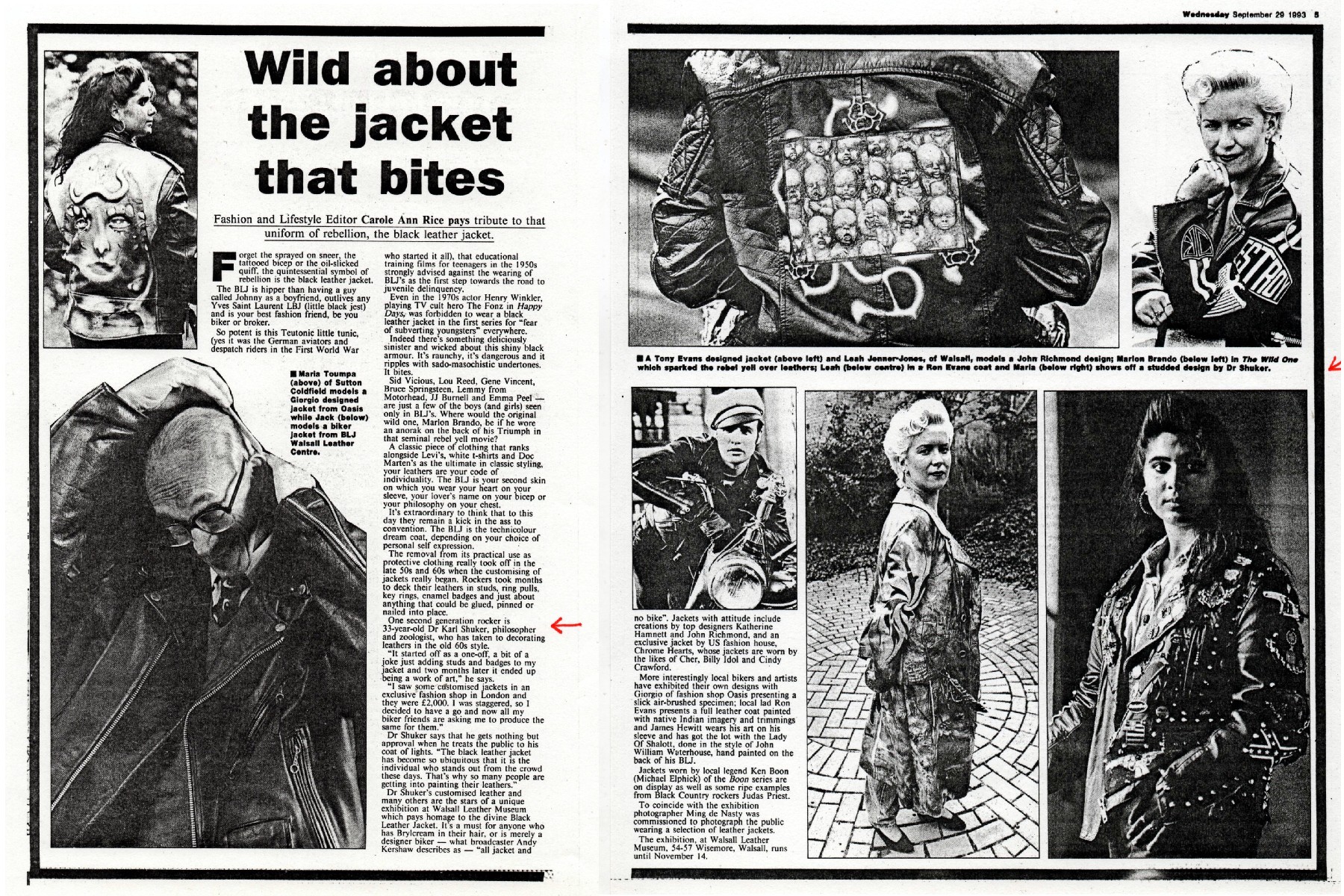
Birmingham Post newspaper's 2-page magazine supplement report for 29 September 1993 re the Walsall Leather Museum's BLJ Exhibition, which includes a name-check and quote from me (arrowed in red) on p.4 and a picture of a model wearing my exhibited BLJ on p. 5 please click to enlarge for reading purposes Birmingham Post/Reach plc – reproduced here on a strictly non-commercial Fair Use basis for educational/review purposes only)

My exhibited BLJ also featured in two local TV news reports, and in one of them it was even worn by Midlands Today presenter Richard Ulridge while sitting astride a motorbike and then riding off on it, with my BLJ's Easyrider back patch fully displayed (click here to view both of these TV news reports – and my BLJ! – on YouTube).

 
Photo-still from the Midlands Today news report re the Walsall Leather Museum's BLJ Exhibition depicting presenter Richard Ulridge wearing my exhibited BLJ (© Dr Karl Shuker/Midlands Today – reproduced here on a strictly non-commercial Fair Use basis for educational/review purposes only)

If you'd like to watch Black Leather Jacket, most of it can currently be viewed free of charge on YouTube, where it has been uploaded in nine parts (but, oddly, Part 3 is seemingly missing), though the resolution quality is not great. Click here to begin viewing with Part 1.

Finally: To view a complete chronological listing of all of my Shuker In MovieLand blog's other film/TV reviews and articles (each one instantly accessible via a direct clickable link), please click HERE, and please click HERE to view a complete fully-clickable alphabetical listing of them.

 
Photo-still from the Midlands Today news report re the Walsall Leather Museum's BLJ Exhibition depicting the back of my exhibited BLJ as worn by presenter Richard Ulridge (© Dr Karl Shuker/Midlands Today – reproduced here on a strictly non-commercial Fair Use basis for educational/review purposes only)


Saturday, November 12, 2022

BILLY BADD (aka MOTOR PSYCHO) (1992)

 
Official videocassette cover for Billy Badd (aka Motor Psycho) (© Alex Downs/Pivot Pictures/York Home Video – reproduced here on a strictly non-commercial Fair Use basis for educational/review purposes only)

It's been a while since I watched a biker movie, so last night I watched the 1992 Alex Downs-directed action film Billy Badd (aka Motor Psycho, but not to be confused with the 1965 b/w Russ Meyer-directed biker movie of this same title).

Directed by the afore-mentioned Alex Downs, who also co-wrote its story, and released by Pivot Pictures in 1992, Billy Badd certainly lives up to its title. As played by Robert Restaino, the title character is a crazed, murderous, totally psychotic biker who, inexplicably, has just been granted parole from a life sentence after being convicted of rape, assault, an assortment of brutal killings that included his own parents, and who knows what else besides!

Not surprisingly, everyone in the vicinity of the desert town where Billy has been released from prison suddenly finds urgent business that demands their attention a long LONG way away – even the local outlaw biker gang departs for burn-ups elsewhere.

Unfortunately for college sweethearts Frankie (Tom Emery Dennis) and Zoey (Nicola Seixas), however, driving on an epic road journey to their scholastic alma mater in New York City via a very long and lonely cross-country highway through California's Mojave Desert, they happen to be entirely unaware of this gruesome back story. That is, until a heavily geared-up Mr Badd rides by them on his motorbike, looking disconcertingly imho like the late great Freddie Starr attired as a Mad Max road warrior, and definitely looking for trouble, BIG trouble! So once he sees F&Z, he decides to create some – with, and for, them!

Totally unhinged, and armed to the teeth with a veritable artillery of weapons, after terrifying the frantic couple for a while via his constant perilous pursuit of them Billy shoots Frankie in the leg, sets fire to their vehicle, and rides off with wounded Frankie strapped onto his bike's fuel tank, a frantic Zoey trailing far behind in the clearly vain, hopeless aim of tracking them down.

 
The smiling assassin, in every sense! Psycho biker Billy Badd, played by Robert Restaino (© Alex Downs/Pivot Pictures/York Home Video – reproduced here on a strictly non-commercial Fair Use basis for educational/review purposes only)

But then an ostensibly unlikely glimmer of hope appears, in the befuddled form of The Rat (Dermott Daniel Downs). He is a shell-shocked vagrant ex-soldier who lives inside a hole in the desert, and not only is even more deluded than Billy (if such a thing were possible!) but also just so happens to be his brother! Happily, however, The Rat is much more pacific and kindly in nature than brother Billy, and after a tortuous time attempting to wrap his muddled mind around what Zoey is telling him about what has happened, he finally provides her with instructions on how to reach the shack where Billy lives, together with a crossbow to use against him once there.

Eventually, after stealing a lorry en route, Zoey arrives at Billy's shack where he is holding a terrified Frankie prisoner and triumphantly regaling him with what he plans to do to him – which is when what has already been a scorching pace for the storyline becomes a veritable inferno! The movie's climax inside the shack certainly pulls no punches (especially in the physical sense!), plus there is an unexpected if wholly implausible twist right at the very end of the movie.

Billy Badd is basically a very violent (albeit not so gory) biker-themed horror thriller, whose freakish central character is brought explosively to life by a wholly unrestrained Restaino, his characterisation of Billy being not so much over the top as completely off the planet, but nonetheless is totally mesmerising throughout – especially as Billy speaks exclusively in pop-culture quotes and sound-bites, thereby rendering him even more bizarre than he already would be. Restaino also performs a number of the movie's hair-raising motorbike stunts personally – no mean feat in itself, so all credit to him for that, let alone everything else.

Dennis and Seixas are also eminently watchable, with Seixas ultimately transforming into a Lana Croft facsimile in order to rescue her man-handled man from his psychopathic abductor. And Downs as The Rat is rather like watching a mind-melted Jekyll lined up against Billy's blood-letting Hyde.

It may be a low-budget flick, but if you like blisteringly wild – and in this case also decidedly wacky – biker movies with plenty of adrenaline-triggering activity, Billy Badd will not disappoint. It even includes some snatches of dark twisted humour entwined amidst the unrelenting madness and mayhem of this road trip to hell. And if you'd like to take a brief ride down that deadly desert highway and experience a heart-pumping encounter with badass Billy himself, be sure to click here to watch an official Billy Badd trailer on YouTube, and here for a swift but savage lesson in how not to interact with Billy!

To view a complete chronological listing of all of my Shuker In MovieLand blog's other film reviews and articles (each one instantly accessible via a direct clickable link), please click HERE, and please click HERE to view a complete fully-clickable alphabetical listing of them.

 
Not a sight that you'd ever want to see through your windscreen – here's Billy!!! (© Alex Downs/Pivot Pictures/York Home Video – reproduced here on a strictly non-commercial Fair Use basis for educational/review purposes only)


Thursday, April 28, 2022

RUMBLE FISH

 
My official UK DVD of Rumble Fish (© Francis Ford Coppola/Zoetrope Studios/Universal Pictures – reproduced here on a strictly non-commercial Fair Use basis for educational/review purposes only)

Last night's movie watch was the iconic early-1980s rebel film Rumble Fish, based upon American authoress S.E. Hinton's eponymous 1975 novel that I read so very long ago as a teenager.

Directed by Francis Ford Coppola, who also co-wrote its screenplay (with Hinton), and released by Universal Pictures in 1983, Rumble Fish centres around an aloof but charismatic motorbike-riding character in his early 20s who is referred to only as The Motorcycle Boy (hereafter TMB in this review for brevity), and is played to perfection as a veritable flawed, earthbound demi-deity (at least in the worshipping eyes of those around him) by the then young and equally charismatic Mickey Rourke.

TMB was once the greatest gang leader in his district of Tulsa, Oklahoma, until he eventually decided that gangs and rumbles were boring, for losers, and single-handedly broke up all the gangs and ended all the rumbles before abruptly disappearing who knows where on his motorbike. Left behind is his slightly younger, idolising brother Rusty James (Matt Dillon), who seeks to emulate TMB and gain the respect among the district's teenage delinquents that he still holds, even in his absence. However, Rusty James (everyone always calls him by his full name for some unexplained reason) has neither his brother's brain nor his mystique to do so.

And then, out of the blue, TMB returns. He has been to California to seek out their mother, who abandoned the family when they were only small children, the shock of which sent their father (Dennis Hopper) spiraling downward into abject alcoholism. TMB arrives back in town just in time to rescue his brother (hereafter RJ for brevity) after he has been stabbed in a fight during the resurgence of gangs and rumbles that has begun during TMB's AWOL.

From then on, we watch how RJ's grip on the leadership of his buddies progressively slips, finally ousted by supposed friend Smokey (a young Nicolas Cage, nephew of Francis Ford Coppola), who also steals his girlfriend Patty (Diane Lane). And after being mugged in an alley, RJ even loses his grip on himself, literally, when he seemingly undergoes a brief out-of-body experience, floating eerily but unseen through the air as he looks down upon his erstwhile compatriots grieving at his apparent death – or was it all just a fevered dream, experienced by him before regaining consciousness after the mugging?

Meanwhile, TMB is just as enigmatic as ever, his succinct comments betraying an erudite, highly intelligent mind that totally surpasses RJ's in every way. But is he really merely enigmatic, or, as others and even his own father suspect, might he actually be insane?

RJ hero-worships TMB too much to permit such doubts to linger in his own far less astute, knowledgeable mind, until the fateful day when he finds TMB in a pet shop, seemingly entranced by a series of small aquaria each containing a single male Siamese fighting fish, some of which are bright red, others blue. TMB tells RJ that they are rumble fish, so aggressive that they will even attack their own reflection in a mirror, which he demonstrates. TMB says that they should be free, in a river, not imprisoned in glass tanks.

That night, while taking RJ for a motorbike ride, TMB turns up at the pet shop, now closed for the evening, and decides to break in to free the fish. Even RJ realises the folly of such a plan, and pleads with him not to do so, but TMB's mind is made up. However, neither of them spies the shadow of a longstanding enemy close by, watching them, armed with a gun and an abiding, obsessive hatred of TMB. Two irrationally-minded entities are about to violently interact head-on, just like a couple of rival rumble fishes, but who – if either one of them – will emerge triumphant?

Rumble Fish is an engrossing, highly memorable movie, very atmospheric visually due to its plethora of smoke and shadows, but rendered even more so by being shot almost entirely in black-and-white, which thereby directly presents to the audience TMB's distinctive vision of the world, as it is revealed early on in the film that he is colour-blind (he is also partially deaf). There is only one major monochromatic exception – the Siamese fighting fish are always filmed in full colour (as is a police car's flashing red siren seen briefly near the end).  Also of note, literally, is the music score, composed and performed by none other than Stewart Copeland, who at that time was also the drummer in the highly successful British rock group The Police.

Dillon puts in a dynamic, muscular performance as rebellious, wannabe gang leader RJ, and is the movie's top-billed star. However, Rumble Fish indisputably belongs to Mickey Rourke – second-billed he may be, but he expertly portrays TMB as a super-cool yet inscrutable, innately dangerous, and quite possibly deranged loner, ostensibly laid-back but in reality perpetually poised and ready to spring into unpredictable yet most probably ultra-violent action should the need arise or his fuse be lit.

If you'd like to pay a visit to the dark, ominous, uncertain world of TMB and RJ, be sure to click here to watch an official Rumble Fish trailer on YouTube.

To view a complete chronological listing of all of my Shuker In MovieLand blog's other film reviews and articles (each one instantly accessible via a direct clickable link), please click HERE, and please click HERE to view a complete fully-clickable alphabetical listing of them.

 
My paperback edition of Rumble Fish (© S.E. Hinton/Dell Publishing – reproduced here on a strictly non-commercial Fair Use basis for educational/review purposes only)