Dr Karl Shuker's Official Website - http://www.karlshuker.com/index.htm

IMPORTANT:
To view a complete, regularly-updated listing of my Shuker In MovieLand blog's articles (each one instantly clickable), please click HERE!

IMPORTANT:

To view a complete, regularly-updated listing of my ShukerNature blog's articles (each one instantly clickable), please click HERE!

IMPORTANT:
To view a complete, regularly-updated listing of my RebelBikerDude's AI Biker Art's thematic text & picture galleties (each one instantly clickable), please click HERE!

IMPORTANT:
To view a complete, regularly-updated listing of my Starsteeds blog's poetry and other lyrical writings (each one instantly clickable), please click HERE!

IMPORTANT:
To view a complete, regularly-updated listing of my Eclectarium blog's articles (each one instantly clickable), please click HERE!


Search This Blog


Showing posts with label horror movies. Show all posts

Monday, March 31, 2025

LIKE A BAT OUTTA HELL (aka BAT OUTTA HELL aka NOWHERE ELSE)

 
Publicity poster for Like A Bat Outta Hell (aka Bat Outta Hell aka Nowhere Else (© Danial Donai/Forescene Films/Tricoast Worldwide – reproduced here on a strictly non-commercial Fair Use basis for educational/review purposes only)

On 17 October 2024, my movie watch was the Australian cryptozoology-themed horror film Like A Bat Outta Hell (aka Bat Outta Hell aka Nowhere Else, the last-mentioned being its original title).

Directed and written by Danial Donai, and released in 2013 by Tricoast Worldwide, Like A Bat Outta Hell is all about a team of four young surfing film-makers – Randy (played by Marco Dapper), Jack (Dan Balcaban), Bianca (Rachael Murphy), and Chris (William Wensley) – sent by their bosses/funders into a vast barren region of South Australia's Outback to film a new but unspecified subject; they'll only be told what it is once they reach their remote location. So far, so sinister…

And indeed, one of the four team members, Chris, is secretly serving as an inside man for the team's bosses, so he does know what the subject is that the team is to film – a scientifically-unrecognised form of human-sized carnivorous bat indigenous to this wasteland and exceedingly dangerous, ripping off the faces of human victims. This is why the other three film-makers were not told about it, as they would never have agreed to set out if they had known

 
One of the giant humanoid bats from this movie (© Danial Donai/Forescene Films/Tricoast Worldwide – reproduced here on a strictly non-commercial Fair Use basis for educational/review purposes only)

But as any clear film footage that proves this mystery beast's reality will net the team's bosses a fortune, they are most anxious for the team to locate and record these monstrous entities, regardless of what terrible fate may await them. The usual mayhem and carnage typically depicted in monster movies like this one duly ensues, but the viewer has to wait an agonisingly long time before some full. clear views of the voracious man-bats (created for the movie via CGI) are finally shown.

They resemble an unsettling hybrid of the giant moths from The Blood Beast Terror and the vampiric Mr Kurt Barlow from the original TV mini-series version of Salem's Lot, but are presented as corporeal cryptids rather than supernatural bloodsuckers or suchlike. Indeed, when the team reach in the afore-mentioned barren Outback a ghost town named Nowhere Else and find it  inhabited by only one elderly man, Simson (Vernon Wells), they also find that he is equipped with some decidedly physical, tangible weaponry and also that he is a closet cryptozoologist, not a private paranormalist.

Moreover, director Donai has stated that he was inspired to write and direct this movie after being informed in the real-life South Australian outback town of Nowhere Else he was visiting that a team of documentary film-makers had lately claimed that while filming in that area they had been attacked by a human-sized bat. Yeah, right – if so, how come the notably rich vein of Australian cryptozoology is entirely dry regarding mystery man-sized Australian bats?

 
Publicity poster for the movie Chiroptera(© Danial Donai/Forescene Films/Tricoast Worldwide – reproduced here on a strictly non-commercial Fair Use basis for educational/review purposes only)

After running for 92 minutes, Like A Bat Outta Hell finally reaches an ending but one that comes unexpectedly and is very disappointing, as it provides no resolution whatsoever to the plot. However, in 2019 a much longer version, containing a lot of additional footage, yielding a total running time of 130 mins, was released, and retitled Chiroptera. I have not seen that version, but it apparently includes several fully-shot scenes that were only spoken about in the 2013 movie.

Like A Bat Outta Hell is an interesting but decidedly odd, offbeat flick, and it doesn't even feature a cameo or any song tracks from the now late but always great Meat Loaf. Shame.

Please click here if you'd like to go batty watching an official trailer on YouTube for this movie, or here to watch the entire movie free of charge, again on YouTube.

Finally: to view a complete chronological listing of all of my Shuker In MovieLand blog's other film reviews and articles (each one instantly accessible via a direct clickable link), please click HERE, and please click HERE to view a complete fully-clickable alphabetical listing of them.

 
Close-up shot of one of the giant humanoid bats from this movie (© Danial Donai/Forescene Films/Tricoast Worldwide – reproduced here on a strictly non-commercial Fair Use basis for educational/review purposes only)


Friday, January 31, 2025

TRACK OF THE MOON BEAST

 
Publicity poster for Track of the Moon Beast (© Richard Ashe/Lizard Productions/Prism Pictures Ince – reproduced here on a strictly non-commercial Fair Use basis for educational/review purposes only)

On 21 September 2024, my movie watch was a seriously oddball American sci fi/horror movie from the mid-1970s entitled Track of the Moon Beast, but it was rendered memorable for me by being the first film I can remember seeing that featured a were-lizard as its antagonist!

Directed by Richard Ashe, and produced in 1972 by Lizard Productions Inc, Track of the Moon Beast was originally intended for cinematic release, but was unable to secure a distributor. Instead, its eventual public debut took place on the small screen, when it premiered as a TV movie on 1 June 1976, but in a much-censored shorter version from which certain particularly gory, gruesome scenes featuring the monster killing people had been deleted (the original, uncensored version is apparently no longer available).

Track of the Moon Beast opens with a young mineralogist named Paul Carlson (played by Chase Cordell) in some Albuquerque mountains studying a lunar meteor shower taking place over New Mexico when he is struck in the head by a fragment from one of the meteorites. The fragment lodges in his brain, with wholly unexpected but decidedly dire consequences.

For now, every night when a full moon appears, Paul transforms into a human-sized bipedal lizard-like entity with rampaging, murderous tendencies – this movie's eponymous moon beast – leaving gory carnage as well as very large clawed tracks in its wake. Moreover, it turns out that this bizarre phenomenon has been happening in this region since time immemorial, as revealed in local Native American legends and ancient paintings subsequently made known to Paul by his Native American mentor, Prof. John 'Jonny Longbow' Salinas (Gregorio Sala).

While human, however, Paul has no knowledge of being a lizard and killing people, and for much of the movie no-one else has either, determined though they are to expose the identity of the elusive killer in their midst. Ultimately, however, as is always the case in films like this, Paul's sinister secret is indeed exposed – although to be fair, had it not eventually become public knowledge there wouldn't have been much of a movie!

Yet even worse was soon to come for Paul. After a top-notch NASA brain surgeon x-rays his head prior to a planned operation in order to remove the fragment, Paul is shattered to learn from the surgeon that the operation cannot proceed because the fragment has disintegrated, but with its toxic, unstable extraterrestrial essence having permeated his entire body. Not only could Paul not be cured by conventional medical means, therefore, but also the fragment's deadly legacy would be death – those of further innocent, randomly-selected victims of Paul's reptilian alter ego, but also Paul's own, the latter via sudden self-combustion in the not-too-distant future.

Knowing that he cannot continue like this, Paul flees to the mountains on his motorbike, having made a stark decision, but one that devastates his loyal girlfriend Kathy (Donna Leigh Drake), as well as his friends and colleagues. So, will they reluctantly accept the inevitable, or will they do everything in their power to prevent it? Watch this movie and find out for yourselves!

Silly sci fi is a movie passion of mine, so whereas it was panned by most film critics, I absolutely loved Track of the Moon Beast, even if the on-screen lunar-influenced lizardman looks nothing near as imposing as the spectacular version depicted in this low-budget creature feature's striking publicity posters and official Prism Pictures VHS video's front cover illustration, as included in this present Shuker In MovieLand review. Even so, the make-up for it took 5-6 hours for make-up artist Joe Blasco to create each time that the actor playing the lizardman (Blasco himself) wore it (Blasco was  taller and therefore more visually imposing than Cordell – who only played it in one scene, when Paul transforms into the lizardman while strapped down for observation purposes in hospital).

If you'd like to watch an official trailer on YouTube for Track of the Moon Beast, please click here – or click here if you'd like to watch the entire movie free of charge on there.

Finally: to view a complete chronological listing of all of my Shuker In MovieLand blog's other film reviews and articles (each one instantly accessible via a direct clickable link), please click HERE, and please click HERE to view a complete fully-clickable alphabetical listing of them.

 
Full cover of the official Prism Pictures VHS video of Track of the Moon Beast (© Richard Ashe/Lizard Productions/Prism Pictures Ince – reproduced here on a strictly non-commercial Fair Use basis for educational/review purposes only)


Saturday, October 19, 2024

SOCIETY

 
Publicity poster for Society (© Brian Yuzna/Wild Street Pictures – reproduced here on a strictly non-commercial Fair Use basis for educational/review purposes only)

Many years ago, I turned on the TV one evening and out of sheer boredom watched a movie whose plot was unknown to me, as was its title, because I'd missed the opening credits. It starred Billy Warlock as a seemingly disturbed teenager named Bill (but also called Billy by some characters) who didn't fit in with either his rich Beverly Hills family (mother, father, and sister) or the rest of society there, so much so that he secretly suspected he'd been adopted, and he was now seeing a psychiatrist at his father's behest.

As this mystery – and mysterious – movie progressed, Billy experienced several strange sights involving various locals, including his own sister. Jenny, who in one scene seemed momentarily to contort her body into a bizarre, anatomically-impossible position, as did another young woman in a later scene. But clearly these were simply hallucinations, figments of Billy's fevered imagination...weren't they?

Slowly but surely, however, events became ever more strange, ever more sinister. Something was definitely very wrong here, but nothing prepared me for the unutterably unreal, shockingly surreal climax, in which everything was finally revealed (in every sense too!), and which is unquestionably one of the most eye-popping, jaw-dropping, brain-bursting 'wtf scenes' that I have ever witnessed in any film!

Even if I hadn't revealed its title by heading this present review with it, many of the more informed film aficionados reading the above summary would have already guessed by now the identity of this truly bizarre movie, as there is nothing else out there that is remotely like it, but it took me a long time back in those pre-internet days to do so. Eventually, however, I discovered that it was called Society, was directed by Brian Yuzna in his directorial debut, and was originally released in 1989 by Wild Street Pictures.

On 27 August 2024, around 30 years after watching it all unsuspectingly on TV, I rewatched Society, but this time on DVD, in its full-length, uncut version, and from the very beginning. In so doing, I discovered a scene half-hidden by the opening credits that hints at what to expect, but which I'd not viewed or known about first time round, due to having missed the movie's beginning, thus explaining why the grotesque climactic revelation came as such a shattering surprise. And what is that revelation?

SPOILER ALERT – Read no further if you don't want to know!

Here it is.

After Billy escapes from a hospital where he has been forcibly taken as a supposed corpse (long story…), he returns home to confront his parents once and for all, only to find a sizeable party taking place there – but this is no ordinary party!

To Billy's horror and disbelief, his parents and sister as well as many of the guests, including his psychiatrist, are all engaged in a terrifying orgy, one in which a lot more than mere sex is taking place, although it is true to say that there is certainly plenty of flesh on show!. Incredibly, they are physically melding and melting into each other, a process dubbed shunting by this movie's producers, their bodies' flesh sucking and slurping and squelching and sliding into and onto each other, a vast amorphous abomination of obscene pulsating protoplasm – but even that is not the worst of it.

They are holding one of Billy's friends, David (Tim Bartell), captive, and it becomes swiftly apparent that these shapeless monstrosities previously in human form are intending to devour him, via some hideously intrusive means – and indeed they do. Not for the squeamish, I might add, though amazingly there is literally no blood to be seen anywhere in this stomach-churning scene, but the unholy melding of flesh in all its voyeuristic vision of revulsion is horrific enough for there to be no need for any additional gore.

Moreover, after the doomed David is consumed by these incorporeal nameless ones, who reveal that they constitute an alternate species that has always existed and which devours lower-class humans (this entire movie satirises society living off those it deems are beneath it), Billy is next on the menu, having been captured by his psychiatrist while still in (mostly) human form. Happily, for Billy's sake, however, one of the other guests, who is of this same shape-shifting, shunting species but has not become part of the current abhorrent assimilation, remaining instead in her usual guise as a young woman named Clarisa (Devin DeVasquez), just so happens to have taken a romantic liking to him. So she rescues him, and together with Billy's best friend, Milo (Evan Richards), who has surreptitiously arrived in the hope of assisting him, they flee the house and drive away. The end.

Or is it? Because here is a very strange thing.

When I watched Society for the first time, roughly three decades ago on TV, I distinctly recall that while in this house of horror, Billy had covertly tampered with its gas supply, and that as they drove away into the distance at the end, the house suddenly exploded – a fitting fate for the revolting life-form(s) inside it. Yet no such scene was featured in the full-length DVD version that I watched in August, nor is it present in a version presently viewable on YouTube (see later). But this is not all.

The very next day after watching it on DVD, I mentioned having done so to an extremely knowledgeable film buff friend, John, who remarked without any prompting from me whatsoever that he particularly remembered the finale "when the house blows up"! Needless to say, therefore, he was most surprised when I told him that although I remembered it too, this scene seems no longer to exist. So as it appears unlikely that we both independently imagined an identical false ending, what has happened to the house-exploding one? I have researched this mystery online, yet can find no mention anywhere of the house exploding. Another example of the Mandela Effect? (Click here for more movie-related info concerning this anomaly presented and discussed by me.)

The body-shunting scene is a truly gruesome sight to behold (and if you don't believe me, click here if you dare, to watch a segment of it on YouTube; incidentally, this segment is labelled on there as 'Society Ending', but it's not, because the escape of Billy, Milo, and Clarisa isn't included). Nevertheless, it is also an incredible feat of on-screen special effects, including extensive prosthetics, and was achieved by internationally-renowned Japanese sfx/make-up supremo Joji Tani – or, as he is much better known to his legion of fans globally, Screaming Mad George. He has designed and devised make-up and special effects for many significant fantasy and sci fi movies, including Big Trouble In Little China, Predator, some of the Nightmare On Elm Street and Silent Night films (click here for my review of the first Elm Street entry), The Bite (reviewed by me here), and Progeny, plus many more.

A sequel movie, provisionally entitled Society 2: Body Modification, was in development as of 2013, but nothing more has apparently been heard of it for quite some time now. However, after acquiring the comic-book rights to Society, two sequels in comic-book format were published in 2002 and 2003 respectively by Rough Cut Comics.

Would I recommend this film? If you enjoy singularly grotesque, gross-out, bizarre, macabre, and totally off-the-wall comedy/horror flicks of the indisputably crazy kind, the chances are that you're gonna love it! Conversely, let's just say that if you don't like body-horror fests featuring gallons of glutinous shunting slime and semi-fluid melding flesh, Society may not be the movie for you!

But don't take my word for it – click here to view an official Society trailer on YouTube; or click here to watch the entire movie, as it is currently free to watch on YouTube.

Finally: to view a complete chronological listing of all of my Shuker In MovieLand blog's other film reviews and articles (each one instantly accessible via a direct clickable link), please click HERE, and please click HERE to view a complete fully-clickable alphabetical listing of them.


Saturday, October 12, 2024

MAD GOD

 
Publicity poster for Mad God (© Phil Tippett/Tippett Studio/Shudder – reproduced here on a strictly non-commercial Fair Use basis for educational/review purposes only)

On 5 August 2024, I watched a stop-motion animation-featuring movie that had taken a staggering 56 years to complete – The Primevals, finally released in 2023, and reviewed by me here. A day later, on 6 August 2024, I watched an almost exclusively stop-motion animation movie with another seriously long production period, over 30 years this time. The creation of modern-day stop-motion movie maestro Phil Tippett, but very much an adult horror movie in nature, as opposed to the family-friendly stop-motion animation-featuring fantasy films of Ray Harryhausen, it is entitled Mad God (aka Phil Tippett's Mad God in some sources), with imho the emphasis very much on mad.

Not only directed but also produced and written by Phil Tippett, who also contributed to the cinematography, and released in 2021 by Shudder, Mad God is as much a series of loosely-connected sequential vignettes as a single cohesive, coherent story. As for its content and tone, the prologue is more than sufficiently daunting to inform you in no uncertain manner of what to expect from the movie itself. Here is that prologue, which consists of a quote from the biblical book of Leviticus:

If you disobey Me and remain hostile to Me, I will act against you in wrathful hostility. I, for My part, will discipline you sevenfold for your sins. You shall eat the flesh of your sons and the flesh of your daughters. I will destroy your cult places and cut down your incense stands, and I will heap your carcasses upon your lifeless idols. I will spurn you. I will lay your cities in ruin and make your sanctuaries desolate and I will not savor your pleasing odors. I will make the land desolate so that your enemies who settle it shall be appalled by it. And you I will scatter among the nations and I will unsheath the sword against you. Your land shall become a desolation and your cities a ruin.

The principal character in Mad God is an enigmatic anonymous humanoid figure clad in iron, wearing a face-obscuring gas-mask, armed with a tattered map, and carrying a suitcase, who is named in the credits merely as the Assassin. He(?) descends inside a diving bell into a ruined, infernal, post-apocalyptic city populated by indescribably hideous monsters and monstrosities, the stronger ones taking savage, sadistic delight in mutilating and slaughtering the weaker ones with unnervingly, unnaturally casual indifference. Even the Assassin himself does not shrink from nonchalantly trampling underfoot a squabbling group of tiny gnome-like entities.

But perhaps the most stark scenes of wanton cruelty are those featuring what appear to be identical (cloned?) humanoid but faceless drones or slave workers carrying out the Mad God's will with regard to extensive construction work, overseen mercilessly by flogging foremen. Moreover, health & safety guidelines are conspicuous only by their absence here, as the drones are regularly maimed, decapitated, or worse by flying sections of machinery, metal shards, etc. And when they have served their purpose, these poor helpless, hapless souls meekly line up to throw themselves down into a deep fiery pit where they are instantaneously incinerated. If ever a work force was in dire need of a representing trade union!

As for the titular mad god itself, this is seen only as a pair of eyes and a huge mouth with hideous teeth and black-scorched flesh surrounding it that appears on screens attached to a lofty tower, and utters all of its vile dictates in an unintelligible, incongruous babble of baby talk.

Meanwhile, avoiding being attacked himself, the Assassin uses his map to find and fend his way through this perilous city's grim and grimy subterranean bowels, brimming on every side with violence, horror, blood, black bile, gore, and more – a veritable vista of Hell itself, surely – until he finally reaches his destination, a location inside the base of the Mad God's tower containing an enormous pile of suitcases identical to his own.

The Assassin opens his case, takes out a bomb, and sets its clock ticking, but never discovers that the clock isn't functioning properly, because a rapacious monster, having crept up behind him unseen, now seizes him in and drags him off onto the darkness.

We next see The Assassin strapped to an operating table, fully awake, where a human surgeon crudely slices open his abdomen, and then inexplicably hauls out great quantities of jewels and books from inside it, plus copious amounts of blood and black innards, before finally pulling forth a bawling larva-like infant that a nurse hurriedly takes away.

She hands it to a huge, fantastically-designed entity resembling a Venetian plague doctor but wholly composed of a floating mass of black ribbons, who in turn takes it to a dwarfish alchemist who calmly grinds up the screaming infant into a fluid that he transmutes into powdered gold. This is then thrown up into space and creates a whole new cosmos

And that is by no means all that happens in this macabre yet mesmerising 82-minute movie, which includes hardly any audible dialogue, functioning almost wholly on a visual level – with regard to which I can honestly say that I have never seen anything like it before, nor do I particularly wish to see anything like it again. Or to put it another way, every time you think that the next scene cannot possibly be more horrific than the previous ones, you are invariably proved wrong!

One professional movie reviewer described Mad God as "a cacophony of savagery and cruelty – [offering] no hope, no respite from the awe-inspiring terror", and I know exactly what they mean!

Equally, however, I freely confess that technically and visually this is a truly astonishing spectacle. For apart from a couple of brief scenes featuring humans, Mad God is composed entirely of stop-motion animation, and is therefore a definite triumph of sorts within that specific cinematic genre. Consequently, this unique, experimental horror movie makes undeniably fascinating (albeit highly disturbing) viewing. So much so that although I may well never watch it again, as someone with a sizeable collection of animated films on DVD and video I readily recognize that any such collection demands that Mad God be included in it. And not merely because there is absolutely nothing else like it in this particular genre, but also, as noted earlier, because of its unquestionable technical brilliance. So I do plan to purchase its DVD in due course.

I simply wish that all of the highly-skilled, immensely creative, and seemingly tireless workmanship that went into producing Mad God could have instead been directed toward preparing something as beautiful as this is nightmarish. Judging from one albeit brief segment in Mad God that presents the creation of a brand-new universe, the production team could most certainly have prepared such an alternative, visually gorgeous movie, because that particular segment is indescribably exquisite and inspirational.

As mentioned at the beginning of this review, Mad God took over 30 years from its beginning to its release. Tippett began filming it in his spare time during the late 1980s, after working on RoboCop 2. A few years later, however, now working on Jurassic Park and seeing at first-hand the truly spectacular nature of its CGI dinosaurs (his involvement in their creation earning him an Academy Award for Best Visual Effects), he shelved his own project as he feared that with the advent of CGI, stop-motion animation was now obsolete.

And there Mad God remained, in creative limbo for the next 20-odd years, until encouragement and assistance from volunteer animators and other film crew plus donations via Kickstarter combined forces in 2009 to reignite Tippett's interest in it and relaunch work upon it, which continued in stages until the film was completed in 2920, and was then officially released in 2021, premiering at the 74th Locarno Film Festival in Switzerland. Another mammoth movie-making undertaking was finished at last, and its success has confirmed, as did that of The Primevals two years later, that the days of stop-motion animation are still far from over. Fittingly, in the Ray Harryhausen Awards for 2022, Tippett was elected to the Harryhausen Hall of Fame.

In summary: albeit an indisputably astounding feat of stop-motion animation, Mad God is not for the faint-hearted, but for those of you made of stronger stuff you can currently watch it in its entirety free of charge on DailyMotion by clicking here. Or if you prefer a more guarded approach to its bloodcurdling contents, click here to watch an official Mad God trailer on YouTube.

Finally: to view a complete chronological listing of all of my Shuker In MovieLand blog's other film reviews and articles (each one instantly accessible via a direct clickable link), please click HERE, and please click HERE to view a complete fully-clickable alphabetical listing of them.


Saturday, September 14, 2024

SPRING

 
Publicity poster for Spring (© Justin Benson/Aaron Moorhead/XYZ Films/Drafthouse Films/FilmBuff – reproduced here on a strictly non-commercial Fair Use basis for educational/review purposes only)

My film watch on 14 July 2024 was a quite extraordinary movie from 10 years ago entitled Spring, and best described as a body horror/modern romance.

It was directed by Jstin Benson and Aaron Moorhead who doubled-up in various other roles too (they co-produced it, with Benson co-editing it, as well as writing its screenplay, plus Moorhead serving as its cinematographer), and released in 2014 by Drafthouse Films and FilmBuff.

Spring centres upon young American Evan (Lou Taylor Pucci) who flies on a whim from the States to Italy in order to escape his grief after his mother succumbs to cancer. While staying in a small village near Naples, he meets a mysterious young woman named Louise (Nadia Hilker) who is very adept at evading questions but is also very keen to have unprotected sex with him, so they do.

The movie's viewers, but not Evan, are then privy to some grotesque scenes in which Louise shape-shifts into bizarre, monstrous entities, during which phases she kills and devours various animals and also murders a young man who approaches her in a dark alley one evening, mistaking her for a prostitute.

After Louise abruptly breaks up with Evan, however, he unexpectedly turns up at her home to try to resolve matters, but is terrified to find her writhing on the floor in the form of a hideous multi-tentacled monster that reminded me of Greek mythology's Scylla. However, he succeeds in injecting her with a hypodermic syringe that she always keeps close by for a medical condition that she has never elaborated upon to Evan, and he watches as she gradually transforms back into human form.

During the lengthy explanation that follows, Louise informs Evan that she is a 2,000-year-old immortal entity who renews herself every 20 years, on the spring equinox of that year, by becoming pregnant and then absorbing the resulting embryo's stem cells. Just prior to each regeneration, however, her body becomes wildly unstable, causing her to metamorphose erratically into previous monstrous incarnations, as has been happening now, and is the reason why she broke up with Evan, to keep him safe from her dangerous ravages.

Evan pleads with Louise to give up her immortality and become mortal so that they can be together as a normal mortal couple – but even though she does love Evan, is her immortality too powerful a gift, or curse, for Louise to be willing or even able to sacrifice?

The special effects are brief but effective, especially the climactic tentacled monster reveal scene, which is positively Lovecraftian and  quite horrific. On the downside, there is far too much wholly gratuitous bad language, which becomes ever more grating as the film progresses. Otherwise, however, Spring is a thoroughly offbeat but engrossing romantic fantasy, quite unlike anything that I've seen before.

If you'd like to watch an official trailer for this movie, please click here to view one on YouTube.

Finally: to view a complete chronological listing of all of my Shuker In MovieLand blog's other film reviews and articles (each one instantly accessible via a direct clickable link), please click HERE, and please click HERE to view a complete fully-clickable alphabetical listing of them.


Friday, September 13, 2024

LOST TIME (aka BODY SNATCHERS)

 
My official DVD of Lost Time (© Christian Sesma/Spotlight Pictures/Ace Entertainment – reproduced here on a strictly non-commercial Fair Use basis for educational/review purposes only)

My movie watch on 7 September 2024 was the 10-year-old straight-to-DVD sci fi/horror movie Lost Time (aka Body Snatchers), and I now understand why I was able to buy its DVD recently at a car boot sale for the princely sum of 10p…

Directed and co-written by Christian Sesma, produced by Spotlight Pictures, and released in 2014 by Ace Entertainment, Lost Time stars Luke Goss, an erstwhile late 1980s/early 1990s British teeny-bop pop star who performed with his twin brother Matt in the UK boy band Bros before reinventing himself a decade later as a successful actor in the USA (including major roles in the likes of Blade II, Hellboy II, Princess of Persia, and Tekken). Here, he plays an American cop named Carter, and the movie itself opens with his girlfriend, a young woman called Valerie Dreyfuss (Rochelle Vallese, who also co-wrote this movie's screenplay as well as its soundtrack's title track), suffering from terminal cancer, and whose sister Melissa (Jenni Blong) is devotedly caring for her.

But returning home from hospital one evening, their car suddenly cuts out, a blinding light encompasses them, and Valerie passes out. When she regains consciousness hours later, however, she is horrified to discover that Melissa has vanished. Nor is she all that has vanished – so too has Valerie's cancer. For, inexplicably, she is now totally cured.

So Valerie utilizes her new-found good health by devoting every waking moment of the next four months trying to find her sister, but when not awake she experiences hideous nightmares of alien entities operating upon her. Yes indeed, we're into alien abduction territory here, explaining the movie's title, which alludes to the frequently reported loss of time experienced by alleged abductees.

A mysterious author, Dr Xavier Reed (Robert Davi), who has written a book with that selfsame title and which deals with people's experiences that are similar to Valerie's, duly attracts her attention, and after meeting him she accepts an invitation to visit his sanctuary – a retreat where such people go to find answers. So she goes, but finds a lot more there than answers – namely, the terrifying realisation that her nightmares were not dreams, but were instead visions of what will happen to her there.

Reed and his staff are all aliens in assumed human form, and are hell-bent on harvesting human DNA in search of the so-called god gene with which to save their own species from impending extinction. Trapped inside the sanctuary, Valerie faces being experimented upon by them and her DNA stolen, not to mention having via an excruciatingly painful operation a centipede-like creature inserted into the base of her spinal cord to control her mind, but boyfriend Carter is hot on her trail after she goes missing.

Will he save her, will they find her sister, will any semblance of a coherent, cohesive plot emerge, will the constant soundtrack oscillations from much-too-quiet dialogue to far-too-loud music and ear-splitting, blood-curdling shrieks at all-too-frequent intervals ever stop, and will the cameramen locate some colour film and lighting equipment after shooting most of the movie in virtual b/w and in the dark?

Luke does his best to hold together and bring some much-needed level-headedness to this rambling, shambling, flight-of-fancy folderol. But when every time that some crucial plot-explanatory dialogue is spoken it is simultaneously drowned out by a cacophonous sound effect or some equally noisy blasts of 'music' (I use that term very loosely here!), you just know that he is doomed to failure.

Worth noting, incidentally, is that the movie tantalizingly ends with a startling twist occurring in its final moments (even more startling, in fact, than the veritable angel entity who makes a highly unexpected, unheralded appearance a short time earlier in finest deus ex machina mode), intimating that a possible sequel might have been under consideration at that time, but nothing has emerged to date.

That may be for the best, however, because at least as far as I'm concerned, the only Lost Time that I experienced here was the 90 minutes or so that elapsed while I was watching this flimsiest of flicks.

Nevertheless, if for some strange reason you'd actually like to watch an official trailer for Lost Time, please click here to view one on YouTube.

Finally: to view a complete chronological listing of all of my Shuker In MovieLand blog's other film reviews and articles (each one instantly accessible via a direct clickable link), please click HERE, and please click HERE to view a complete fully-clickable alphabetical listing of them.


Saturday, May 11, 2024

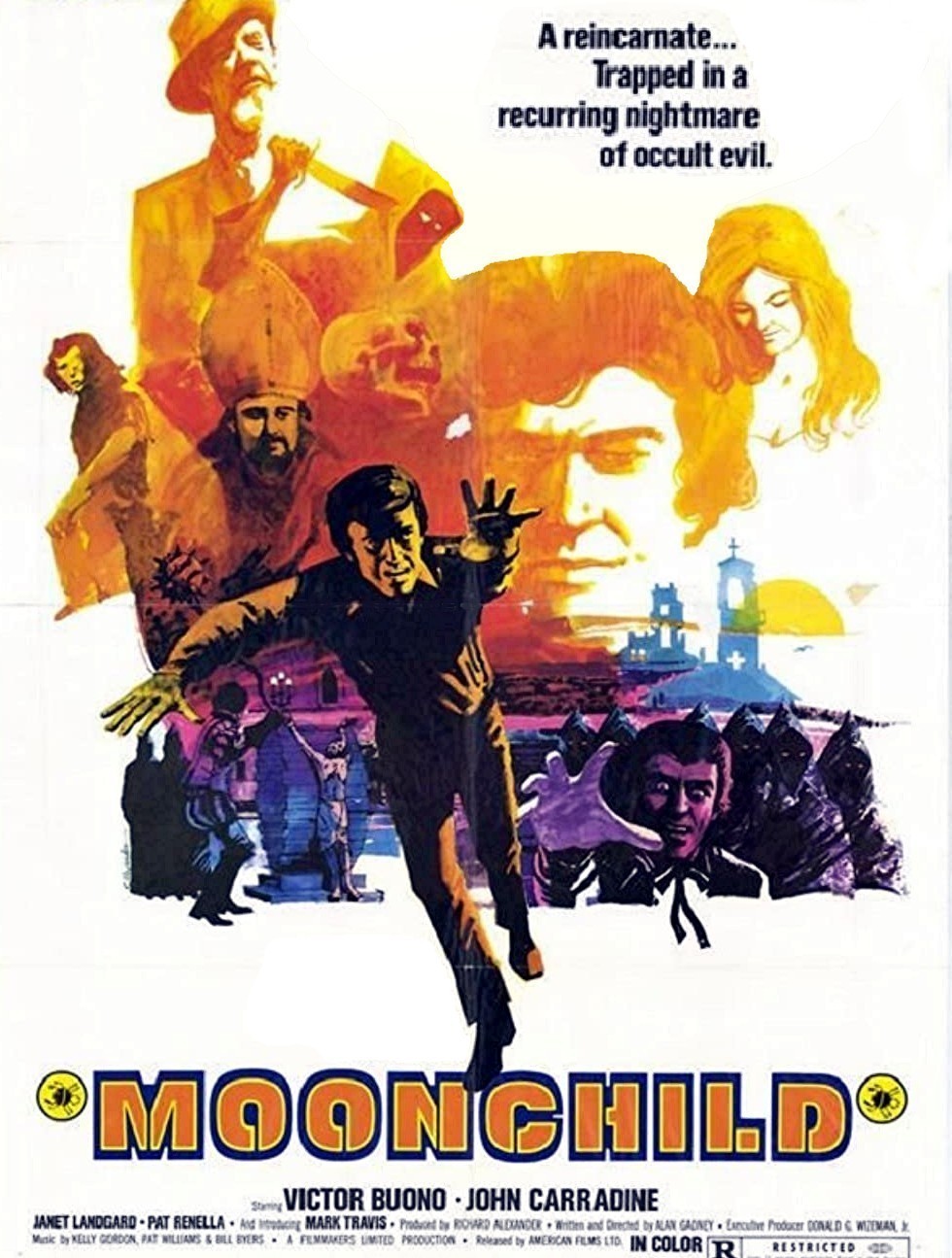
MOONCHILD

 
Publicity poster for Moonchild (© Alan Gadney/Filmmakers Ltd – reproduced here on a strictly non-commercial Fair Use basis for educational/review purposes only)

On 19 May 2022 I watched, and then last night rewatched, one of the strangest films that I have ever seen (and that's saying something for me!). Not to be confused with the werewolf movie of the same title released two years earlier (not that it could ever be confused with any other movie, shared title or otherwise, frankly!), this trippy, quintessentially '70s fantasy confection of great visual beauty but insuperably abstruse content is Moonchild.

Directed and written by Alan Gadney, filmed by him in 1971, and given a limited commercial release by Filmmakers Ltd in 1974 (during which its somewhat melodramatic publicity marketed it as a horror movie, which I don't consider it to be at all), Moonchild actually originated as a university student film, a project produced and submitted by Gadney for his Masters degree thesis at the University of Southern California. I'd previously read a fair amount about Moonchild before finally watching it, which was just as well, because for much of its length its plot is by no means evident, and even when events ultimately seem more lucid, it is by no means certain that they actually are. This presumably explains why I have read several different interpretations of the storyline, but here is mine.

Moonchild opens with an art student (played by Mark Travis), whose name is eventually revealed to be Gavalin (spelling?) and whose zodiac birth sign is Cancer (with Moonchild being a name often applied to Cancerians, hence the memorable title of this movie) painting on canvas a former Christian mission, now converted into a desert hotel but retaining its very imposing original architectural beauty. While painting, he is approached by an amicable but decidedly eccentric old man (John Carradine) who introduces himself as a poet and Walker of the World, or Mr Walker for short. After giving the student some ungratefully-received advice regarding his artwork, Walker suggests that they visit the mission so that the student can see its impressive appearance at close hand.

When they enter it, however, they are swiftly confronted by the hotel's very severe and decidedly unfriendly Manager (Pat Renella), who coerces the student into booking in as a guest, with Walker also booking in. The student is allocated a room whose number is 7 (which is later seen to have especial significance).

The student soon discovers that the hotel is populated by a host of bizarre, highly mysterious, secretive persons. These include a hunchbacked simpleton named Homunculus (Frank Corsentino) who serves as a lackey (and is one of the very few characters in this film to sport an actual name); a shrewish, vituperative housekeeper/maid (Marie Denn); and a good-natured, ancient-looking man who turns out to be an alchemist (William Challee) and may have created Homunculus. Most distinctive of all, however, is the Maitre D' (Victor Buono), who is a religious zealot of volcanic temperament, liable to erupt at any moment, especially when confronting the Manager, with whom he has a decidedly inimical emotional relationship. There is also an enigmatic young woman (Janet Landgard) who appears fleetingly, but whenever she is pursued by Travis, who experiences vivid flashbacks featuring the two of them in scenes of romance and sexual passion, she somehow disappears.

The student also experiences other flashbacks, in which he is a soldier and various other persons, as well as visualizing an ecclesiastical inquisition attended by red-garbed monks, plus the maid as a fanatical prosecutor, and the Maitre D' as the Grand Inqusitor, with the student and the alchemist on trial for heresy. It is here that the student – and the movie's audience – finally learns that his name is Gavalin (he had somehow managed to forget it until then). Walker is also present, recording the proceedings but also attempting to plead the student's case, only to be harshly rebuked by the Inquisitor for interceding on the latter's behalf instead of confining himself to recording the trial.

These flashbacks appear repeatedly throughout the movie, interspersed between scenes of the student at the hotel, and can be quite disorienting due to their abrupt appearances and mystifying content – until, at last, all is revealed…or is it?

Apparently, the student is trapped inside some kind of reincarnation cycle, and so too within his cycle are all of the persons at the hotel. Every 25 years, he finds himself back at the hotel, from which he duly escapes, but is soon killed, and is then reborn, over and over again, down through time, with his present life being his seventh – hence the significance of his hotel room's number. Only when his sins are purged from his soul can the cycle end – and only then will he find salvation and peace, as too will all of those trapped alongside him within his cycle. According to one review of this movie that I've read, in his first, original life the student was himself a killer, a murderer, but I personally saw no firm evidence for this in the movie, unless the reviewer was referring to the past life in which the student was a soldier?

In addition, it appears that the Maire D' and the Manager are fighting one another for the student's soul, the former upon the side of good, the latter upon the side of evil (though again I've read reviews claiming that the Maitre D' represents evil). In addition, the alchemist is denounced as a heretic because as an embryonic scientist he challenges religious orthodoxy, and the student's interest in his activities brings him into conflict with the Maitre D' too, as does his fervour for the elusive young woman, who personifies lust. And through it all, Walker records it all, and speaks in riddles, as does everyone else, for that matter, for much of the movie's length.

Finally, in the movie's eventful climax, the student breaks free of the hotel, escaping into the hills with the alchemist, who informs him that he has fled further this time than in any previous life (meaning that he has shed more sins this time?) – but the Manager is in hot, murderous pursuit! Moreover, as the reincarnation theme of the movie has by now been revealed to its audience by the characters, it's no spoiler to say that because the student has still not attained a state of total purity, he does not elude the Manager.

Instead, inevitably, the student meets his end yet again – only for the final scene to see him very much alive outside the mission, just like he was at the beginning of the movie, but this time equipped not with a canvas and easel to capture its appearance but with a movie camera instead, confirming that time (and attendant technology) has advanced quite considerably (another quarter-century) since his previous arrival there. And who should walk up and begin talking to him again? None other than Mr Walker, of course – because the student's reincarnation cycle has begun once more. But will his eighth life end in salvation for him at last? The movie has reached its end, so we never find out.

The only movie that I've ever seen which in any way reminds me of Moonchild is Malpertuis (click here to read my review of it). Both are dark fantasies infused with an almost tangibly malign atmosphere, peopled by an unfathomable company of grotesque characters, and ensconced within an otherworldly, preternatural setting ostensibly contained within our reality yet effectively delineated from it, which cycles incessantly. Indeed, some reviewers consider Moonchild to be a New Age-inspired allegory for the grand circle of life that drives our entire planet and everything that exists within it.

Best acting performance for me in Moonchild is definitely Carradine's, endowing the twinkly-eyed and somewhat loquacious Walker with the necessary mystique and verbal dexterity to yield a convincing, ever-interesting 'Keeper of Words' (one of his own description of himself). And the much-missed Victor Buono could always be relied upon to give his customary masterclass in delightfully hammy, unrestrained over-acting, with his OTT Maitre D' virtually chewing the scenery during his hyper-histrionic theological outbursts against the Manager, the student, and anyone else he happens to encounter!

The sumptuous scenes inside the mission/hotel and its architecturally spectacular exterior were reputedly filmed at the Riverside Hotel in California, And apart from a pervasive greenish lunar tinge most prominent in scenes of the student fleeing through never-ending subterranean tunnels and passages within the hotel's claustrophobic foundations from pursuing figures in sinister black robes and hoods with unseen faces and undetermined motives, the colours inside the hotel are vibrant and very diverse. As for its music, this is unequivocally late 1960s/early 1970s in style, as epitomized by its haunting, psychedelic opening theme song.

Some reviewers have variously written off Moonchild as pretentious unmitigated nonsense or impenetrable art-house folderol, and it may have been its overall rejection by audiences and critics alike at the time of its release that resulted in Gadney becoming a cinematic one-hit wonder, inasmuch as Moonchild is the first and only movie that he ever directed. If so, this is a great shame, because notwithstanding its baffling plot, I personally found Moonchild to be an immensely engrossing albeit incredibly surreal fantasy, beautifully filmed and thoroughly captivating, and I can only wonder what extraordinary movies Gadney would certainly have gone on to direct had he stayed in the world of film-making, refining his creativity and expanding his directorial experience.

I also wonder how a mere student producing a movie simply as a university project was able to enlist such a starry cast as John Carradine, Victor Buono, and William Challee. Yet like so much else concerning Moonchild, it seems unlikely that we shall ever know the answer to this mystery.

Moonchild may not be for everyone, but if like me you enjoy arcane Gothic fantasies with caliginous plots set in exquisite surroundings, then I definitely encourage you to give this undeniably weird but unjustly neglected masterpiece of the macabre a viewing – especially as if you click here you can currently watch the entire movie free of charge on YouTube.

To view a complete chronological listing of all of my Shuker In MovieLand blog's other film reviews and articles (each one instantly accessible via a direct clickable link), please click HERE, and please click HERE to view a complete fully-clickable alphabetical listing of them.

 
The student (Mark Travis) and the Maitre D' (Victor Buono) (© Alan Gadney/Filmmakers Ltd – reproduced here on a strictly non-commercial Fair Use basis for educational/review purposes only).