Front
cover of my big box ex-rental VHS videocassette of Rock N' Roll Cowboys (© Rob Stewart/Cinefunds Limited in
association with Somerset Film Productions/Guild Home Video Limited –
reproduced here on a strictly non-commercial Fair Use basis for
educational/review purposes only)
Last night I watched a little-known Australian
made-for-TV movie that I had only viewed once before, around 30 years ago, when I hired it
from a video rental shop in the UK. Although screened on TV a few times here, as far as I am aware it has never
been officially re-released in any other home viewing format (sell-thru video, DVD, Blu-Ray,
etc), but a couple of years ago I was able to purchase one of the original UK big
box ex-rental VHS videocassettes of it still in existence, and which
plays perfectly. The movie in question is a totally surreal rock fantasy/horror film
entitled Rock N' Roll Cowboys, and although
I greatly enjoyed it when I watched it three decades ago (which is why I swiftly
purchased its nowadays very hard to find video when chancing upon it recently),
I freely confess that I couldn't make head or tail of what was supposed to be
happening in it.
So when I decided to view this film again
last night, I was interested to find out whether a second viewing would make
everything clearer – but, guess what, I still have little idea of what it was
all about! Here, though, is my best attempt at making some sense of this entertaining
but thoroughly offbeat offering!
Directed by Rob Stewart, written by David
R. Young, featuring an original rock soundtrack with songs co-written by the
likes of David Skinner and former Status Quo member Alan Lancaster, and
released in 1988 by Somerset Film Productions, Rock N' Roll Cowboys was originally screened as one of a series of
Australian TV movies called Tomorrow's
News. However, it was subsequently released on video as a stand-alone movie
in its own right.
Before we even begin to examine its plot,
my first issue with Rock N' Roll Cowboys
is its title – why cowboys? Apart from a single brief scene featuring a TV
cowboy, nothing in its storyline has any connection, literally or
metaphorically, with cowboys, Westerns, or anything even remotely relevant to
this genre as far as I could tell. Perhaps because words such as 'rebels' or
'outlaws' have been used so extensively in relation to rock'n'roll, its screenplay's
writer Young decided to utilize this movie's very tenuous cowboy link as an
alternative means of implying such characteristics?
Cowboys notwithstanding, the movie
focuses upon a rock band whose effervescent lead singer, Teena Tungsten (played
by Nikki Coghill), is dating its exceedingly arrogant lead guitarist Stevie Van
Blitz (Greg Parke), who is also the band's song writer and self-appointed
leader. Stevie is insultingly dismissive of their two roadies – the
outward-going general fixer-upper Eddie (Peter Phelps), and the shy, introverted
sound technician Mickey (David Franklin).
Mickey, the central character in Rock N' Roll Cowboys (and depicted on
the cover of its big box video – see this present review's opening picture), is
secretly in love with Teena and is also a talented songwriter who fantasizes
about playing his own songs up on stage one day. In reality, conversely, he is completely
passed over in this capacity by the band, most especially Stevie.
(Incidentally, although David Franklin plays
the film's lead character, he receives second billing to top-billed Phelps,
presumably because the latter had a greater acting profile, thanks at that time
to his popular role as heart-throb hunk John Palmer in the long-running 1980s Aussie
soap Sons and Daughters, plus his
widely-acclaimed performance in the celebrated 1987 movie The Lighthorsemen.)
The band rehearses in a shoddy garage
with very dodgy electrics, and when a circuit blows in the middle of one
rehearsal, causing their instruments to lose power, Stevie storms off in a
tantrum after blaming Mickey for not having checked the circuitry beforehand.
With no chance of further rehearsals that night, the other band members follow him,
leaving Eddie and Mickey behind – only for a couple of thrilling, willing groupies
to appear on the scene, swiftly leading Eddie astray and away for a passionate
threesome. Now alone in the garage, Mickey discovers a strange spiked sphere of
unknown origin, but which, equally unknown to him, is what had caused the
circuit to blow on this particular occasion, not the garage's ramshackle wiring.
Picking up the sphere, Mickey feels a
shock of pain shoot through his head, and then hears strange music coming from
a room above the garage. After a precarious climb up the drainpipe leading to
the room, he is pulled inside by its occupant – a tall, decidedly singular-looking
man of pallid complexion whose name is revealed to be Damien Shard (John Doyle).
Unbeknownst to Mickey, Shard had purposefully sent the spiked sphere into the
garage to disrupt the rehearsal and lure Mickey up to him.
Incidentally, is it just me (probably!),
but has anyone else who has actually watched this nowadays largely forgotten
tele-movie thought that whereas Shard bears something of a facial resemblance
to UK TV presenter and comedian Paddy McGuiness, in general demeanour and dress
style he more readily recalls a certain UK MP by the name of Jacob Rees-Mogg? (Now
there's a composite image to toy with in the wee small hours!) Moreover, as if
all of this were not enough to deal with, Shard subsequently turns up in one
scene almost as if expecting to star in a vintage b/w screen musical, judging
at least from his sartorial selection of top hat and tails, while twirling a
cane like a facsimile Fred Astaire. All very strange, yet par for the course
for such a weird and very wacky flick as this one!

Damien
Shard (played by John Doyle) – would you hook your mind into a thought synthesizer
invented by this man? (© Rob Stewart/Cinefunds Limited in association with
Somerset Film Productions/Guild Home Video Limited – reproduced here on a
strictly non-commercial Fair Use basis for educational/review purposes only)
But I digress – back to the story. Shard
shows Mickey his secret invention, which is the source of the music that Mickey
had heard. Referred to by Shard as a psychotronic alpha sampler, it resembles a
synthesizer, but when headphones are attached to it, their wearer can use it to
produce music by the sheer power of his own thoughts, as Mickey discovers when
Shard invites him to try it out.
Mickey is totally mesmerized by Shard's
invention, so much so that he loses no time in contacting the band's manager, a
sleazy OTT despot named Harvey Glutzman (Ben Franklin), given to gratuitous
swastika decorations and debauched fantasies of the chains, whips, and hellfire
variety (this character, incidentally, is meant to provide the movie's comic
relief!), as well as the other band members, urging them to purchase it from
Shard.
A meeting with Shard to make this happens
proves unsuccessful, however, when, after he insists that it must be Mickey who
plays his thought-controlled synthesizer, not the band's official keyboard
player, James Dupont (Robin Copp), the band refuses, disparaging Mickey as a
mere roadie, not a band member, which causes Mickey to temporarily quit in
anger. Meanwhile, Dupont attempts to create his own version of Shard's
invention, with disastrous results – emissions from it dramatically distort his
thought processes, turning him mentally into a monkey!
Without a functional keyboard player now,
the band has no option but to allow Mickey to play (and, in so doing, gaining
the use of Shard's thought synthesizer, which Shard has donated to him). This
he does to great success during a performance by the band aimed at procuring a
record contract. However, Mickey is suffering more and more from terrible pains
inside his head, enhanced by the strange spiky spheres turning up in his
vicinity.
Moreover, events soon take an even more
sinister, alarming turn when Shard is revealed to have an ulterior, decidedly
non-altruistic reason for making his synthesizer available – but this is also
where the movie's plot quite literally loses the plot, at least for me.
Flashbacks show Shard as a TV-watching
young boy back in the early 1950s (judging from the primitive b/w TV featuring
in these flashbacks). The TV is screening an ultra-conservative Sunday morning kids'
show, in which its superficially genial cowboy-costumed host, Uncle Sam (Ron
Blanchard), is telling the small children in his audience (whom he refers to as
his Ponderosa Kids) that rock'n'roll is the devil's music, and is exhorting
them to smash their older siblings' records – yee haa!
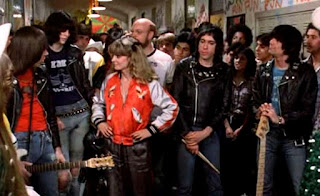
Peter
Phelps as Eddie (left) and David Franklin as Mickey (right) in Rock N' Roll Cowboys (© Rob
Stewart/Cinefunds Limited in association with Somerset Film Productions/Guild
Home Video Limited – reproduced here on a strictly non-commercial Fair Use
basis for educational/review purposes only)
Heavily influenced by Uncle Sam's
insidious brainwashing, Shard has grown up to become a religious zealout who
has specifically invented his thought synthesizer to destroy rock'n'roll music,
by way of those who perform it, like Mickey and the band. For the synthesizer
has been designed by Shard to inflict brain haemorrhages upon its unfortunate
users, as he gloatingly informs a pain-racked Mickey. Nice.
From here onwards, the storyline runs
amok, with a rock'n'roll party taking place for no apparent reason at a club
owned by Shard, but where somehow his own music – a recording of the twee theme
music to Uncle Sam's 1950s children's TV show – has hynotised the minds of
everyone there, even the independent Teena.
Their only possible savior is Eddie, who has
somehow been rendered deaf by one of Shard's pesky spiked spheres, and so, by
being unable to hear the music, is unaffected by it. Consequently, he is able
to knock out Shard not only physically but also aurally, by playing a
particularly strident rock riff on an electric guitar, which stuns him. And
that's about it, basically. Shard is vanquished, rock'n'roll lives to play another
day, and, right at the end, a miraculously fully-recuperated Mickey gets Teena.
But what about all of the abounding storyline inexplicabila and inconsistencies
readily visible in Rock N' Roll Cowboys?
For example, the whole Shard master plan
makes no sense whatsoever. After all, if he intends to eradicate rock'n'roll on
a band by band basis, and even includes in his malign sights such amateur, non-professional examples as the
band at the heart of this movie, it's going to take an awfully long time,
that's for sure!
Furthermore, the official Rock N' Roll Cowboys film trailer
provides an explanation for Shard's heinous activities that is not even included
in the movie itself. Namely, that he is a time-traveller from the future, where
in his extreme opinion the world has been corrupted by rock'n'roll. So he
travels back to our time to annihilate this music genre that he hates so much. This
revelation goes some way to elucidating the otherwise perplexing claim in the
plot summary on the reverse of this movie's video that Shard is a
time-travelling cowboy, and would also explain his futuristic synthesizer and
other creations. Yet it is a plot thread that appears nowhere in the actual
movie – how bizarre is that? Consequently, I am wondering whether there may
have originally been a scene revealing all of this back story but which was cut
before the movie's release.
Every so often, a team of human figures
wearing gas masks and yellow outfits resembling hazard-suits appear on the
scene, seemingly employed by Shard but with no explanation ever given for their
bizarre garb, and invariably failing in their hapless attempts to threaten whoever
they encounter – so what are they all about? Were they also from the future,
brought back to our time by Shard in order to assist him in his nefarious
schemes?
And why, shortly after first meeting
Mickey, does Shard say that he had seen him on TV, despite Mickey stating that
he has never been on TV? That intriguing plot line is never pursued, so why was
it included in the first place? Or did I miss something?
Also, if Mickey has already been
inflicted with brain haemorrhages by Shard's infernal inventions (both the
synthesizer and those spiked spheres) as Shard claims, how is he able to make a
complete recovery once Shard is defeated? Equally, why does Mickey suddenly
begin sneezing very noticeably, on several different occasions during the movie
and even actively mentioned by other characters, yet without any significance
or explanation ever being given concerning this odd yet distinctive plot development?
And how does Eddie's hearing suddenly
return – assuming that it does? That highly significant aspect is never
actually clarified – like so many other ostensibly noteworthy plot lines in
this movie, after having been introduced it seems to have simply been forgotten
about.
Faced with all of these anomalies, all that I can suggest is that if you'd like to
attempt for yourself to discover what on earth is happening in Rock N' Roll Cowboys, you can currently
watch this entire movie free of charge on YouTube by clicking here.
It may not make much sense, but Rock N'
Roll Cowboys is a fun movie nonetheless, an oddity from Oz that every rock
movie fan needs to embrace in all its marvelous madness!
To view a complete chronological listing of all of my
Shuker In MovieLand blog's other film reviews and articles (each one instantly
accessible via a direct clickable link), please click HERE, and please click HERE to view a
complete fully-clickable alphabetical listing of them.
Full
cover of my big box ex-rental VHS videocassette of Rock N' Roll Cowboys (© Rob Stewart/Cinefunds Limited in
association with Somerset Film Productions/Guild Home Video Limited –
reproduced here on a strictly non-commercial Fair Use basis for
educational/review purposes only)


,%202.JPG)

.JPG)