Dr Karl Shuker's Official Website - http://www.karlshuker.com/index.htm

IMPORTANT:
To view a complete, regularly-updated listing of my Shuker In MovieLand blog's articles (each one instantly clickable), please click HERE!

IMPORTANT:

To view a complete, regularly-updated listing of my ShukerNature blog's articles (each one instantly clickable), please click HERE!

IMPORTANT:
To view a complete, regularly-updated listing of my RebelBikerDude's AI Biker Art's thematic text & picture galleties (each one instantly clickable), please click HERE!

IMPORTANT:
To view a complete, regularly-updated listing of my Starsteeds blog's poetry and other lyrical writings (each one instantly clickable), please click HERE!

IMPORTANT:
To view a complete, regularly-updated listing of my Eclectarium blog's articles (each one instantly clickable), please click HERE!


Search This Blog


Showing posts with label magic. Show all posts

Sunday, April 16, 2023

WIZARDS OF THE LOST KINGDOM

Video front cover for Wizards of the Lost Kingdom (© Héctor Olivera/Roger Corman/Concorde Pictures/Juno Media/Medusa Home Videos – reproduced here on a strictly non-commercial Fair Use basis for educational/review purposes only)

Last night I returned to my collection of big box ex-rental videos to watch an absolute classic, staple movie from the era of 1980s video rental shops – Wizards of the Lost Kingdom.

Directed by Héctor Olivera under the auspices of Roger Corman during a run of 10 movies that Corman producd in Argentina during the 1980s, and released in 1985 by Concorde Pictures, Wizards of the Lost Kingdom is a swords and sorcery movie that packs into 90 minutes virtually every S&S meme and motif that you can shake a sword at – and then some – albeit with wildly differing degrees of success. (Worth noting, incidentally, is that its original cut was only 58 minutes long, so to pad it out Corman incorporated excerpts from some of his earlier S&S movies, such as Battle Beyond The Stars, Sorceress, and Deathstalker!)

So: virtuous king of a faraway land cruelly betrayed by his haughty queen and slain by his evil supercilious wizardly vizier – check. Youthful rightful heir to the throne forced to flee to escape vizier's clutches – check. Said youthful rightful heir championed by a laconic rebel adventurer armed with a ready supply of quips as well as a hefty sword – check. A motley assortment of monsters, especially of the actors wearing monster masks kind – check. Villainous but inane henchmen who perform more pratfalls and double-takes than Peter Glaze on Crackerjack (an allusion specially for British TV viewers of a certain age to enjoy!) – check. A vertically-challenged comic-relief character (in this instance a hobgoblin) – check. A giant furry friend of the youthful heir (in this instance an albino wookie, or something like that!) – check. And so on.

The plot is both formulaic and episodic. His name notwithstanding, evil wizard and erstwhile king's counselor Shurka (Thom Christopher) does not shirk from killing his noble monarch King Tylor (Augusto Larreta) in order to seize the throne of Axeholme, with the approval of his lover Udea (Barbara Stock), Tylor's traitorous queen. All Shurka needs now to gain absolute power is the magical ring owned by Tylor's good wizard Wulfrik (Edgardo Moreira) – but before he has chance to claim the ring, Wulfrik magics it away to safety with his teenage son Simon (Vidal Peterson) and Simon's huge hirsute companion Gulfax (Moreira again, but now in a white wookie-lite suit) – or so Wulfrik thinks.

Unbeknownst to him, however, the ring falls off Simon's finger at the precise moment that he and Gulfax are teleported out of Tylor's royal castle, the ring falling into the open jaws of a stone pantheresque statue in the castle's throne room where it remains hidden throughout almost the entire movie from the array of servants sent by Shurka to locate it.

Simon and Gulfax, meanwhile, find themselves lost in a forest far beyond the castle, but soon encounter a rugged rogue adventurer modestly (and alliteratively) known as Kor the Conqueror (Bo Svenson). Kor agrees to assist Simon in his goal to return to the castle and avenge the death of his father (whom Shurka has also slain) as well as that of the king, and rescue the king's teenage daughter Princess Aura, whom Shurka has imprisoned but secretly plans to marry, thereby betraying Queen Udea just like she betrayed the king.

The remainder of the movie sees Kor, Simon, and Gulfax fighting a succession of monsters, some serving as henchmen of Shurka, others serving simply as plot devices to keep the movie's momentum from slumping. So we have an alluring maiden named Acrasia (Maria Socas) who bewitches young Simon with her womanly wiles and a flagon of wine before turning into a hideous gigantic insect ready to devour him before he comes to his senses and dispatches her. Whether still inebriated or not I'm not sure, but no sooner has Simon escaped from Acrasia's deadly embrace than he comes up with the bright idea of resurrecting some long-deceased warriors to fight alongside him and Kor, only for the resulting zombies to attack them instead, before being persuaded to return to their earthly resting places.

Then we have a trio of louche lizardmen hassling a poor little hobgoblin named Hurla (Michael Fontaine) until Kor steps in and rids him of his reptilian aggressors, after which a grateful Hurla promises to utilize his magic powers in assisting their quest to defeat Shurka. There is also the charmingly-named Suicide Cave through which Simon and Kor have to pass (Gulfax having wisely sat out this particular challenge by remaining with Hurla), in which they are harassed by a succession of semi-transparent howling ghosts that fly at them from all directions.

And did I mention the rainbow-engendering mermaid-like naiad, the magic-spitting winged lion (which, disappointingly, is nothing remotely as impressive as its image on its video's front cover shown above would have you believe), or the warrior cyclops who captures Kor to ensure that he keeps an earlier promise to marry the cyclops's hideous sister or else be eaten alive? Like I said earlier, the storyline is very episodic, but at least there's never a dull moment!

Thanks to the naiad, Simon, Kor, Gulfax, and Hurla finally reach the castle, just in time to prevent Shurka from forcing Aura to marry him, and Simon retrieves the lost ring from one of Shurka's minions who had just that moment spotted it in the jaws of the stone panther. There then follows the obligatory battle to the death between good wizard Simon and evil wizard Shurka, in which Shurka is obviously destroyed (this is after all a PG-rated movie aimed at a youth audience), Simon is made king, and Kor departs for adventures new elsewhere. The end. (Except that a sequel, imaginatively entitled Wizards of the Lost Kingdom II, was released in 1989, but this did not feature any of the original film's cast or crew.)

Made at a time when CGI was not so much in its infancy as still a cinematic embryo, Wizards of the Lost Kingdom relies extensively upon what in comparison were the very primitive albeit sometimes quite effective special effects available back then – with the notable exception of the winged lion, that is…

Throughout its brief appearance after having been summoned by Simon in a dream, this intriguing entity remains resolutely motionless while suspended in the sky, only its head and mouth moving slightly and its expanded wings fluttering a little. And no, regardless of what the movie video's spectacular front cover artwork depicts so vividly, nobody gets to ride on its back either – due to that winged lion artwork apparently having derived directly from the Dungeons & Dragons board-game box's artwork!

Equally ambiguous is this film's title, bearing in mind that the kingdom isn't lost – usurped yes, but not actually lost. What is lost, at least for most of the movie, is the magical ring that the two rival, regal wizards – Shurka and Simon – are both intent upon possessing. So perhaps a more apt title for it would have been Lords of the Ring – then again, I have the distinct feeling that something like this may have already been used in some capacity…

As a fantasy movie for the more youthful audience, I feel sure that Wizards of the Lost Kingdom would satisfy just as successfully as the many classic Sinbad and Thief of Baghdad-themed films have done for decades of Saturday morning TV viewing – which is why I am puzzled never once in almost 40 years since its original mid-1980s release to have seen it included in any listings for the main UK terrestrial TV channels. So unless it was hired from a video rental shop, or subsequently purchased as a sell-thru video or DVD, this means that generations of pre-internet/streaming youngsters never had the chance to see this engaging family movie, which is a great shame.

Happily, however, at least at the time of posting this present review online here at Shuker In MovieLand, I'm happy to confirm that Wizards of the Lost Kingdom can be viewed free of charge in its entirety on YouTube by clicking here. Or if you'd prefer a taster of what to expect first, please click here to view an official trailer for it.

Finally: to view a complete chronological listing of all of my Shuker In MovieLand blog's other film reviews and articles (each one instantly accessible via a direct clickable link), please click HERE, and please click HERE to view a complete fully-clickable alphabetical listing of them.


Wednesday, June 1, 2022

THE PRESTIGE

 
Publicity poster for The Prestige (© Christopher Nolan/Touchstone Pictures/Warner Bros Pictures/Newmarket Films/Syncopy/Buena Vista Pictures Distribution – reproduced here on a strictly non-commercial Fair Use basis for educational/review purposes only)

My movie watch on 13 April 2022 was the fascinating sci fi/fantasy thriller The Prestige, one of the best films that I have viewed in a very long time, and truly magical in every sense of the word.

Directed, co-produced, and its screenplay co-written by Christopher Nolan, released internationally by Warner Bros in 2006, and based upon the 1995 titular Christopher Priest novel, The Prestige pits two early 20th-Century London-based stage magicians, Robert Angier (played by Hugh Jackman) and Alfred Borden (Christian Bale), against one another in an intense rivalry based upon increasingly obsessive one-upmanship, each desperate to outdo the other, whatever the cost.

Angier and Borden begin their careers as friends, working together in the same act, until Angier's wife Julia drowns on stage inside a water tank after being unable to untie the problematic type of knot that Borden has obstinately used on her, despite having been warned against it by their very experienced mentor John Cutter (Michael Caine). Angier blames Borden, and they become implacable enemies thereafter. Establishing their own separate, rival acts (Angier as The Great Danton, still working with Cutter; Borden as The Professor, working with the mysterious Bernard Falon), they ruthlessly sabotage and out-compete each other's tricks at every available opportunity, as a result of which Angier is partially crippled and Borden has a finger blown off.

Their deadly confrontations culminate (and fulminate!) with a visually sensational trick devised by Borden and called by him 'The Transported Man', in which he enters one wardrobe and then almost instantaneously steps out from inside another one placed at some distance away from the first. Angier is desperate to discover the secret to this extraordinary illusion, but Borden skillfully fools him into setting forth on a wild transatlantic goose chase to America, in order to visit none other than the contentious Serbo-American scientist Nikola Tesla (and played by none other than David Bowie, employing an intriguing Scottish accent!) at his laboratory in Colorado Springs. Here he is aided in his highly controversial, explosive experiments in electricity and magnetism by his loyal assistant Mr Alley (Andy Serkis).

However, Borden's cruel scheme unexpectedly backfires when Tesla creates for Angier a machine that will duplicate Borden's trick, and in an even more spectacular manner – but at a terrible cost, yet one that Angier is willing to pay in order to surpass Borden's act.

As a movie whose theme is sleight-of-hand stage magic, do not be surprised to learn that nothing in The Prestige is what it seems to be, most especially the true explanations for the two magicians' respective versions of 'The Transported Man'. Borden's involves a traditional but ingeniously-executed deception, whereas Angier's is something else entirely, as you'd expect from anything created by Tesla. Having said that, I've actually included a subtle clue as to the latter's incredible modus operandi here in this mini-review – did you spot it? And, if you need a clue for Borden's, thinking about anagrams is the name of the game…or the game of the name!

The Prestige is a superb, wonderfully entertaining movie, which kept me totally captivated throughout its 2-hr 10-minute running time. It includes excellent performances by all four of its leading cast members (Scarlett Johansson being the fourth, appearing as Olivia, a double-agent love interest between the two magicians), as well as some exciting special effects, especially within Tesla's classic 'mad scientist' laboratory, whose evocative design incorporates some dramatic steampunk visuals.

Josh Hartnett was apparently considered for the role of Angier, but Jackman's powerful rendition of this embittered character, driven half-crazy by his wife's needless death at the hands of Borden and hell-bent upon avenging her, is absolutely perfect, as poignant as it is chilling, especially when the twin voices of conscience and reason beseeching him inside his head become increasingly stilled as his mania escalates swiftly and surely towards its inevitable, catastrophic conclusion.

Adhering to the sacred traditions of stage magic, I'll say no more, but the closing scenes, when all is finally revealed, are as visually breathtaking as they are shocking – their stark, unforgettable images exposing the horrific depths to which the rivals have sunk in order to achieve each other's total destruction, yet little realising how this will impact upon their own survival. Or, to put it another way: what goes around, comes around.

Last but certainly not least: if you don't already know what a prestige is in the particular context of prestidigitation ('prestige' deriving from 'praestigium', the Latin word for 'trick'), you need to watch this movie – all will be revealed, or will it? But if you can't wait that long, here is Cutter's own explanation of it:

Every great magic trick consists of three parts or acts. The first part is called "The Pledge". The magician shows you something ordinary: a deck of cards, a bird or a man. He shows you this object. Perhaps he asks you to inspect it to see if it is indeed real, unaltered, normal. But of course... it probably isn't. The second act is called "The Turn". The magician takes the ordinary something and makes it do something extraordinary. Now you're looking for the secret... but you won't find it, because of course you're not really looking. You don't really want to know. You want to be fooled. But you wouldn't clap yet. Because making something disappear isn't enough; you have to bring it back. That's why every magic trick has a third act, the hardest part, the part we call "The Prestige".

If you'd like to conjure forth a tantalizing glimpse of the spellbinding sights and incongruous illusions that await you in The Prestige, be sure to click here to view an official trailer for this dark, twisted, yet mesmerizingly macabre, magical film on YouTube.

To view a complete chronological listing of all of my Shuker In MovieLand blog's other film reviews and articles (each one instantly accessible via a direct clickable link), please click HERE, and please click HERE to view a complete fully-clickable alphabetical listing of them.


Tuesday, October 12, 2021

MR PIPER

 
Two screenshots from Mr Piper, starring Alan Crofoot in the title role (© Martin Andrews/Allan Wargon/Pied Piper Films Ltd/Independent Television Corporation/World Wide Distribution – reproduced here on a strictly non-commercial Fair Use basis for educational/review purposes only)

Time for another of my rare forays beyond the big-screen world of the movies into the small-screen but no less fascinating world of TV. Today, after almost 60 years on from my first viewing of it, I am revisiting what for me will always be a wonderful, uniquely special TV show.

What is the very first TV show that you can remember watching? In my case, it is the truly magical but nowadays all-but-forgotten children's show to which this present blog article of mine is devoted – Mr Piper.

Created in Toronto, Canada, by Martin Andrews and Allan Wargon in 1960, and with Wargon also serving as its executive producer,  Mr Piper was a 25-min show that was originally screened by CBC Television in Canada in 1963, and was also shown on ITV in the UK during the 1960s, initially in its entirety, but when reshown here during the 1970s it was split into two 12.5-min shows (see later for more details). It takes its name from its central character and narrator, the somewhat stout, ever-cheerful, and totally magical Mr Piper, played by Canadian actor/opera singer Alan Crowfoot, and clearly inspired both in costume and in concept by the Pied Piper of Hamelin of European folklore. But whereas the latter used dark enchantments to lure children away from their parents and homes, TV's Mr Piper used his sunny enchantments to lure children into spending a happy, fun-filled time watching his joyful and also subtly educational show, which I absolutely loved as a small child in the early 1960s, viewing it with Mom on ATV, ITV's now long-gone West Midlands regional channel.

Incidentally, there is some controversy in online coverages of Mr Piper regarding the total number of episodes that were made and screened, with claims ranging from 13, 14, or 15, right up to as many as 39. However, my own memories tally with 15 episodes (39 episodes seems far too high a number, unless the subsequently-screened 12.5-min split versions of the original 25-min ones are also being included in this count, i.e. as separate episodes in their own right?).

Moving on, here is a breakdown of the Mr Piper show's fondly-remembered format. Each episode would begin with Crofoot as Mr Piper very tunefully singing over its animated opening titles what is unquestionably one of the catchiest TV theme songs ever written. Although I last watched this show on TV during the early 1970s, I have never forgotten that irrepressibly cheery song, and when, several years ago, I was delighted to be able to buy at long last a couple of DVDs containing a few segments (mostly Tele Tunes, see below) from various Mr Piper episodes, I discovered that I had indeed accurately remembered its theme song verbatim. If you'd like to hear it for yourself, click here to do so on YouTube.

 
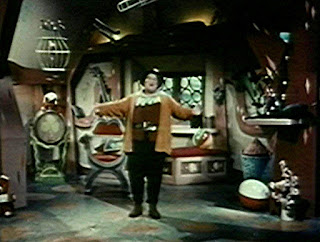
Mr Piper singing his show's theme song inside his magical home, Pied Piper House, the setting for all of the Mr Piper episodes (© Martin Andrews/Allan Wargon/Pied Piper Films Ltd/Independent Television Corporation/World Wide Distribution – reproduced here on a strictly non-commercial Fair Use basis for educational/review purposes only)

After the theme song ended, each episode would then consist of 4 wholly autonomous segments (each with its own director), which could therefore be shown in any sequence, but here in the UK they were always screened in the following one (in Canada, they were apparently shown in a different sequence).

Segment 1 was 'Bag of Tricks', directed by Allan Wargon, during which Mr Piper would invariably get himself into all manner of humorous slapstick trouble when he pulled out of his big, polka-dotted, box-shaped bag of tricks a magical object (a different one in each episode). Memorably, he would always preface this segment with a short but relevant introductory statement, and point with his thumb or index finger to add emphasis, an action often accompanied by the sound of a single invisible bell ring, emphasizing the magical nature of what is about to happen. 'Bag of Tricks' was my favourite of the four segments per episode, so I was always glad that it was shown first within each episode screened here in the UK.

 
Mr Piper with his big polka-dot spotted bag of tricks (© Martin Andrews/Allan Wargon/Pied Piper Films Ltd/Independent Television Corporation/World Wide Distribution – reproduced here on a strictly non-commercial Fair Use basis for educational/review purposes only)

Segment 2 was 'Tele Tunes', directed by James Mackay, in which Mr Piper would narrate a fairy story, usually a traditional folktale from somewhere in Europe or from the Arabian Nights. It would be accompanied by a visual portrayal of the story using (very) limited but nonetheless charming animation, and end with Mr Piper drawing forth a worthy moral from the tale. I was to learn many years later that in much of the USA, the Tele Tune cartoons were the only segments broadcast from episodes of Mr Piper, so that viewers there were entirely unaware that each episode originally contained three other segments too. Crofoot would provide some of the character voices, with others provided by an uncredited Billie Mae Richards.

 
A scene from a Tele Tune cartoon segment entitled 'Ali Baba' (© Martin Andrews/Allan Wargon/Pied Piper Films Ltd/Independent Television Corporation/World Wide Distribution – reproduced here on a strictly non-commercial Fair Use basis for educational/review purposes only)

Segment 3 was 'Port of Call' (whose director is not presently known to me), the most educational segment, in which Mr Piper would narrate documentary-style film footage about cultures from around the world as seen through the eyes of their children. Once again, this was very charmingly conceived and presented, but due to its distinct lack of either magic or animals, I'm ashamed to say that I personally found it to be the least interesting of the quartet of segments per episode of Mr Piper. Even at that tender age, it was clear that my future career leanings were not going to point towards any sociological or anthropological aspirations!

 
A scene from a Port of Call segment featuring a Hong Kong boat-dwelling family (© Martin Andrews/Allan Wargon/Pied Piper Films Ltd/Independent Television Corporation/World Wide Distribution – reproduced here on a strictly non-commercial Fair Use basis for educational/review purposes only)

Much more to my liking, conversely, was Segment 4, entitled 'Animal Farm', and directed by Vincent Vaitiekunas. Reminiscent of another popular 1960s children's TV show, the UK's Tales From the Riverbank, it was a very sweet vignette featuring several small animals inside a tiny barnyard, who would be talking to one another with human voices, mostly supplied by Crowfoot (plus some by Richards again), and involved in all manner of adventures. All of the animals had alliterative names, with my favourite animal being a beautifully-marked black and white pet rat called Rupert. Others that I could still readily recall even before chancing upon the above-mentioned Mr Piper DVDs some years ago include Kookie the Kitten, Harriet the Hen, and Bessie the Bunny.

 
Rupert the Rat from an Animal Farm segment (© Martin Andrews/Allan Wargon/Pied Piper Films Ltd/Independent Television Corporation/World Wide Distribution – reproduced here on a strictly non-commercial Fair Use basis for educational/review purposes only)

Finally, albeit not a full-length segment in its own right, usually being interposed between the end of Segment 4 and the show's closing credits instead, was a brief scene featuring a talking scarlet macaw named Polly who in each episode would poses a different taxing riddle for Mr Piper to solve. She would always begin by uttering the line: "Piper – fiddle diddle, here's a riddle", to which Mr Piper variously replied: "All right, Polly" or "What is it, Polly?" She would address him in a somewhat imperious, peremptory manner as "Piper", and squawk with triumphant laughter when he invariably failed to work out the answer to her riddle. Here’s one of them: "When is it correct to eat with a knife, fork, AND spoon?" I'll leave you to puzzle over that while reading the remainder of this review (but if you can't wait that long, the answer is revealed at the end of the review).

 
Mr Piper and Polly (© Martin Andrews/Allan Wargon/Pied Piper Films Ltd/Independent Television Corporation/World Wide Distribution – reproduced here on a strictly non-commercial Fair Use basis for educational/review purposes only)

There are 15 different Tele Tune segments known to exist (another reason for believing that there were 15 original full-length episodes of Mr Piper in total), and these can be variously found online on YouTube, DailyMotion, etc, as well as on various DVD releases. However, few examples of the other three segments apparently still survive, sadly.

When Mr Piper was rescreened in the UK during the 1970s, the original 4-segment, 25-min episodes were now screened in split format, as 2-segment, 12.5-min episodes. Each of these half-length versions either contained one Segment 1 and one Segment 2, or one Segment 3 and one Segment 4. Obviously, me being me, with an abiding love of magic and cartoons, I preferred those half-length versions that contained Segments 1 and 2.

Until I purchased the DVDs, I'd never seen Mr Piper in colour (back in the 1960s and early 1970s when it was being screened, we still had a b/w TV set). So it was interesting and also pleasing to discover when watching the DVDs that the principal shades which featured, especially in Segment 1, were pastel greens, ochre, russets, and browns, nothing garish or gaudy, which would have been so out of place in this very tasteful, thoroughly genteel, and gentle, little show.

 
Mr Piper and Pals is one of the two Mr Piper DVDs that I own – this one contains a selection of the Tele Tune cartoon segments from various episodes of Mr Piper (© Martin Andrews/Allan Wargon/Pied Piper Films Ltd/Independent Television Corporation/World Wide Distribution/East West Entertainment LLC – reproduced here on a strictly non-commercial Fair Use basis for educational/review purposes only)

Prior to the coming of the internet, I'd been wholly unable to locate any mention of Mr Piper in any book or magazine that I'd ever read through in search of information concerning it, and it was only my exceptionally detailed, and happy, memories of it (plus those of my mother, who'd watched it with me) that convinced me that the show had indeed existed, and was not a product of my extremely fertile imagination as a child! But scattered in cyberspace are various details and a few rare screenshots too, plus the Tele Tune segments, thereby reinforcing the internet's invaluable nature as a source of information if utilised carefully.

Consequently, my online perusals finally revealed what had long been for me the hitherto-cryptic identity of the man who had played Mr Piper. He was Alan Crofoot, who, as already mentioned here, was a Canadian actor and classically-trained opera tenor. He had performed well-received roles in several major operas, such as Puccini's Tosca, Smetana's The Bartered Bride, Richard Strauss's Salome, and Offenbach's Orpheus in the Underworld (click here to hear him on YouTube in the dual role of John Styx/Charon the Ferryman singing 'King of the Boeotians' from Offenbach's afore-mentioned opera when staged in London by the famous Sadler's Wells Opera Company in 1960), as well as in stage productions of the smash-hit musicals Oliver! in London's West End and Man of La Mancha on Broadway. Moreover, Crowfoot had also starred in several Western movies and in a wide range of notable TV shows, the latter including Encounter, Quest, The Forest Rangers, Police Surgeon, NET Opera Theater, and The Great Detective.

 
A photograph of Alan Crofoot when not playing his most famous, beloved TV role as Mr Piper (public domain – from the Toronto Star Photograph Archive, click here for further details regarding this photo)

Like I say, the internet is certainly a marvelous tool, enabling me to uncover information that had previously proved undiscoverable – but sometimes it can also yield information that I'd have preferred not to have uncovered. So it was with Mr Piper, for during my researches into this much-loved show, I was both shocked and extremely saddened to discover that Alan 'Mr Piper' Crofoot had committed suicide, in 1979, aged just 49. It was seemingly a tragic consequence of his inadvertent mixing of alcohol with blood pressure tablets. These tablets had previously sent him into fits of depression, and, exacerbated by alcohol drunk with them by him the night before, they apparently led Crofoot during the early morning of 5 March 1979 to jump to his death from the window of his fifth-floor hotel room in Dayton, Ohio – where he had been due to direct the Dayton Opera Company's production of Salome.

Such a tragic, terrible fate for someone who had always seemed so jolly and carefree in his Mr Piper persona, and who had brought so much happiness and joy to so many children, including me, down through the years, as well as to opera and stage musical aficionados, and to TV and movie buffs. May you rest in peace, Alan Crofoot, secure in the knowledge that even if Mr Piper is not widely known nowadays, with you as its star and genial title character it remains very fondly remembered and treasured in the memories of those of us who were fortunate enough to watch you in this warm-hearted, inspiring show back in its day, and which, by being both entertaining and educational, was far ahead of its time in the history of children's TV shows, a precursor of Play School and many others that have deftly combined fun and facts.

 
How I shall always remember Alan Crofoot, as Mr Piper (© Martin Andrews/Allan Wargon/Pied Piper Films Ltd/Independent Television Corporation/World Wide Distribution – reproduced here on a strictly non-commercial Fair Use basis for educational/review purposes only)

If this nostalgic blog article of mine (containing the most detailed Mr Piper coverage anywhere online) can help in however small or large a way to bring Mr Piper, and Mr Crowfoot, to the attention of modern generations of small-screen and music fans alike, I shall be very happy, and honoured.

Several of the Tele Tune cartoon segments from episodes of Mr Piper can be viewed on YouTube (here, here, here, and here, for example), and are preceded by this show's thoroughly charming theme song. More recently, a few complete episodes have also surfaced on YouTube – so click here to watch one of them, and here to watch a second one (though its segments are not presented in this TV show's usual order of appearance).

Finally, I was pleasantly surprised to see a brand-new jumbo-sized Mr Piper fridge/freezer/locker magnet for sale on ebay recently, for just £1.99 plus p&p. Did I buy it? What do you think!! And here it is, a precious physical memento of my first-ever TV experience – and which remains to this day my all-time favourite TV experience too:

 
My jumbo-sized Mr Piper fridge/freezer/locker magnet (photograph © Dr Karl Shuker)

And the answer to Polly's earlier riddle? "When you're hungry!" Speaking of which: Polly's riddles were clearly an acquired taste!

To view a complete chronological listing of all of my Shuker In MovieLand blog's other film/TV reviews and articles (each one instantly accessible via a direct clickable link), please click HERE, and please click HERE to view a complete fully-clickable alphabetical listing of them.

 
Rupert the Rat, Kookie the Kitten, and Bessie the Bunny, in a scene from an Animal Farm segment of an episode of Mr Piper (© Martin Andrews/Allan Wargon/Pied Piper Films Ltd/Independent Television Corporation/World Wide Distribution – reproduced here on a strictly non-commercial Fair Use basis for educational/review purposes only)