Dr Karl Shuker's Official Website - http://www.karlshuker.com/index.htm

IMPORTANT:
To view a complete, regularly-updated listing of my Shuker In MovieLand blog's articles (each one instantly clickable), please click HERE!

IMPORTANT:

To view a complete, regularly-updated listing of my ShukerNature blog's articles (each one instantly clickable), please click HERE!

IMPORTANT:
To view a complete, regularly-updated listing of my RebelBikerDude's AI Biker Art's thematic text & picture galleties (each one instantly clickable), please click HERE!

IMPORTANT:
To view a complete, regularly-updated listing of my Starsteeds blog's poetry and other lyrical writings (each one instantly clickable), please click HERE!

IMPORTANT:
To view a complete, regularly-updated listing of my Eclectarium blog's articles (each one instantly clickable), please click HERE!


Search This Blog


Showing posts with label John Carradine. Show all posts

Saturday, May 11, 2024

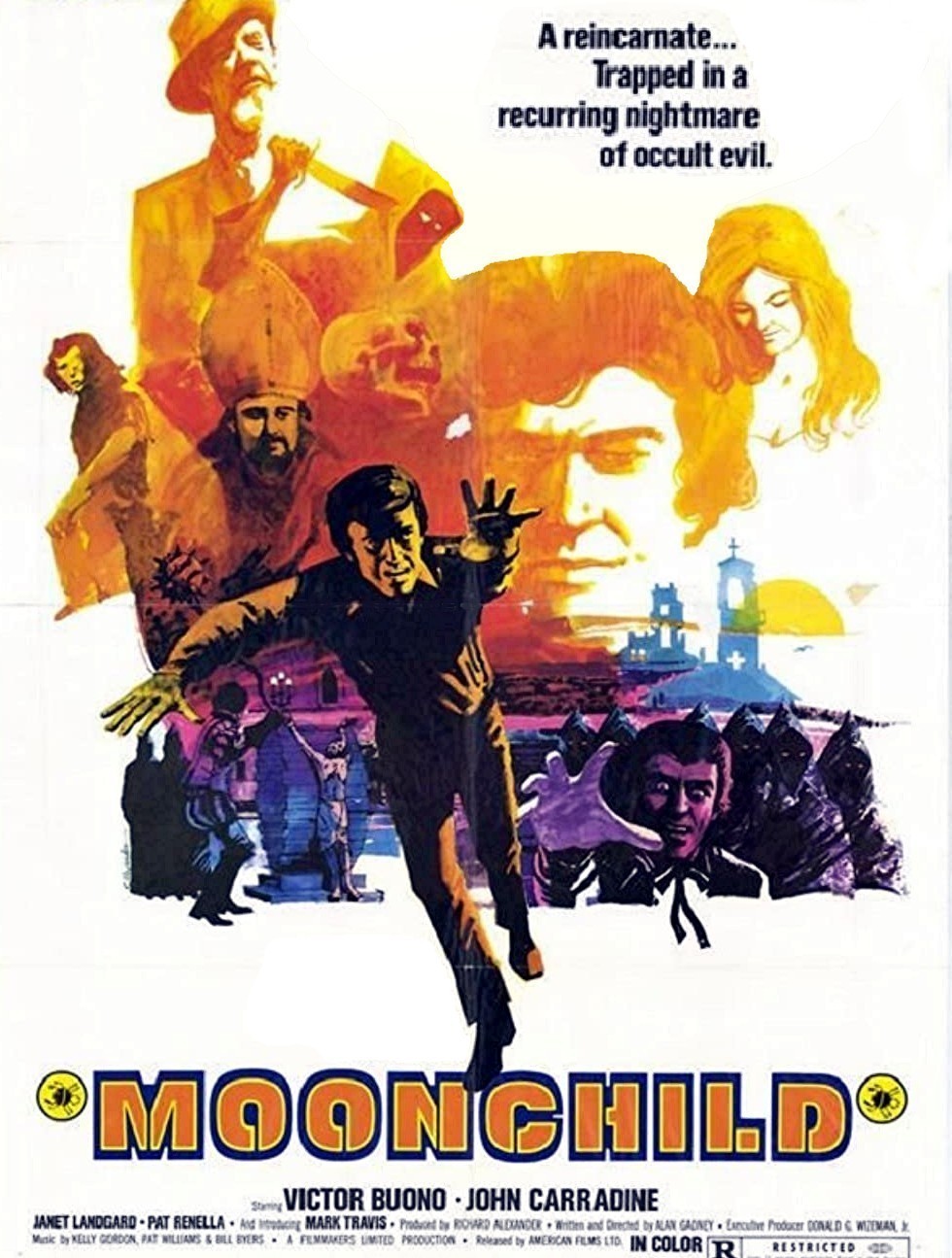
MOONCHILD

 
Publicity poster for Moonchild (© Alan Gadney/Filmmakers Ltd – reproduced here on a strictly non-commercial Fair Use basis for educational/review purposes only)

On 19 May 2022 I watched, and then last night rewatched, one of the strangest films that I have ever seen (and that's saying something for me!). Not to be confused with the werewolf movie of the same title released two years earlier (not that it could ever be confused with any other movie, shared title or otherwise, frankly!), this trippy, quintessentially '70s fantasy confection of great visual beauty but insuperably abstruse content is Moonchild.

Directed and written by Alan Gadney, filmed by him in 1971, and given a limited commercial release by Filmmakers Ltd in 1974 (during which its somewhat melodramatic publicity marketed it as a horror movie, which I don't consider it to be at all), Moonchild actually originated as a university student film, a project produced and submitted by Gadney for his Masters degree thesis at the University of Southern California. I'd previously read a fair amount about Moonchild before finally watching it, which was just as well, because for much of its length its plot is by no means evident, and even when events ultimately seem more lucid, it is by no means certain that they actually are. This presumably explains why I have read several different interpretations of the storyline, but here is mine.

Moonchild opens with an art student (played by Mark Travis), whose name is eventually revealed to be Gavalin (spelling?) and whose zodiac birth sign is Cancer (with Moonchild being a name often applied to Cancerians, hence the memorable title of this movie) painting on canvas a former Christian mission, now converted into a desert hotel but retaining its very imposing original architectural beauty. While painting, he is approached by an amicable but decidedly eccentric old man (John Carradine) who introduces himself as a poet and Walker of the World, or Mr Walker for short. After giving the student some ungratefully-received advice regarding his artwork, Walker suggests that they visit the mission so that the student can see its impressive appearance at close hand.

When they enter it, however, they are swiftly confronted by the hotel's very severe and decidedly unfriendly Manager (Pat Renella), who coerces the student into booking in as a guest, with Walker also booking in. The student is allocated a room whose number is 7 (which is later seen to have especial significance).

The student soon discovers that the hotel is populated by a host of bizarre, highly mysterious, secretive persons. These include a hunchbacked simpleton named Homunculus (Frank Corsentino) who serves as a lackey (and is one of the very few characters in this film to sport an actual name); a shrewish, vituperative housekeeper/maid (Marie Denn); and a good-natured, ancient-looking man who turns out to be an alchemist (William Challee) and may have created Homunculus. Most distinctive of all, however, is the Maitre D' (Victor Buono), who is a religious zealot of volcanic temperament, liable to erupt at any moment, especially when confronting the Manager, with whom he has a decidedly inimical emotional relationship. There is also an enigmatic young woman (Janet Landgard) who appears fleetingly, but whenever she is pursued by Travis, who experiences vivid flashbacks featuring the two of them in scenes of romance and sexual passion, she somehow disappears.

The student also experiences other flashbacks, in which he is a soldier and various other persons, as well as visualizing an ecclesiastical inquisition attended by red-garbed monks, plus the maid as a fanatical prosecutor, and the Maitre D' as the Grand Inqusitor, with the student and the alchemist on trial for heresy. It is here that the student – and the movie's audience – finally learns that his name is Gavalin (he had somehow managed to forget it until then). Walker is also present, recording the proceedings but also attempting to plead the student's case, only to be harshly rebuked by the Inquisitor for interceding on the latter's behalf instead of confining himself to recording the trial.

These flashbacks appear repeatedly throughout the movie, interspersed between scenes of the student at the hotel, and can be quite disorienting due to their abrupt appearances and mystifying content – until, at last, all is revealed…or is it?

Apparently, the student is trapped inside some kind of reincarnation cycle, and so too within his cycle are all of the persons at the hotel. Every 25 years, he finds himself back at the hotel, from which he duly escapes, but is soon killed, and is then reborn, over and over again, down through time, with his present life being his seventh – hence the significance of his hotel room's number. Only when his sins are purged from his soul can the cycle end – and only then will he find salvation and peace, as too will all of those trapped alongside him within his cycle. According to one review of this movie that I've read, in his first, original life the student was himself a killer, a murderer, but I personally saw no firm evidence for this in the movie, unless the reviewer was referring to the past life in which the student was a soldier?

In addition, it appears that the Maire D' and the Manager are fighting one another for the student's soul, the former upon the side of good, the latter upon the side of evil (though again I've read reviews claiming that the Maitre D' represents evil). In addition, the alchemist is denounced as a heretic because as an embryonic scientist he challenges religious orthodoxy, and the student's interest in his activities brings him into conflict with the Maitre D' too, as does his fervour for the elusive young woman, who personifies lust. And through it all, Walker records it all, and speaks in riddles, as does everyone else, for that matter, for much of the movie's length.

Finally, in the movie's eventful climax, the student breaks free of the hotel, escaping into the hills with the alchemist, who informs him that he has fled further this time than in any previous life (meaning that he has shed more sins this time?) – but the Manager is in hot, murderous pursuit! Moreover, as the reincarnation theme of the movie has by now been revealed to its audience by the characters, it's no spoiler to say that because the student has still not attained a state of total purity, he does not elude the Manager.

Instead, inevitably, the student meets his end yet again – only for the final scene to see him very much alive outside the mission, just like he was at the beginning of the movie, but this time equipped not with a canvas and easel to capture its appearance but with a movie camera instead, confirming that time (and attendant technology) has advanced quite considerably (another quarter-century) since his previous arrival there. And who should walk up and begin talking to him again? None other than Mr Walker, of course – because the student's reincarnation cycle has begun once more. But will his eighth life end in salvation for him at last? The movie has reached its end, so we never find out.

The only movie that I've ever seen which in any way reminds me of Moonchild is Malpertuis (click here to read my review of it). Both are dark fantasies infused with an almost tangibly malign atmosphere, peopled by an unfathomable company of grotesque characters, and ensconced within an otherworldly, preternatural setting ostensibly contained within our reality yet effectively delineated from it, which cycles incessantly. Indeed, some reviewers consider Moonchild to be a New Age-inspired allegory for the grand circle of life that drives our entire planet and everything that exists within it.

Best acting performance for me in Moonchild is definitely Carradine's, endowing the twinkly-eyed and somewhat loquacious Walker with the necessary mystique and verbal dexterity to yield a convincing, ever-interesting 'Keeper of Words' (one of his own description of himself). And the much-missed Victor Buono could always be relied upon to give his customary masterclass in delightfully hammy, unrestrained over-acting, with his OTT Maitre D' virtually chewing the scenery during his hyper-histrionic theological outbursts against the Manager, the student, and anyone else he happens to encounter!

The sumptuous scenes inside the mission/hotel and its architecturally spectacular exterior were reputedly filmed at the Riverside Hotel in California, And apart from a pervasive greenish lunar tinge most prominent in scenes of the student fleeing through never-ending subterranean tunnels and passages within the hotel's claustrophobic foundations from pursuing figures in sinister black robes and hoods with unseen faces and undetermined motives, the colours inside the hotel are vibrant and very diverse. As for its music, this is unequivocally late 1960s/early 1970s in style, as epitomized by its haunting, psychedelic opening theme song.

Some reviewers have variously written off Moonchild as pretentious unmitigated nonsense or impenetrable art-house folderol, and it may have been its overall rejection by audiences and critics alike at the time of its release that resulted in Gadney becoming a cinematic one-hit wonder, inasmuch as Moonchild is the first and only movie that he ever directed. If so, this is a great shame, because notwithstanding its baffling plot, I personally found Moonchild to be an immensely engrossing albeit incredibly surreal fantasy, beautifully filmed and thoroughly captivating, and I can only wonder what extraordinary movies Gadney would certainly have gone on to direct had he stayed in the world of film-making, refining his creativity and expanding his directorial experience.

I also wonder how a mere student producing a movie simply as a university project was able to enlist such a starry cast as John Carradine, Victor Buono, and William Challee. Yet like so much else concerning Moonchild, it seems unlikely that we shall ever know the answer to this mystery.

Moonchild may not be for everyone, but if like me you enjoy arcane Gothic fantasies with caliginous plots set in exquisite surroundings, then I definitely encourage you to give this undeniably weird but unjustly neglected masterpiece of the macabre a viewing – especially as if you click here you can currently watch the entire movie free of charge on YouTube.

To view a complete chronological listing of all of my Shuker In MovieLand blog's other film reviews and articles (each one instantly accessible via a direct clickable link), please click HERE, and please click HERE to view a complete fully-clickable alphabetical listing of them.

 
The student (Mark Travis) and the Maitre D' (Victor Buono) (© Alan Gadney/Filmmakers Ltd – reproduced here on a strictly non-commercial Fair Use basis for educational/review purposes only).


Wednesday, February 1, 2023

THE HOWLING - #3 IN A TERRIFYING TRIO OF CLASSIC HORROR FILMS FINALLY TICKED OFF ON MY 'MUST-SEE' MOVIES LIST

 
German publicity poster for The Howling (© Joe Dante/International Film Investors/Wescom Productions/Embassy Pictures/Studiocanal – reproduced here on a strictly non-commercial Fair use basis for educational/review purposes only)

During the past few days at Shuker In MovieLand I've reviewed The Silence of the Lambs (click here to read my review) and A Nightmare On Elm Street (click here to read my review) – two members of the terrifying trio of classic horror movies only very belatedly viewed by me recently. So now it's time for me to post a review of the third member of that trio – and here it is.

My movie watch on 15 August 2022, just a week after viewing A Nightmare On Elm Street for the first time, was yet another classic monster movie never previously seen by me. This one was being shown on the UK TV channel Legend – I sometimes wonder why I buy movie DVDs, as I seem to spend so much time watching movies on Legend!

Directed by Joe Dante, loosely inspired by the eponymous 1977 novel by Gary Brandner, and released in 1981 by Embassy Pictures, this horror film was the hugely influential 1981 werewolf movie The Howling. [But Howling IV: The Original Nightmare, 1988, is a more faithful cinematic version of Brandner's novel.]

After narrowly escaping being murdered by a serial killer stalker named Eddie Quist (played by Robert Picardo in his big-screen debut), TV anchorwoman Karen White (Dee Wallace) and her husband Bill (Christopher Stone) follow the advice of Karen's therapist Dr George Waggner (Patrick Macnee) and book themselves into a remote resort deep in the countryside for Karen's traumatised mental state to recuperate.

Not such a good idea, however, because they soon discover to their horror that in reality it comprises a secret colony of murderous lycanthropes (one of whom, Erle Kenton, is played by John Carradine), whose leader is none other than said therapist, and whose members include none other than said serial killer stalker! Oops! Incidentally, when you watch this movie's shock ending, keep watching – because that's when you see its second, even more shocking real ending!

Despite being an early 1980s movie, The Howling boasts special effects by Rob Bottin creating the werewolf transformation scenes that are still just as jaw-droppingly astonishing (as well as jaw-extendingly effective!) today as they were truly ground-breaking state-of-the-art back in those distant pre-CGI times over 40 years ago. And if you don't believe me, just click here to view the most famous, dramatic example, featuring killer Eddie transforming after confronting a petrified Karen. Equally famous, but not for the same reason, conversely, is the decidedly different lycanthrope make-up displayed by a certain other character – less werewolf, more wookie?

Originally, special make-up effects wizard Rick Baker was slotted to create this movie's transformation scenes, but as an associate of director John Landis he opted to perform this function for Landis's own in-progress werewolf movie instead, An American Werewolf In London, released just five months after The Howling, so his assistant Bottin stepped into the breach for the latter movie. Worth noting is these two movies' very different depiction of the transformed werewolf morphology – quadrupedal like a wolf in the former, bipedal like a human in the latter. Interestingly, however, after having already designed the bipedal version for The Howling before leaving to work on An American Werewolf In London and being replaced by Bottin, Baker planned to do the same in that movie too, but was overruled by Landis, who wanted a quadrupedal 'hell hound' look for it.

Chronologically speaking, The Howling (March 1981) led a veritable pack of high-profile lycanthrope-themed movies released during the 1980s. These others include: Wolfen (July 1981, reviewed by me here), An American Werewolf in London (August 1981), Full Moon High (October 1981), The Company of Wolves (September 1984), Teen Wolf (23 August 1985), Howling II (28 August 1985), Silver Bullet (October 1985), Howling III (13 November 1987), and Teen Wolf Too (20 November 1987. It is also notable for the plethora of wolf-related in-jokes and sight-gags included; for the naming of several characters after horror-movie directors (plus the inclusion of famous horror-movie director Roger Corman in a cameo role); and for being the first English-language werewolf movie in colour to contain any female werewolves.

I was sufficiently impressed by The Howling after watching it on Legend to purchase its 2-disc Special Edition DVD, as well as some of the several other entries in its long-running movie franchise (currently standing at eight movies). Among the ones that I purchased is Howling III: The Marsupials (1987), which, as you'd surmise correctly from its title, is set in Australia and features shape-shifting predators with pouches, but is not linked in terms of its plot or characters to other films in this series. And as a longstanding lover of movies featuring mysterious carnivals and circuses, I also bought Howling VI: The Freaks (1991).

Be sure to click here to watch on YouTube an official trailer for The Howling, providing a tantalizing glimpse of the therianthropic thrills that it has in store for its viewers.

To view a complete chronological listing of all of my Shuker In MovieLand blog's other film reviews and articles (each one instantly accessible via a direct clickable link), please click HERE, and please click HERE to view a complete fully-clickable alphabetical listing of them.

 
My 2-disc Special Edition DVD of The Howling (© Joe Dante/International Film Investors/Wescom Productions/Embassy Pictures/Studiocanal – reproduced here on a strictly non-commercial Fair use basis for educational/review purposes only)


Thursday, June 30, 2022

THE MOUSE AND HIS CHILD

 
The UK video version of The Mouse and His Child (© Charles Swenson/Fred Wolf/Murakami-Wolf Productions/Sanrio/DeFaria-Lockhart-Sanrio – reproduced here on a strictly non-commercial Fair Use basis for educational/review purposes only)

A few weeks ago, I finally watched the animated movie version of one of my favourite childhood novels, Russell Hoban's delightful 1967 fantasy, The Mouse and His Child.

Directed by Charles Swenson and Fred Wolf, and released in 1977 by the Japanese company Sanrio, The Mouse and His Child stays fairly faithful throughout to its literary original, perhaps a little too faithful, in fact, as I'll explain shortly.

As in the novel, the movie focuses upon a clockwork toy consisting of a father mouse and his child with hands connected who dance together when wound up. At the movie's beginning, they are housed safely inside a cozy toyshop, waiting to be purchased alongside many other toys there, as Christmas grows very near, but inadvertently they find themselves abandoned upon the snowy street outside.

They are initially rescued by a kindly tramp (voiced by John Carradine) before being seized by an evil rat named Manny (Peter Ustinov), who enslaves clockwork toys to do his every bidding, and callously breaks up any that fail to meet his requirements. Thanks to a prophecy-spouting frog (Andy Devine), however, the mouse and his child succeed in escaping the rat's clutches, but he pursues them unrelentingly as they engage upon a series of exciting adventures, meeting all manner of distinctive creatures in their quest to become self-winding toys. Other famous names in this movie's voice cast include Sally Kellerman as a seal and Cloris Leachman as Euterpe the parrot.

In the original novel, Hoban's characters are given to all manner of philosophizing, often at length, which is why, famously, this book is as popular among adults as it is among children. That same tendency is reiterated in this film version, but unfortunately with far less success.

For whereas a book by its very nature is primarily verbal in format, an animated movie (or any other kind, for that matter) is primarily visual, and in this particular movie the philosophizing comes across as being not so much verbal as verbose, slowing down the action on an all-too-frequent basis. Unlike the novel, moreover, this movie version of it is aimed fair and square at children, so the philosophizing is likely not only to go completely over the heads of much of its intended audience but also to bore them rigid.

To be frank, even I found it tedious and heavy-going at times, despite my having enjoyed it all those years ago when reading the novel. Sometimes the written word simply does not translate well on screen, and this movie, sadly, is definitely a prime example of that. It is nothing if not intriguing, therefore, that Hoban is said to have disliked how, in his opinion, the novel's philosophizing was watered down in the movie! More watering, less wording, is what I say!

The animation is of a very basic nature – Disneyesque, it ain't – but nonetheless is serviceable for a movie that has a quaint, whimsical charm in spite of its prolix proclivity, so if you get the chance to view this film, do so.

Indeed, at the time of writing this review, The Mouse and His Child can be watched in its entirety free of charge on YouTube, so click here if you'd like to do so.

To view a complete chronological listing of all of my Shuker In MovieLand blog's other film reviews and articles (each one instantly accessible via a direct clickable link), please click HERE, and please click HERE to view a complete fully-clickable alphabetical listing of them.