Publicity
poster for Oz: A Rock 'N' Roll Rock Movie
(aka 20th Century Oz) (©
Chris Löfvén/Australian Film Commission/B.E.F. Film Distributors in association
with Count Features Inc/Greater Union – reproduced here on a strictly
non-commercial Fair Use basis for educational/review purposes only)
First published in 1900, The Wonderful Wizard of Oz (often
shortened to The Wizard of Oz in
later reprints) by L. Frank Baum is one of the most popular children's fantasy
novels of all time. Not surprisingly, therefore, it has inspired a large number
– and a very wide range – of movie adaptations. As a great fan of the novel and
its many sequels penned by Baum and others, I own a fair few of these movies.
They include: the legendary eponymous
1939 version (starring Judy Garland as Dorothy); Journey Back to Oz (released in 1971, a colourful animated
adaptation of Baum's second Oz novel and notable for Garland's daughter Liza
Minnelli voicing Dorothy); The Wiz
(1978, starring Diana Ross and Michael Jackson, based upon the Broadway stage musical
of the same title); Disney's Return to Oz
(1985, featuring one of the darkest, creepiest opening scenes that I've ever seen
in an ostensibly child-friendly movie); Lion
of Oz (2000, a prequel to Baum's original first Oz novel, and based upon
one penned by his great-grandson Roger S. Baum); After the Wizard (2012, an unofficial modern-day sequel of sorts to
the original classic story); Oz the Great
and Powerful (2013, providing an origin story for the Wizard, played by
James Franco); Legends of Oz: Dorothy's
Return (2014, an American/Indian 3-D animated musical version of an Oz
novel once again penned by Roger S. Baum); and Guardians of Oz (2015, a Mexican/Indian computer-animated movie
featuring new characters); plus the 2007 TV mini-series Tin Man and the 2011 TV mini-series The Witches of Oz (this latter being re-released a year later in
edited form as a movie, entitled Dorothy
and the Witches of Oz).
As would be expected, all of these Oz
treatments contain a profusion of magic – after all, where would any movie
inspired by Baum's classic novels be without magic? Fittingly enough, and as I
discovered just a few days ago, the answer to that question is none other than
Australia, which is commonly colloquially dubbed Oz for short – because on 31
October 2021 I watched a nowadays obscure yet thoroughly fascinating Aussie
movie hitherto unknown to me whose basic premise was that of the original Wizard
of Oz, yet whose storyline displayed a singular and very conspicuous absence of
magic. And the title of this Oz from Oz movie? In fact, it has two – Oz: A Rock 'N' Roll Road Movie (frequently
abbreviated to Oz), and also, under
which it was released in the USA, 20th
Century Oz. At only 90 minutes long, this latter version is shorter than
the original 103-min Australian release (which is what I watched), yet it was much more successful at the
box office.
Directed, written, and co-produced by
Chris Löfvén, and released in 1976 by B.E.F. Film Distributors in association with Count Features Inc/Greater Union, Oz is
fundamentally a rock musical (Australia's first, with its music written by Ross
Wilson) and also a road movie, with both Dorothy's real world and her alternate reality/fantasy world set entirely in what was then contemporary Australia. Moreover, it provided
early roles for a number of performers who went on to achieve notable success
in the Australian movie world and beyond, most especially Bruce Spence
(appearing in various films within the Mad
Max, Lord of the Rings, Star Wars, Narnia, and Pirates of the
Caribbean franchises).
SPOILER
ALERT: I
don't normally present the entire plot of a movie when reviewing it, but I'm
doing so here in order to highlight the many clever twists and parallels
between Oz and more conventional, traditional
interpretations of Baum's original 1900 novel. So if you don't want to discover
how it plays out, read no further.
Joy
Dunstan as Dorothy and Robin Ramsay as Glynn, in Oz: A Rock 'N' Roll Rock Movie (aka 20th Century Oz) (© Chris Löfvén/Australian Film
Commission/B.E.F. Film Distributors in association with Count Features
Inc/Greater Union – reproduced here on a strictly non-commercial Fair Use basis
for educational/review purposes only)
The movie begins one evening with teenage
groupie Dorothy (played by Joy Dunstan) visiting in her home town a concert by
a decidedly underwhelming four-man rock band called Wally and the Falcons, yet
whose lead singer Wally (Graham Matters) in particular has profound delusions
of grandeur as far as his own less than tuneful talent is concerned. After the
concert is over, Dorothy hitches a ride with the band in their tour bus, having
become attracted to the handsome if hubristic Wally, but the bus's driver becomes
distracted, causing it to crash and Dorothy to be knocked unconscious.
When Dorothy regains consciousness and
opens her eyes, she is surprised to find that it is broad daylight and even
more so to discover that she has somehow been transported into a wholly
unfamiliar rural Aussie landscape in the middle of nowhere. After wandering
aimlessly for a while, she reaches a largely deserted, boarded-up ghost town, but
standing somewhat incongruously at the centre of it is a block of smart new
shops. One of these, a boutique named The Good Fairy, has a very eyecatching
pair of sparkling ruby shoes on display in the window, so Dorothy ventures
inside for a closer look at them. Sashaying forth from the back room is the
proprietor of The Good Fairy – an elegantly-dressed, immaculately-coiffed,
overtly camp man of indeterminate age (Robin Ramsay), who introduces himself as
Glynn and appears kindly disposed towards her – truly a friend of Dorothy, one
might say...
As you'll have no doubt guessed by now, The
Good Fairy boutique's proprietor Glynn is this movie's counterpart to the
classic Baum story's Glinda the Good Witch. Moreover, Glynn reveals to Dorothy
that she inadvertently killed a local hoodlum upon arriving here when the tour
bus crashed into him, and he rewards her on behalf of the entire grateful
community by gifting her the ruby shoes. Who should then show up but the
deceased hoodlum's equally unpleasant but still very much alive truckie brother
(played by Ned Kelly, who was also the road manager for Aussie heavy rock band
AC/DC at that time), threatening revenge, but Glynn soon turns him out of his
boutique. The two hoodlum brothers clearly represent the original story's Wicked
Witches of the East and West respectively.
Seeing how alarmed she is, Glynn then
informs Dorothy comfortingly if vaguely that the ruby shoes will keep her safe,
and when Dorothy sees a poster inside the boutique of an androgynous glam rock
star named The Wizard (who despite all of his Bowie-like make-up looks very
like Wally) and learns from Glynn that he will be performing tonight in the
city at one final concert before retiring, she decides to travel there and see
him – but has no idea of the route. However, Glynn assures her that as long as
she follows the highway, it will take her to the city (echoing Glinda's advise
to Dorothy in the original novel to follow the Yellow-Brick Road in order to
reach the Emerald City where she'll find the Wizard of Oz), so Dorothy sets off
straight away.

Bruce
Spence as Blondie the affable surfie, in Oz:
A Rock 'N' Roll Rock Movie (aka 20th
Century Oz) (© Chris Löfvén/Australian Film Commission/B.E.F. Film
Distributors in association with Count Features Inc/Greater Union – reproduced
here on a strictly non-commercial Fair Use basis for educational/review
purposes only)
After a while she encounters a tall, slim,
blonde-haired surfie (Aussie-speak for a surfer, and played by Bruce Spence),
whose car has suffered a puncture. However, he has no idea how to use his car's
jack to hoist it up in order that he can change the tyre. So Dorothy does it
for him, and in gratitude he promises to drive her to the city. Referred to by
Dorothy and all of the other characters in this movie simply as Blondie, he
proves a very affable and loyal friend to Dorothy, albeit decidedly
unencumbered by intelligence. Coupled with his spindly frame, does this sound
familiar within the standard Oz plot? Yes indeed, because Blondie is Oz's very own Scarecrow simulacrum – lanky,
friendly, and very faithful, but in sore need of some brains.
Eventually, the gauge in Blondie's car
shows that there is little fuel left in the tank, so they stop at a fuel and
vehicle repairs garage, to fill up with petrol, and Greaseball, a car mechanic
(played by the aptly-named Michael Carman) working there, takes a particular
shine to Dorothy. So when he discovers from Blondie that she is not his
girlfriend but is nonetheless unable to persuade Blondie to let him take her
the rest of the way to the city, with heartless and ruthless guile Greaseball
surreptitiously sabotages the unsuspecting, unassuming surfer's car, so that
Dorothy has no option but to accept his offer to drive her instead.
At first, I missed the clues as to which
character from the original novel Greaseball represented in this modern-day
movie version, but then the proverbial penny dropped with a loud clang inside
my mind. Here was a guy who albeit metaphorically was totally heartless, and as
a mechanic was literally surrounded by tin and other metals in the form of the
cars that he repaired each day – in short, Greaseball was the Tin Man, needing in
emotional terms a heart!
Meanwhile, a biker (Gary Waddell) – or
bikie, as Aussies call them – rides in, also seeking petrol. He calls himself
Killer and puts on a very aggressive, arrogant display to everyone there, until
Dorothy becomes so annoyed by his obnoxious behaviour and constant swearing (a telling reminder that this is no children's movie) that she slaps his face – only
to be startled when he instantly breaks down and cries. Killer's tough-guy
image is nothing but a front, a façade – in reality, as he shamefacedly
confesses to Dorothy, he is so cowardly that he has even been expelled from his
motorbike gang, The Lions Motorcycle Club, for not being rough and tough
enough. All the clues are there to work out which classic Wizard of Oz
character Killer represents – his fake aggression masking his real cowardice,
and his status as a (former) member of The Lions readily identify him as Oz's answer to the Cowardly Lion.

Gary
Waddell as Killer, the tough-talking but not so brave-acting Aussie bikie, in Oz: A Rock 'N' Roll Rock Movie (aka 20th Century Oz) (© Chris
Löfvén/Australian Film Commission/B.E.F. Film Distributors in association with
Count Features Inc/Greater Union – reproduced here on a strictly non-commercial
Fair Use basis for educational/review purposes only)
Leaving Blondie behind, tinkering
futilely with his car's scuppered engine and assisted in his aimless endeavours
by Killer, Greaseball and Dorothy drive off, but ironically it's not long
before Greaseball's own car breaks down, so he in turn is abandoned by Dorothy,
who begins walking down the highway once more, wondering if she will ever reach
the city and see the Wizard. Happily, however, help is at hand in the shape of
Killer, who catches up with her on his motorbike and takes her with him as his
pillion passenger as he heads cityward. At much the same time, who should turn
up to rescue Greaseball but Blondie, whose car had been repaired by Killer back
at the garage. So Blondie and Greaseball now drive on in search of Dorothy, but
unbeknownst to them, Dorothy is also being steadfastly pursued in his truck by
the vengeful Wicked Truckie of the West.
Eventually Killer and Dorothy reach the
coast, where they rest for a while, with Dorothy, lulled by the hypnotic sound
of the lapping tide, falling into a deep sleep (Oz's Aussie take on the original novel's slumber-inducing poppy
fields). Blondie and Greaseball then arrive, but Dorothy sleeps on, unaware of
their presence. Greaseball soon frightens Killer away and sabotages his
motorbike, but while he and Blondie are talking, Glynn pulls up in a snazzy
Mustang, spots Dorothy lying asleep on the sand, promptly wakes her up, and
then drives her all the way to the city.
Once there, it doesn't take Dorothy long
to locate where the Wizard's concert is about to be held and to coerce the
venue's doorman to let her in without a ticket. She also encounters her loyal
trio of friends there, who have just arrived, but the doorman refuses to let
them in as well, so they wait outside for her until the concert ends. Dorothy is
totally captivated by the dazzling spectacle of the Wizard's dynamic on-stage
performance, and when she finally re-emerges, she tells her friends that she
wants to track down the Wizard's hotel so that she can inveigle herself into
his room. But before she is able to do so, Truckie sends a gang of thugs
(representing the novel's flying monkeys), who beat up her friends and kidnap
Dorothy herself, handing her to Truckie waiting in his vehicle. He rides off
with her to an empty house, where he locks himself with her inside a room, and
in no uncertain terms tells her what he wants from her, ordering her to strip…
Happily, having recovered from their
beating, Dorothy's friends set off in hot pursuit, and spot Truckie's vehicle
outside the house. Stepping cautiously inside, they hear Truckie threatening
Dorothy, and when she screams they burst into the room, distracting Truckie and
allowing Dorothy to place a well-aimed kick in his tucker box. And just for
good measure, Killer surprises himself as well as all of the others by
courageously felling Truckie with a single punch, after which they get back
into Blondie's car and set off to see the Wizard, the wonderful Wizard of Oz
(whoops, sorry, wrong movie!). But where can he be? To their surprise, it is Blondie who very
cleverly comes up with the correct answer. As the biggest star in the city, the
Wizard must surely be staying in its biggest hotel, so that's where they drive
to. And while en route, Greaseball shows a hitherto-absent degree of genuine, warm-hearted
concern for Dorothy and her well-being. Needless to say, this key scene mirrors
the version in the original novel where the Cowardly Lion, Scarecrow, and Tin
Man discover that they actually already possess the qualities that they were
hoping to obtain from the Wizard of Oz.
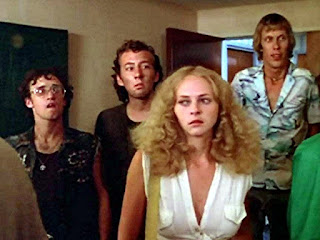
From
left: Gary Waddell as Killer, Michael Carman as Greaseball, Joy Dunstan as
Dorothy, and Bruce Spence as Blondie, in Oz:
A Rock 'N' Roll Rock Movie (aka 20th
Century Oz) (© Chris Löfvén/Australian Film Commission/B.E.F. Film
Distributors in association with Count Features Inc/Greater Union – reproduced
here on a strictly non-commercial Fair Use basis for educational/review
purposes only)
Finding the hotel and the Wizard's
luxurious suite where he is throwing a lavish post-concert party for the decadent
glitterati, Dorothy and her friends reluctantly join in, hoping to encounter
him among the bohemian throng. Finally Dorothy locates his private inner
sanctum, which she swiftly enters, stepping into the shower room and at long
last into the arms of the showering Wizard, willingly disrobing to join and
submit to him. However, her happiness is short-lived, because she swiftly
discovers to her shock and sadness that he is a shallow untalented sham, a whiny
humbug hiding behind special visual effects and amplified recorded sound, and interested
only in himself and fame. To make matters even worse, Glynn abruptly turns up,
reveals that he is the Wizard's agent, and informs him that a leading
showbusiness reporter is clamouring to interview him for a major feature.
Then, in what at least for me was a
totally unexpected, shock departure from what until now had been a markedly
close parallel in basic plot between the original novel and this movie (lack of
magic notwithstanding), Glynn turns to Dorothy and informs her coldly, curtly,
and callously (far removed indeed from Glinda's kindly behaviour to Dorothy
throughout the novel) that whereas there are thousands of her out there, there
is only one Wizard. Glynn then departs with him to meet the press, leaving a
still-dripping, towel-wrapped Dorothy behind in the Wizard's room, all alone,
thoroughly dejected, disillusioned, and all too clearly unwanted by him.
Happily, Dorothy's three friends find the
Wizard's sanctum, enter the shower room, and comfort her. But when they step
outside to give her some privacy while she dresses, in a sudden fit of rage Dorothy
picks up her ruby shoes and hurls them at a large mirror on the wall,
shattering it, so she closes her eyes – and when she opens them again, it is
evening and she is lying on the ground next to the tour bus of the rock band,
whose members are all anxiously bending over her, but delighted when they
realize that she is unharmed and conscious.
Looking up at them, Dorothy realizes how
very closely they all resemble the characters she'd encountered in her fantasy
world – the bass player as Blondie, the drummer as Greaseball, the guitarist as
Killer, and, above all, Wally the lead singer as the Wizard. But would he prove
to be more genuine to her than the Wizard had been? They all get back on board
the bus and drive away – so I guess we'll never know!
Graham
Matters as the Wizard, in Oz: A Rock 'N'
Roll Rock Movie (aka 20th
Century Oz) (© Chris Löfvén/Australian Film Commission/B.E.F. Film
Distributors in association with Count Features Inc/Greater Union – reproduced
here on a strictly non-commercial Fair Use basis for educational/review
purposes only)
The sheer quirkiness of Oz is very
engaging, and it's certainly fun to watch its variously comedic and sly
interpretations and interpolations of so many of the beloved characters and
components of Baum's original within a contemporary Australian scenario. Having
said that, some worked better for me than others.
Spence's 'dumb blonde' surfer take upon
the original Scarecrow character works very well, as does Waddell's faux-feisty
biker as this movie's Cowardly Lion counterpart (though his language was at
times unnecessarily coarse). Conversely, Greaseball's less literal, much more
metaphorical Tin Man representation is not so successful for me, although obviously
I recognise that a genuine heart-lacking tin-encased human could not exist in
an unenchanted modern-day setting. And Dunstan's supposedly 16-year-old (but
visibly older), sexually-aware Dorothy contrasts uneasily for me with the much
younger, wide-eyed and innocent, traditional Dorothy as portrayed not only in
the Oz novels but also in the vast majority of big-screen presentations; then
again, within the much more mature context of this particular movie treatment,
the latter version of Dorothy would be wholly unsuitable.
As for its unexpected transmutation of enchanted Glinda
into effeminate Glynn: we have to remember that Oz was made almost 50 years ago, during the pre-PC mid-1970s, when
camp characters were regularly albeit regrettably utilized largely as light relief
or figures of fun in movies and TV shows. However, as noted earlier, I remain
perplexed by why Glynn suddenly turns upon Dorothy in such a verbally vicious
manner at Oz's climax, an action
entirely and inexplicably at odds not only with the original novel's story but
also with his own previously kind behaviour towards her in this film, and
serving no real purpose anyway. After all, the Wizard had already betrayed his own
vacuously vapid, self-obsessed nature to Dorothy before Glenn had arrived in his shower
room and found them together there, so Glynn's support for him and nastiness toward
Dorothy seem wholly uncalled for – unless of course I should be taking into
account here that by being Good Fairy Glynn rather than Good Witch Glinda, his
allegiance is more likely to be for the Wizard than for Dorothy? Who knows?
What I do know is that Oz is a very engrossing, thoroughly entertaining
movie – very 1970s, extremely Australian, and wholly original in its execution,
with for the most part a collection of likeable characters who epitomize the
value of friends and friendship in precisely the way that their original
equivalents did in Baum's book. And above all else, Oz is an excellent example of how magical in every sense a movie inspired
by a magical book but lacking any actual magic itself can nonetheless be. But don't take my word for it - click here to view an official trailer for this Aussie Oz feature film and make up your own mind.
To view a complete chronological listing of all of my
Shuker In MovieLand blog's other film reviews and articles (each one instantly
accessible via a direct clickable link), please click HERE, and please click HERE to view a complete fully-clickable
alphabetical listing of them.
Publicity
poster for 20th Century Oz –
the shorter American version of Oz: A
Rock 'N' Roll Rock Movie (© Chris Löfvén/Australian Film Commission/B.E.F.
Film Distributors in association with Count Features Inc /Greater Union –
reproduced here on a strictly non-commercial Fair Use basis for
educational/review purposes only)

.jpg)


