Dr Karl Shuker's Official Website - http://www.karlshuker.com/index.htm

IMPORTANT:
To view a complete, regularly-updated listing of my Shuker In MovieLand blog's articles (each one instantly clickable), please click HERE!

IMPORTANT:

To view a complete, regularly-updated listing of my ShukerNature blog's articles (each one instantly clickable), please click HERE!

IMPORTANT:
To view a complete, regularly-updated listing of my RebelBikerDude's AI Biker Art's thematic text & picture galleties (each one instantly clickable), please click HERE!

IMPORTANT:
To view a complete, regularly-updated listing of my Starsteeds blog's poetry and other lyrical writings (each one instantly clickable), please click HERE!

IMPORTANT:
To view a complete, regularly-updated listing of my Eclectarium blog's articles (each one instantly clickable), please click HERE!


Search This Blog


Showing posts with label Roger Corman. Show all posts

Saturday, June 24, 2023

THE TWILIGHT PEOPLE

 
Front cover of my big box ex-rental VHS videocassette of The Twilight People (© Eddie Romero/Four Associates Ltd/New World Pictures/Dimension Pictures/Atlas Home Video/Les Edwards – reproduced here on a strictly non-commercial Fair Use basis for educational/review purposes only)

On 22 June 2023, my movie watch was my big box ex-rental VHS videocassette, only purchased recently, of a nowadays largely-forgotten Filipino-American monster/horror movie from the early 1970s entitled The Twilight People and loosely based upon the classic H.G. Wells science fiction novel The Island of Dr Moreau.

Directed by veteran Filipino film director Eddie Romero, who also co-wrote its screenplay, and released by Dimension Pictures in 1972, The Twilight People (for some unknown reason, the 'The' was omitted from its title in my video's front cover artwork – more about that iconic artwork later – but not from its on-screen title) opens with the underwater kidnapping of scuba diver Matt Farrell. The movie's hero, he is played by John Ashley, a major American heart-throb actor and rock'n'roll singer during the late 1950s, who also co-produced this movie alongside the likes of Roger Corman.

Farrell is swiftly rendered unconscious and subsequently wakes up bound to a bed aboard a boat taking him to a remote tropical Pacific island. This island is inhabited by a maverick Nobel laureate scientist named Dr Gordon (Charles Macaulay), his beautiful, highly alluring, but sexually naïve daughter Neva (Pat Woodell), Gordon's sadistic Nazi-ish henchman/assistant Steinman (Jan Merlin), and a retinue of staff including a squad of armed guards. Gordon has chosen to live here, in a palatial home-cum-laboratory, after his radical experiments and his theft of massive amounts of funding swiftly led to his exile from the scientific community.

 
Blu-Ray+DVD Combo version of The Twilight People – worth noting is that most of the beast people illustrated here do not appear in the movie! (© Eddie Romero/Four Associates Ltd/New World Pictures/Dimension Pictures – reproduced here on a strictly non-commercial Fair Use basis for educational/review purposes only)

Speaking about Gordon's experiments: this island also contains eight other individuals – a benighted octet of mostly abducted humans who have been converted against their will into grotesque bestial humanoids no longer entirely human but not entirely animal either, in Gordon's crazed quest to create a race of super-human beings. Many reviews of this movie state that there are five of these beast-humans, these twilight people, but this is incorrect. Yes, there are five principal ones, but three others make brief appearances too.

The five principal ones are: Ayesha, the snarling, spitting Panther Woman (none other than Pam Grier!); Kuzma, the gentle horned Antelope Man (Ken Metcalfe); Darmo, the winged Bat Man, who can indeed fly (Tony Gosalvez); Primo, the hooting, arm-swinging Ape Man (Kim Ramos); and Lupa, the decidedly hirsute, lycanthrope-looking Wolf Woman (Mona Morena).

Additionally, in one scene showing these beast-humans caged in an underground cave where Gordon keeps them all prisoners, a sixth one is also briefly seen with them, a shy plume-headed, silver-costumed woman resembling a kind of half-human, half-bird entity. And just after Farrell is brought onto the island, there is a brief scene featuring an escapee beast-man named Dorro whom Gordon is trying to recapture alive with the assistance of his armed guards, but with his usual malevolence Steinman cold-bloodedly shoots him dead. When the beast-man's dead body is seen in close-up, it is revealed to have the tusked face of a wild boar. As for the eighth one – let's just say for now that she holds a very special, unique status…

SPOILER ALERT – Because I have yet to discover a detailed plot description online for this movie, I am providing one here, so if you'd rather not know what to expect before watching it, read no further!

Anyway, back to Farrell, who is informed by Gordon once installed in the latter's home that on account of his exceptional intelligence, knowledge, and physical attributes, this veritable latter-day Renaissance Man is to be utilized to engender Gordon's planned super-race, with his mind, brain power, and fitness to be transferred into each one of them. No details are given as to how such transference will be achieved, but it seems evident that however it is accomplished, Farrell will not survive the procedure, becoming a scientific martyr for the common good of future humanity as far as Gordon is concerned.

Moreover, as Steinman takes great delight in telling him, thanks to the island being a good 300 miles away from any other land mass, and patrolled by Gordon's squad, Farrell has no chance of escaping. Nevertheless, Steinman encourages him to attempt it, brazenly admitting that he would love the chance to pursue Farrell and kill him – and that's not all. As the story progresses, it becomes exceedingly obvious that blonde, blue-eyed Steinman has the hots for handsome, muscular Farrell, something that Neva loses no time in telling Steinman, inciting his fury – but he's not the only one in the Farrell fan club.

For Neva herself is too – she has spent her whole life on the island with her father in the absence of her mother, so until now she has never experienced what it is like to fall in love – but after Farrell kisses her while she is examining him in her trained medical capacity, all her pent-up passion explodes, she realizes the madness of her father's experiments, and vows to save Farrell from her father's dastardly plans. So the two of them plan their escape together, but Neva insists that the beast people are released and taken with them too.

When Neva attempts to free them from their cages in the cave, however, the bird woman refuses to leave hers and come with them but the other five do, and led by Farrell and Neva they make their escape into the jungle via a secret tunnel leading there from the cave whose existence is known only to Neva and her father. To give them a head start, Neva has drugged Steinman, but eventually he awakens, and sets off on their trail with an armed posse of the island's guards. Farrell, meanwhile, has told Neva that he is the person Steinman will be pursuing most emphatically, in the fervent hope of killing him, so their best chance of success is if they split up. Farrell convinces Neva to take charge of the beast people while he follows a different route to the coast, where they can then all meet up. What he doesn't tell her, however, is that he plans to return to the house, kidnap her father, and force him to come along, using him a hostage should Steinman and his squad track him down.

The rest of the movie focuses upon Neva's trek through the jungle with the beast people, and the various trials and tribulations experienced by them en route to the coast. These include: the Panther Woman ambushing and killing some of Steinman's men before deciding to do the same to the Antelope Man before he is rescued by the Wolf Woman who is friends with him; the Ape Man attempting to rape Neva before being warded off by the others; the Bat Man soaring through the jungle in quite spectacular fashion (the movie's only major special effect, the beast people having been rendered as such by little more than face masks and fake hair); and a stand-off confrontation by them against Steinman and his men that results in the latter's temporary capture of Neva.

As for Farrell and Gordon: at one point during their own jungle journey, Farrell ties him to a tree while investigating some movement in nearby foliage, but when after finding nothing he returns to the tree, Gordon is gone, the ropes having been mysteriously cut. Farrell also hears a strange, eerie, semi-human voice warning him that Steinman's men are near, which they are, but again he cannot trace who – or what – has warned him. Meanwhile, the confrontation between Neva and the beast people with Steinman and his men leaves only Neva and the Bat Man still standing. All of the others have been shot dead or killed by the beast people, and with all of these except for the Bat Man having themselves been shot dead too.

 
The full cover of my big box ex-rental VHS videocassette of The Twilight People (© Eddie Romero/Four Associates Ltd/New World Pictures/Dimension Pictures/Atlas Home Video/Les Edwards – reproduced here on a strictly non-commercial Fair Use basis for educational/review purposes only)

Finally, we see Gordon returning to his home, taking some important files out of a cabinet and fleeing back down the secret tunnel into the jungle – only to be seized when he emerges by a hideous humanoid entity shrouded in leaves, its face little more than a bloodied skull. This proves to be the eighth beast person, who was the very first one that Gordon had created – and guess who it is?? Read my review above again, the clue to her identity is there…

Anyway, this entity – the same one who had previously cut his ropes and had also warned Farrell of Steinman's men – now slays Gordon, whose dead body is subsequently found by Neva and Farrell. Afterwards, they sit together looking over the island, the last two fully human people left alive on it, and as they do so the Bat Man suddenly flies over their heads and soars through the sky, out across the island towards the sea, and beyond. And that's it, all over, The End, albeit quite an anti-climactic one.

There is no doubt that even by the early 1970s standards of monster and horror movies, The Twilight People very much falls into this film genre's low-budget B-movie category. Nonetheless, I found it to be immensely entertaining, and it very effectively elicits genuine sympathy for the beast people in light of their horrendous plight, while Macaulay's sinister mad scientist has more than a little of the Blofeld Bond villain about him. And speaking of villains, Steinman is evil incarnate, whose eventual demise is imho far too nondescript and merciful, regrettably, compared to what he deserves. Throw him unarmed to Panther Woman, I say, let her teeth and talons do for him!

As for Farrell: my problem with him was that in this movie John Ashley playing him bears an uncanny resemblance to English actor Kenneth Cope, who was most famous for playing the ghost in the very popular 1970s fantasy TV show Randall and Hopkirk (Deceased), aka My Partner The Ghost as entitled when screened in the States. Consequently, when Steinman informs Farrell that because he has no clothes (having been captured while scuba diving in nothing but diving gear, remember), some new ones have been specially made for him, I was half-expecting him to appear dressed in an all-white suit! Equally, in view of Ashley's fame as a serious rock'n'roll singer coupled with this movie's rainforest setting, there was always the chance that he may suddenly give voice to Hank Mizell's 1958 hit song 'Jungle Rock', but sadly that didn’t happen either!

What did happen, however, which took me completely by surprise, is that during the music soundtrack (by Ariston Avelino and Tito Arevalo) accompanying Steinman and his squad's pursuit of Neva with the beast people through the jungle, a brief session of drumming suddenly, incredibly, segued into the unmistakeable theme 'Approaching Menace' – which is the iconic, menacing intro music to the BBC's cerebral UK TV quiz show Mastermind! And not just the music either, it was the exact same arrangement as in the latter show, and was periodically repeated throughout the remainder of the movie. Naturally, I'd always assumed that this piece of music, composed by English composer/conductor Neil Richardson, had been written specially for Mastermind, but its first series was screened in 1972, the same year that The Twilight People was released, so I'm mystified as to how this theme came to occur in both the TV show and the latter entirely-unrelated movie. Which featured it first? If anyone can explain this musical mystery, please post details below my review, thanks very much!

One last noteworthy aspect well worth highlighting here is as follows. Lovers of fantasy/horror artwork will no doubt have previously seen the very striking illustration that features on the front cover of my big box ex-rental video of The Twilight People – and for good reason. For it just so happens to be a cropped version of one of the most famous paintings produced by world-renowned fantasy artist Les Edwards – 'The Ghoul', which he created in 1979 (my video was released some years later by Atlas Home Video). As seen, it depicts the eponymous entity, whose extraordinarily lengthy arms have always intrigued me, emerging from some subterranean vertical tunnel or crypt inside what looks to be an Egyptian or some other Middle Eastern temple. Hence it has absolutely nothing whatsoever to do with The Twilight People!

 
'The Ghoul', by Les Edwards, 1979 (© Les Edwards – reproduced here on a strictly non-commercial Fair Use basis for educational/review purposes only)

However, this deceptive non-sequitur between the storyline of a video-format movie and the often highly-dramatic artwork depicted on said video's cover was a very frequent occurrence back in the bygone days of big box ex-rental videos, no doubt an artful (in every sense!) means of enticing punters to rent out such videos.

If you'd like to pay a brief visit to the nightmarish world of The Twilight People, be sure to click here to view an official trailer for this movie on YouTube; or if you'd like to watch the entire movie, click here, because it is currently available to watch for free on YouTube.

Finally: to view a complete chronological listing of all of my Shuker In MovieLand blog's other film reviews and articles (each one instantly accessible via a direct clickable link), please click HERE, and please click HERE to view a complete fully-clickable alphabetical listing of them.


Thursday, June 15, 2023

THE WASP WOMAN

 
Publicity poster for The Wasp Woman (© Roger Corman/The Filmgroup/Santa Cruz Productions/Allied Artists – reproduced here on a strictly non-commercial Fair Use basis for educational/review purposes only)

My movie watch earlier today was the 'classic' sci fi/monster/horror movie The Wasp Woman, made in b/w (and which I have on DVD) but also available to view as an excellent colorized version that I watched on YouTube.

Directed by the legendary Roger Corman, and released in 1959 by Allied Artists, The Wasp Woman (aka The Bee Girl and Insect Woman) is a wonderfully silly (and unintentionally comical) low-budget' movie set in Janice Starlin Enterprises, a cosmetic company headed by and named after its founder (played by Susan Cabot in her last movie role).

Moreover, for the past 16 years, Starlin had also been its only face model, becoming the established, trusted symbol of her company in the eyes of the general public buying her products, until age began to catch up with her looks (she was now around 40 years old). So she retired from that role – only for her company's profits to plummet alarmingly after a new, younger face model replaced her.

Desperate to create a revolutionary product that will save her company from bankruptcy, Starlin hires maverick scientist Dr Eric Zinthrop (Michael Mark), who claims to have invented a truly incredible, fast-acting rejuvenation serum using royal jelly, but obtained not from queen bees – instead, from queen wasps! Uh-oh!

Yes indeed, for when Starlin secretly injects herself with substantial amounts of Zinthrop's still highly experimental serum in the hope of restoring her fading beauty, she discovers to her horror that although it does indeed rejuvenate her, and very swiftly, it also temporarily transforms her into a humanoid wasp that kills some of her company's unsuspecting staff – until one of them discovers her terrifying secret!

My two favourite scenes from The Wasp Woman are as follows. The first one sees Zinthrop hold up and inject two aged guinea pigs with his rejuvenating serum, and just a few moments later Starlin reacts with astonishment at their dramatic transformation – as well she might, bearing in mind that the creatures now being held up by Zinthrop are not guinea pigs but laboratory rats! Oops.

The second one is when Starlin turns up at her office one morning after having covertly given herself yet another massive injection of the rejuvenation serum and one of her secretaries, Mary Dennison (Barboura Morris), claims that she looks no more than 22-23 years old, when in reality (and as any viewer of this movie can readily see), apart from sporting a different hairstyle and some artfully-applied make-up, Cabot (the actress playing Starlin) looks exactly the same as she did before! Should've gone to Specsavers, Mary!

The wasp woman monster comes complete with insectoid compound eyes, vicious mandibles, and horn-like antennae (not to mention an hourglass figure that would have made Disney's Tinker Bell even more green than usual, but this time with envy!), and certainly looks much better in colour than in b/w. Conversely, the film itself is definitely one to watch with all disbelief not so much suspended as chained up and locked away inside a steel chamber that the light of truth can never penetrate!

Both the original b/w version and the colorized one of The Wasp Woman are currently available to watch free of charge on YouTube. So click here to watch the former, here to watch the latter, and here to watch an official trailer for it.

Also, to view a complete chronological listing of all of my Shuker In MovieLand blog's other film reviews and articles (each one instantly accessible via a direct clickable link), please click HERE, and please click HERE to view a complete fully-clickable alphabetical listing of them.

Finally, it's time for some total trivia: By pure coincidence, a supernatural wasp woman character appeared in a dark fantasy novel that I read (and enjoyed) earlier this year, and which has a back story all of its own. About 20 years ago I saw this book at my hometown's regular Tuesday morning bric-a-brac market, yet although tempted to buy it, I didn't, but I long remembered it afterwards (due in no small way to its very striking dustjacket illustration – see below) and wished that I had done so (it was only 50p !!). What I didn't remember, unfortunately, was either its title or its author, which made seeking it out all but impossible. Some years passed, and then I happened to chance upon another copy of this selfsame book, again priced at 50p, but this time in a charity shop in the nearby town of Darlaston. Yet, bizarrely, I still didn't buy it, nor did I take note of its title and author.

After that, I never saw this tantalising book again – until early July 2022, that is, when at a local Thursday morning car boot sale I saw a copy of it on a stall, priced yet again at just 50p. But, believe it or believe it not, I STILL didn't buy it (why ever not???), strolling away down the next aisle of stalls instead, before I finally came to my senses, walked swiftly back, and purchased it! Third time lucky, as they say. And the book is... a 1995 supernatural/horror-themed hardback novel entitled Daemonic, authored by Stephen Laws, and which would make a superb movie! Film directors take note!

 
Above: The very eyecatching artwork featuring on the dustjacket of my copy of Daemonic; Below: its front flyleaf outlining its plot (© Stephen Laws/Hodder and Stoughton – reproduced here on a strictly non-commercial Fair Use basis for educational/reproduction purposes only)


Sunday, April 16, 2023

WIZARDS OF THE LOST KINGDOM

Video front cover for Wizards of the Lost Kingdom (© Héctor Olivera/Roger Corman/Concorde Pictures/Juno Media/Medusa Home Videos – reproduced here on a strictly non-commercial Fair Use basis for educational/review purposes only)

Last night I returned to my collection of big box ex-rental videos to watch an absolute classic, staple movie from the era of 1980s video rental shops – Wizards of the Lost Kingdom.

Directed by Héctor Olivera under the auspices of Roger Corman during a run of 10 movies that Corman producd in Argentina during the 1980s, and released in 1985 by Concorde Pictures, Wizards of the Lost Kingdom is a swords and sorcery movie that packs into 90 minutes virtually every S&S meme and motif that you can shake a sword at – and then some – albeit with wildly differing degrees of success. (Worth noting, incidentally, is that its original cut was only 58 minutes long, so to pad it out Corman incorporated excerpts from some of his earlier S&S movies, such as Battle Beyond The Stars, Sorceress, and Deathstalker!)

So: virtuous king of a faraway land cruelly betrayed by his haughty queen and slain by his evil supercilious wizardly vizier – check. Youthful rightful heir to the throne forced to flee to escape vizier's clutches – check. Said youthful rightful heir championed by a laconic rebel adventurer armed with a ready supply of quips as well as a hefty sword – check. A motley assortment of monsters, especially of the actors wearing monster masks kind – check. Villainous but inane henchmen who perform more pratfalls and double-takes than Peter Glaze on Crackerjack (an allusion specially for British TV viewers of a certain age to enjoy!) – check. A vertically-challenged comic-relief character (in this instance a hobgoblin) – check. A giant furry friend of the youthful heir (in this instance an albino wookie, or something like that!) – check. And so on.

The plot is both formulaic and episodic. His name notwithstanding, evil wizard and erstwhile king's counselor Shurka (Thom Christopher) does not shirk from killing his noble monarch King Tylor (Augusto Larreta) in order to seize the throne of Axeholme, with the approval of his lover Udea (Barbara Stock), Tylor's traitorous queen. All Shurka needs now to gain absolute power is the magical ring owned by Tylor's good wizard Wulfrik (Edgardo Moreira) – but before he has chance to claim the ring, Wulfrik magics it away to safety with his teenage son Simon (Vidal Peterson) and Simon's huge hirsute companion Gulfax (Moreira again, but now in a white wookie-lite suit) – or so Wulfrik thinks.

Unbeknownst to him, however, the ring falls off Simon's finger at the precise moment that he and Gulfax are teleported out of Tylor's royal castle, the ring falling into the open jaws of a stone pantheresque statue in the castle's throne room where it remains hidden throughout almost the entire movie from the array of servants sent by Shurka to locate it.

Simon and Gulfax, meanwhile, find themselves lost in a forest far beyond the castle, but soon encounter a rugged rogue adventurer modestly (and alliteratively) known as Kor the Conqueror (Bo Svenson). Kor agrees to assist Simon in his goal to return to the castle and avenge the death of his father (whom Shurka has also slain) as well as that of the king, and rescue the king's teenage daughter Princess Aura, whom Shurka has imprisoned but secretly plans to marry, thereby betraying Queen Udea just like she betrayed the king.

The remainder of the movie sees Kor, Simon, and Gulfax fighting a succession of monsters, some serving as henchmen of Shurka, others serving simply as plot devices to keep the movie's momentum from slumping. So we have an alluring maiden named Acrasia (Maria Socas) who bewitches young Simon with her womanly wiles and a flagon of wine before turning into a hideous gigantic insect ready to devour him before he comes to his senses and dispatches her. Whether still inebriated or not I'm not sure, but no sooner has Simon escaped from Acrasia's deadly embrace than he comes up with the bright idea of resurrecting some long-deceased warriors to fight alongside him and Kor, only for the resulting zombies to attack them instead, before being persuaded to return to their earthly resting places.

Then we have a trio of louche lizardmen hassling a poor little hobgoblin named Hurla (Michael Fontaine) until Kor steps in and rids him of his reptilian aggressors, after which a grateful Hurla promises to utilize his magic powers in assisting their quest to defeat Shurka. There is also the charmingly-named Suicide Cave through which Simon and Kor have to pass (Gulfax having wisely sat out this particular challenge by remaining with Hurla), in which they are harassed by a succession of semi-transparent howling ghosts that fly at them from all directions.

And did I mention the rainbow-engendering mermaid-like naiad, the magic-spitting winged lion (which, disappointingly, is nothing remotely as impressive as its image on its video's front cover shown above would have you believe), or the warrior cyclops who captures Kor to ensure that he keeps an earlier promise to marry the cyclops's hideous sister or else be eaten alive? Like I said earlier, the storyline is very episodic, but at least there's never a dull moment!

Thanks to the naiad, Simon, Kor, Gulfax, and Hurla finally reach the castle, just in time to prevent Shurka from forcing Aura to marry him, and Simon retrieves the lost ring from one of Shurka's minions who had just that moment spotted it in the jaws of the stone panther. There then follows the obligatory battle to the death between good wizard Simon and evil wizard Shurka, in which Shurka is obviously destroyed (this is after all a PG-rated movie aimed at a youth audience), Simon is made king, and Kor departs for adventures new elsewhere. The end. (Except that a sequel, imaginatively entitled Wizards of the Lost Kingdom II, was released in 1989, but this did not feature any of the original film's cast or crew.)

Made at a time when CGI was not so much in its infancy as still a cinematic embryo, Wizards of the Lost Kingdom relies extensively upon what in comparison were the very primitive albeit sometimes quite effective special effects available back then – with the notable exception of the winged lion, that is…

Throughout its brief appearance after having been summoned by Simon in a dream, this intriguing entity remains resolutely motionless while suspended in the sky, only its head and mouth moving slightly and its expanded wings fluttering a little. And no, regardless of what the movie video's spectacular front cover artwork depicts so vividly, nobody gets to ride on its back either – due to that winged lion artwork apparently having derived directly from the Dungeons & Dragons board-game box's artwork!

Equally ambiguous is this film's title, bearing in mind that the kingdom isn't lost – usurped yes, but not actually lost. What is lost, at least for most of the movie, is the magical ring that the two rival, regal wizards – Shurka and Simon – are both intent upon possessing. So perhaps a more apt title for it would have been Lords of the Ring – then again, I have the distinct feeling that something like this may have already been used in some capacity…

As a fantasy movie for the more youthful audience, I feel sure that Wizards of the Lost Kingdom would satisfy just as successfully as the many classic Sinbad and Thief of Baghdad-themed films have done for decades of Saturday morning TV viewing – which is why I am puzzled never once in almost 40 years since its original mid-1980s release to have seen it included in any listings for the main UK terrestrial TV channels. So unless it was hired from a video rental shop, or subsequently purchased as a sell-thru video or DVD, this means that generations of pre-internet/streaming youngsters never had the chance to see this engaging family movie, which is a great shame.

Happily, however, at least at the time of posting this present review online here at Shuker In MovieLand, I'm happy to confirm that Wizards of the Lost Kingdom can be viewed free of charge in its entirety on YouTube by clicking here. Or if you'd prefer a taster of what to expect first, please click here to view an official trailer for it.

Finally: to view a complete chronological listing of all of my Shuker In MovieLand blog's other film reviews and articles (each one instantly accessible via a direct clickable link), please click HERE, and please click HERE to view a complete fully-clickable alphabetical listing of them.


Tuesday, January 17, 2023

SADKO & THE MAGIC VOYAGE OF SINBAD

 
Publicity poster for The Magic Voyage of Sinbad (© Aleksandr Ptushko/Artkino Pictures/Roger Corman/The Filmgroup – reproduced here on a strictly non-commercial Fair Use basis for educational/review purposes only)

In my previous Shuker In MovieLand post (click here to read it), I revealed how on 19 April 2021, following years of unsuccessful searching online, I finally discovered which movie contained some very striking chevron-headed monsters and gigantic hell hounds that I'd recalled seeing a long time ago in a film clip on YouTube. The movie was Almighty Thor, which I later watched on DVD and have now reviewed here. However, this was a very fortuitous, serendipitous discovery, because on that particular occasion I was actually searching for a totally different yet equally mystifying movie that once again I recalled seeing a clip of on YT several years earlier but whose identity I'd once again been unable to uncover. All I knew about it was that it was an Arabian Nights-type film that featured a very distinctive magical bird with the head of a woman, which I remembered very clearly from the YT film clip that I'd viewed.

Consequently when on 19 April 2021, brimming with delight at finally identifying Almighty Thor, I posted some details about it on my Facebook timeline page, I also added a brief mention of the Arabian Nights mystery movie with the woman-headed bird, in the hope that it may sound familiar to someone else. And sure enough, only a little later on that very same day, FB friend Richard Hing posted a comment beneath mine, in which he conclusively identified the latter film – thanks Richard!

It turned out to be The Magic Voyage of Sinbad, an English-dubbed version of a Russian movie originally released a decade earlier with the title Sadko – a movie that, ironically, has precious little to do with either Sinbad or the Arabian Nights, as I discovered to my surprise after tracking down and watching both versions as well as reading about their odd history. All will now be revealed.

 
Publicity poster for Sadko (© Aleksandr Ptushko/Mosfilm/Artkino Pictures – reproduced here on a strictly non-commercial Fair Use basis for educational/review purposes only)

Directed by Aleksandr Ptushko, produced by Mosfilm, and released with English subtitles in the USA by Artkino Pictures in 1953, Sadko was adapted by Konstantin Isayev from the famous Russian composer Nikolai Rimsky-Korsakov's 1898 opera Sadko. This in turn had been based upon a bylina (a medieval Russian oral epic poem) of the same title.

The movie Sadko tells of its namesake (played by Sergei Stolyarov), a noble medieval mariner and musician from the Russian city of Novgorod, who has been away for some years but has now returned to Novgorod, only to discover to his horror that during his absence the city's ordinary folk have become so poor that many are starving, or have been forced to sacrifice themselves into slavery in order to survive. Meanwhile, the rich merchants have become ever more wealthy and disparaging to the poor ordinary folk, treating them with disdain and mockery, and deliberately flaunting their money and resplendent clothes. Sadko entreats the merchants to be kind to the poor people, to give them money and make everyone in Novgorod happy, but they laugh in his face, dismissing him as a fool, a simpleton.

As well as being an experienced sailor, however, Sadko is also a skilled singer and player of a zither-like musical instrument called a gusil, which originated in Novgorod. One night, sitting alone beside a lake, he plays his gusil and sings a beautiful ballad so sweetly that he enchants the youngest daughter of the great Sea King, who rises up from the lake and promises to help him persuade the merchants to give money, food, and clothing to Novgorod's poor people.

 
The beautiful sea princess from Sadko (© Aleksandr Ptushko/Mosfilm/Artkino Pictures – reproduced here on a strictly non-commercial Fair Use basis for educational/review purposes only)

The sea princess (Ninel Myshkova) tells Sadko to go into town the following morning and challenge the merchants to a wager – if he should succeed in netting some magical golden fishes before the end of that same day, they must give the poor people their riches. This Sadko does, and with the princess's unseen underwater assistance he nets three golden fishes before sundown, forcing the merchants to honour their pledge. But Sadko is shocked to find that even when they do, there are simply too many poor people in Novogorod for all of them to be adequately fed, clothed, and rendered truly happy.

Consequently, Sadko announces that he plans to set sail on an epic voyage to far-off lands in search of a fabled creature known as the Bird of Happiness, which he will capture and return with to Novgorod so that everyone's sadness there will be vanquished forever. Unfortunately, however, such a voyage will cost a great deal of money, far more than Sadko possesses, but once again the sea princess comes to his aid, by transforming the three golden fishes netted by him into a huge pile of gold!

Now a very rich man, Sadko with three newly-acquired ships and their personally-selected crews duly sets forth on his quest for the Bird of Happiness, but during their first landing in search of it, on a rocky, wind-swept island, they encounter a belligerent band of weapon-brandishing Viking warriors. However, Sadko and his men bravely confront these attackers, and eventually achieve victory. They also capture a beautiful horse that the Vikings have left behind, so they take it with them when they continue their search elsewhere for the Bird of Happiness, having correctly decided that such a heavenly creature couldn't possibly exist in such a hellish land as this Viking-infested island.

 
Sadko holding up the magical golden fishes caught by him (© Aleksandr Ptushko/Mosfilm/Artkino Pictures – reproduced here on a strictly non-commercial Fair Use basis for educational/review purposes only)

Eventually Sadko and company reach India, where the bird is said to be securely housed in the uppermost, golden-hued tower of a heavily-fortified palace owned by a despotic Indian prince and protected by a thousand guards. But despite encountering initial hostility from the prince, Sadko finally extracts a promise from him that he and his men can freely take the Bird of Happiness back home to Russia with them if he beats the prince at a game of chess. If he loses, however, the prince will receive the beautiful Viking horse. Sadko agrees to this proposition, and wins the chess game, so the prince shows them a pair of enormous doors inside the very heart of the palace that open to reveal a hidden passageway leading up via a steep series of steps to the golden tower's chamber in which the wondrous bird resides.

Once Sadko and three of his men are inside the passageway, however, the huge doors close behind them, exactly as the treacherous prince had planned. With no backward exit from the passageway now available to them, therefore, nor any other option other than to continue their journey forward through it, Sadko and his comrades duly clamber upwards until they finally enter the tower's secluded chamber – and there, at last, they encounter the Bird of Happiness…except that it's not!

Instead, it proves to be a sirin, a creature from Russian mythology but derived directly from the sirens of classical Greek legends. For whereas it sports the body of a large bird regally adorned with shimmering green plumage, its head is that of a woman, wearing not only a glittering crown but also an imperious, perpetual scowl on her haughty, disdainful face – not an expression that I'd expect any authentic Bird of Happiness to be wearing, that's for sure!

 
Hardly a picture of happiness! The sour-faced sirin from Sadko (© Aleksandr Ptushko/Mosfilm/Artkino Pictures – reproduced here on a strictly non-commercial Fair Use basis for educational/review purposes only)

The sirin also possesses the malign power to lull swiftly into deep, eternal sleep anyone who hears her soporific chant-like singing, which she attempts to accomplish with Sadko and his three companions, but Sadko is sufficiently strong-willed to resist her deadly lullaby and is able to awaken the others, who have indeed fallen asleep. Although he now realises that this evil creature is not the Bird of Happiness, Sadko decides to take her with them anyway, so he encloses her inside a large sack – a decision that soon proves very propitious. For when they successfully escape from the chamber with this magical bird, and are pursued by the prince's numerous guards, by plucking out a couple of her tail feathers Sadko and his men force the sullen sirin to sing, and all of the guards fall to the ground, fast asleep (Sadko & Co have presumably blocked their own ears to avoid suffering the same somnolent fate!).

After sailing onward to other exotic locations in search of the real Bird of Happiness, including Egypt (and where, bizarrely, the Pyramids and Great Sphinx of Giza are on the coast!), but always without success, a homesick Sadko decides to seek his feathered quarry no longer, and to journey back to Russia instead, but that is by no means the end of his adventures. For during some very stormy weather at sea, their three ships are in imminent danger of capsizing, so Sadko sacrifices himself to the sea gods by throwing himself overboard in the hope that they will bestow calm weather upon his ships and their crews in return. Instead of dying, however, he finds himself on the ocean bottom, where he miraculously survives without drowning and makes the acquaintance of the elderly Sea King (Mikhail Troyanovsky). However, the king promptly forces Sadko to select one of his many princess daughters as his bride, because he is anxious for Sadko to take over as ruler of the undersea world once he has died.

Sadko chooses the king's youngest daughter, as she turns out to be the princess who had earlier helped him net the magical golden fishes and transform them into gold, but he cannot love her as he is already betrothed to a fair maiden named Lyubava (Alla Larionova) waiting for him in Novgorod and whom he truly loves. The king is not best pleased about this, but despite her own profound sadness and love for him the princess helps Sadko to escape – fleeing upon a very speedy hippocampus (giant sea horse) from the pursuing Sea King, and returning home to Novgorod both a hero to its people and a man of independent means, thanks to the remainder of the transmuted fish-into-gold that he still owns. So is that the end of the movie? Not quite…

 
She's mean and green but seldom seen – the sinister sirin ensconced inside her gilded chamber (© Aleksandr Ptushko/Mosfilm/Artkino Pictures – reproduced here on a strictly non-commercial Fair Use basis for educational/review purposes only)

The movie closes with Sadko very belatedly experiencing an epiphany of sorts, comparable with that of Dorothy Gale from The Wizard of Oz – informing his fellow noble Novgorodians that in fact they don't actually need a Bird of Happiness from a far-flung land to bring happiness to them after all. For in reality, Sadko goes on to state, it is here, within their own homes, where true happiness exists – or, as Dorothy would more succinctly say, there's no place like home. What a pity that he didn't extract this pearl of wisdom from his oyster-shell brain before launching his exceedingly arduous sea-quest! Who'd be the long-suffering crew members of an even longer sea voyage led by such a flighty bird-brain? (And I don't mean the sirin either!)

Nowadays widely deemed (and rightly so) to be a cinematic masterpiece, Sadko is a beautifully shot movie, the vibrant colours of its magnificent sets rivaling those of an American Technicolor film, and the undersea sequences are both highly imaginative and exquisitely staged, especially for that time period. True, the characters are two-dimensional stereotypes rather than three-dimensional individuals – Sadko is indefatigably noble, cheerful, handsome, and brave, the sea princess is unwaveringly demure, loving, beautiful, and self-sacrificing, and so forth. But as someone who has seen all too many modern-day fantasy movies in which the principal characters have been invested by the script writers with all manner of 'issues' and troubled back-stories that were conspicuous only by their absence in the original folkloric source material, it was actually very refreshing to encounter here some characters that simply played their parts in an uncomplicated, unburdened manner, exactly as presented in the original medieval Russian fairy story.

Also needing a serious mention here is this movie's exquisite musical score, appropriated very extensively but effectively from Rimsky-Korsakov's opera, to yield a sizeable number of melodious songs and energetic dances that make it a bona fide musical film, and with the hypnotic 'Song of India' accompanying the somniferous sirin's first appearance being a particularly inspired choice. Speaking of which: the sirin is indeed the woman-headed bird that I remembered so well from the film clip I'd viewed all those years ago on YouTube, and is a visual highlight of this film.

 
From the scene in Sadko featuring the woman-headed bird aka the sirin that I remember so well seeing on YouTube several years ago (© Aleksandr Ptushko/Mosfilm/Artkino Pictures – reproduced here on a strictly non-commercial Fair Use basis for educational/review purposes only)

That, then, is Sadko, the original 1953 Russian movie featuring a medieval Russian singer-sailor travelling to India and elsewhere in search of an elusive Bird of Happiness but encountering a creepy sleep-inducing woman-headed bird from Russian folklore instead. So how did this same film later come to feature Sinbad and an Arabian Nights setting? I'm glad you asked!

The year 1958 saw the release of the smash-hit Columbia Pictures Hollywood film The 7th Voyage of Sinbad, the first in a now-classic trio of Sinbad-entitled fantasy movies in which the eponymous Arabian Nights sailor pits his wits against a plethora of spectacular monsters of the stop-motion Dynamation variety created by special-effects genius Ray Harryhausen.

Mindful of how successful it was, and mindful also of Sadko, American film director Roger Corman had the novel idea of acquiring the latter's rights and converting it into a Sinbad movie, which he duly did, retitling it as The Magic Voyage of Sinbad, providing it with English dubbing, and releasing it in 1962 through his own company The Filmgroup.

 
Publicity poster for The 7th Voyage of Sinbad (© Nathan H. Juran/Charles H. Schneer/Ray Harryhausen/Morningside Productions/Columbia Pictures – reproduced here on a strictly non-commercial Fair Use basis for educational/review purposes only)

Corman achieved this ostensibly unlikely movie plot conversion by employing a certain youngster named Francis Ford Coppola to adapt (uncredited) the script of Sadko accordingly in a number of ingenious ways. Firstly, despite the fact that all of the characters in medieval Novgorod were, naturally, dressed in medieval Russian attire, Novgorod was recast as a city beyond Arabia and renamed Kobasan (vt Copasand in some coverages), home of Sinbad. Speaking of whom: Sadko was renamed Sinbad, and a vocal narration was added that opened the movie with a back-story for Sinbad, and which even referred to his adventures in the earlier, afore-mentioned Harryhausen film (though not actually mentioning the latter film by name). Quite a few other place-names and character names were changed too, to ones in accordance with a Middle Eastern setting, and even Sadko's gusil was now reimagined as a magical harp owned by Sinbad.

The movie's basic storyline remained the same (albeit with Soviet Communist propaganda present in Sadko mostly deleted from it here), but the Bird of Happiness was now the phoenix – even though none of the phoenix's most famous attributes, such as burning itself alive in its conflagrating nest, and being reborn from its own ashes, were present. Nor does the phoenix's mythology state that it sported the head of a woman, brought happiness, or could lull people to sleep with its song. In short, this was all merely a conversion of convenience, the best Arabian avian replacement available for the Russian sirin. Another notable change was the excising of virtually all of the songs and much of the music that had featured in Sadko, and which in my view had immeasurably enhanced its appeal. No longer a musical as such, but thereby closer in form and content once again to the successful Harryhausen style of Sinbad movies. Finally, the names of the cast and technical crew in the movie's credits list were anglicized as much as possible, to give them more of an American appeal, disguising their Russian reality. For instance, Sadko/Sinbad actor Sergei Stolyarov became Edward Stolar, Sea King actor Mikhail Troyanovsky became Maurice Troyon, Lyubava actress Alla Larionova became Anna Larion, and so on.

Transforming Sadko into The Magic Voyage of Sinbad was an inventive cinematic experiment, and aside from the lack of geographical costume correspondence it actually worked quite well, but it never attracted even remotely the attention and acclaim either from the critics or from the viewing public that Sadko has done, or the bona fide Sinbad films of Harryhausen. This is a great shame, because even though it is a repackaged movie, it is still sumptuous to behold, with sets and effects wholly unlike anything previously seen in an ostensibly Western fantasy film (this being due of course to the fact that in reality it was of Russian, not Western, origin). Hence I recommend The Magic Voyage of Sinbad to anyone like me who has a particular liking for fantasy movies with an Arabian Nights flavour. To appreciate fully what you are viewing, however, you obviously need to watch it in its original unadulterated Russian form, as Sadko.

 
Publicity poster for the 2018 animated movie The Underwater Adventures of Sadko (© Vitaliy Mukhametzyanov/Maksim Volkov/CTB Film Company – reproduced here on a strictly non-commercial Fair Use basis for educational/review purposes only)

Incidentally, in 2018 Sadko reappeared as the star of a full-length Russian animated feature film variously entitled in English as The Underwater Adventures of Sadko or simply Sadko. However, this version, although visually stunning, plays very fast and exceedingly loose with the original Sadko storyline – I certainly don't recall a villainous tentacular undersea witch named Barracuda in the latter! Directed by Vitaliy Mukhametzyanov and Maksim Volkov, and released by CTB Film Company, an English-subtitled version of The Underwater Adventures of Sadko can be viewed for free on YouTube by clicking here.

Meanwhile, if you'd like to view the original 1953 Russian movie Sadko, click here to watch it in its entirety for free and with English subtitles on YouTube. And click here to view free of charge on YT its repackaged, English-dubbed, Arabian Nights equivalent, The Magic Voyage of Sinbad, in its entirety.

Finally: to view a complete chronological listing of all of my Shuker In MovieLand blog's other film reviews and articles (each one instantly accessible via a direct clickable link), please click HERE, and please click HERE to view a complete fully-clickable alphabetical listing of them.

 
Sadko, depicted in a traditional Palekh miniature painting (public domain)


Monday, February 14, 2022

ROCK 'N' ROLL HIGH SCHOOL

My official UK DVD of Rock 'N' Roll High School (© Alan Arkush/Roger Corman/New World Pictures – reproduced here on a strictly non-commercial Fair Use basis for educational/review purposes only)

My DVD movie watch on 30 January 2022 was the full-length, uncut version of a Roger Corman classic – Rock 'N' Roll High School – the cult comedy rock musical starring pioneering US punk rock band The Ramones, alongside whom everything else was totally incidental.

Directed and co-written by Alan Arkush, with the afore-mentioned Corman as executive producer, and released in 1979 by New World Pictures, it is incredible, and also incredibly tragic, to think that Rock 'N' Roll High School was released 42 years ago now, and that of the four Ramones featuring in it – Joey, Johnny, Dee Dee, and Marky – three are now gone (only Marky remains with us). (Incidentally, 'Ramone' was not their real surname, just a stage name that they came up with; they were not actually related to each another.)

The storyline of this manic movie, which is set in and around the fictional Vince Lombardi High School (but filmed in a real-life closed-down Los Angeles school as well as in a school at Manhattan Beach, California), is the usual one of anarchy inside and outside the classroom, with everyone – but most especially rebellious student leader and Ramones über-fan Riff Randell (played by P.J. Soles) – far more interested in attending a local Ramones concert than lessons (understandable!).

In addition, Riff has written a song specifically for them that she is determined to hand directly to Joey Ramone. Its title? 'Rock 'N' Roll High School' of course! (Ironically, in real life P.J. Soles had never even heard of the Ramones before appearing in this movie!) And like all the best films, this one definitely goes off with a bang – albeit quite literally, when in its climactic sequence the entire school is blown up!

 
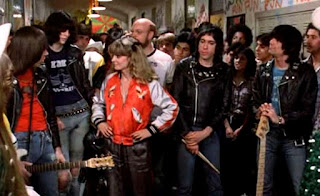
The Ramones with P.J. Soles (as Riff Randell) in Rock 'N' Roll High School (© Alan Arkush/Roger Corman/New World Pictures – reproduced here on a strictly non-commercial Fair Use basis for educational/review purposes only)

Rock 'N' Roll High School contains several totally surreal characters – Mrs Mouse, a human-sized female white mouse, being one (honestly!). However, I particularly enjoyed the evil (and, imho, spookily Jennifer Saunders-ish) Evelyn Togar – the new school principal and an avowed hater of rock music, who has been brought in to bring to this infamously low-achieving school some much-needed discipline (no hope of that here!). She is played in uproariously unhinged fashion by Mary Woronov, a frequent actress in Roger Corman movies.

Also worthy of mention is the captain of the school's American football team, Tom Roberts (Vince Van Patten), who in spite of his handsome looks and muscular physique is hilariously clueless when it comes to getting a girl. However, his obsession with talking constantly about the weather until his would-be paramour heads for the hills to escape his tedious tirade may have something to do with it!

Nor should we forget Eaglebauer (Clint Howard), a wholly illegal fixer-upper for the students who, inexplicably, is seemingly permitted by the school to operate his dodgy deals on site – indeed, from an office installed inside the students' toilet building!

As for the Ramones, who perform several of their own classic songs in Rock 'N' Roll High School as well as the title number (written by them), there is only one word to describe them – sensational! And in any case, how can you not love and respect a band whose lyrics from their song 'Teenage Lobotomy' include the wondrous rhyming couplet:

"Now I guess I'll have to tell 'em
That I got no cerebellum."

Fantastic!

Johnny Ramone in
Rock 'N' Roll High School (© Alan Arkush/Roger Corman/New World Pictures – reproduced here on a strictly non-commercial Fair Use basis for educational/review purposes only)

And yet, ironically, the Ramones were far from being the first choice of rock performers to star in Rock 'N' Roll High School. Todd Rundgren, Cheap Trick, Devo, Tom Petty, and Van Halen had all been considered before them, but for varying reasons no deal had been struck with any of them.

Then someone (accounts differ) suggested the Ramones, who, to the delight of massive Ramones fan Alan Arkush (this movie's director), agreed to appear – and the rest, as they say, is cinematic, and rock, history.

Also, once the Ramones were on board, the movie's original title, Disco High, was swiftly dropped, with Rock 'N' Roll High School instated in its place – a major mercy indeed!

In addition to the Ramones, this movie musical also features tracks from a number of other major contemporary acts. These include Paul McCartney and Wings, Fleetwood Mac, Brian Eno, the Paley Brothers, Eddie and the Hot Rods, Nick Lowe, Velvet Underground, Chuck Berry, Alice Cooper (singing – what else! – 'School's Out'), and Devo, plus Todd Rundgren (who allegedly has always regretted turning down the chance to star in it).

An early Ramones line-up, performing in Toronto, Canada, 1976; from left – Johnny, Tommy (on drums, replaced by Marky in 1978), Joey, and Dee Dee (© Plismo/Wikipedia –
CC BY-SA 3.0 licence)

True, its storyline may be insubstantial, but what gives Rock 'N' Roll High School a lasting, inestimable value is that it constitutes a truly wonderful visual as well as musical record of the Ramones, capturing the band for all time at the very height of their fame and powerhouse performance flair. In short, it confers upon them an absolute immortality, in which they will never grow old, never fade away, but remain forever young, vital, and rocking as only the Ramones can!

In 1991, a Rock 'N' Roll High School sequel movie was released, entitled Rock 'N' Roll High School Forever, but set at a different school, not including the Ramones (except for a single track featuring Dee Dee), and presenting a whole new cast of characters. Notably, however, the Vice Principal is played by none other than Mary Woronov, although her character, Vadar, appears different from Principal Tagar in the original movie.

Moreover, plans to remake Rock 'N' Roll High School have been mooted for more than a decade now, but I personally hope that this never happens. After all, how could anyone possibly take the place of the Ramones in it? Or, to put this another way, how could anyone improve upon perfection?

If you'd like to experience some of the classroom chaos, anthemic anarchy, and Ramones rock'n'roll, be sure to click here  to watch an official Rock 'N' Roll High School trailer on YouTube, and here to watch the Ramones performing 'Do You Wanna Dance?' in it! Gabba Gabba Hey!

To view a complete chronological listing of all of my Shuker In MovieLand blog's other film reviews and articles (each one instantly accessible via a direct clickable link), please click HERE, and please click HERE to view a complete fully-clickable alphabetical listing of them.

 
A fitting tribute: standing 8 ft tall and designed by Wayne Toth, the magnificent bronze Johnny Ramone cenotaph monument at Hollywood Forever Cemetery in Los Angeles, California – RIP Johnny, Rock In Perpetuity! (© Donmike10/Wikipedia – CC BY-SA 4.0 licence)