Dr Karl Shuker's Official Website - http://www.karlshuker.com/index.htm

IMPORTANT:
To view a complete, regularly-updated listing of my Shuker In MovieLand blog's articles (each one instantly clickable), please click HERE!

IMPORTANT:

To view a complete, regularly-updated listing of my ShukerNature blog's articles (each one instantly clickable), please click HERE!

IMPORTANT:
To view a complete, regularly-updated listing of my RebelBikerDude's AI Biker Art's thematic text & picture galleties (each one instantly clickable), please click HERE!

IMPORTANT:
To view a complete, regularly-updated listing of my Starsteeds blog's poetry and other lyrical writings (each one instantly clickable), please click HERE!

IMPORTANT:
To view a complete, regularly-updated listing of my Eclectarium blog's articles (each one instantly clickable), please click HERE!


Search This Blog


Thursday, May 26, 2022

MUNE: GUARDIAN OF THE MOON

 
Publicity poster for Mune: Guardian of the Moon © Alexandre Heboyan/Benoît Philippon/On Animation Studios/Onyx Films/Kinology/Orange Studio/Paramount Pictures/GKIDS/Universal Pictures – reproduced here on a strictly non-commercial Fair Use basis for educational/review purposes only)

My movie watch on 2 May 2022 was the thoroughly delightful French 3D/2D computer-animated fantasy film Mune: Guardian of the Moon (=Mune, le Gardien de a  Lune).

Directed by Alexandre Heboyan and Benoît Philippon (with Philippon also providing the original idea that he and Jérôme Fansten then developed into a dialogue-containing movie format), it was originally released in France in 2015 by Paramount Pictures. In 2017, it was then released in the States by GKIDS (and by Universal Pictures internationally), with an English-dubbed cast that includes Rob Lowe and Christian Slater.

Mune: Guardian of the Moon  tells the captivating story of a small planet far away in which the sun has its own guardian, and so too does the moon. On the day when the two old guardians are ceremonially replaced by two new ones, the moon side of the planet's purest creature, a kind of lunar ewe, does not choose the expected humanoid figure, Leeyoon (voiced by Slater), to be the new moon guardian but instead selects a small, inexperienced, blue rodent-like entity named Mune (Joshua J. Ballard).

Unfortunately, however, Mune's inevitable inexperience and timidity cause all manner of disasters at the beginning of his reign, much to the exasperation of Sohone (voiced by Lowe), the new super-confident sun guardian. But soon they face even worse issues when an embittered former sun guardian, Necross (Davey Grant), now inhabiting the Underworld and volcanic in form, steals the sun and plans to destroy it.

Much to their initial mutual disgust, Sohone and Mune, together with a candlewax girl named Glim (Nicole Provost) who is very knowledgeable about the ancient laws, find themselves working together to rescue the sun, defeat Necross, and fix the earlier damage caused to the moon by Mune.

The story itself thereby follows the tried and trusted path of learning to work together, respect one another's talents and differences, become friends etc. But what makes this magical movie stand out so emphatically from such all-too-familiar film fare are its highly imaginative, creative visuals (including the sun and moon being towed through the sky by a pair of gigantic creatures plodding across their respective halves of the planet), but especially the imagery of the planet's lunar half, whose fauna is truly surreal yet also exquisitely designed. I've seen reviews of this film that have likened it to a youngster's version of Avatar, and I understand why after watching it.

Equally, however, as I can personally verify, there is much to enjoy in this movie for adults too, particularly its strange luminous beauty and haunting ethereal music. Mune: Guardian of the Moon is an absolute delight – I loved it!

If you'd like to acquaint yourself with the charismatic dream-like world of Mune and Sohone, be sure to click here in order to view an official Mune: Guardian of the Moon trailer on YouTube.

To view a complete chronological listing of all of my Shuker In MovieLand blog's other film reviews and articles (each one instantly accessible via a direct clickable link), please click HERE, and please click HERE to view a complete fully-clickable alphabetical listing of them.


Tuesday, May 24, 2022

MR HORATIO KNIBBLES

 
Publicity photograph for Mr Horatio Knibbles (© Robert Hird/Anvil Film & Recording Group/Children's Film Foundation – reproduced here on a strictly non-commercial Fair Use basis for educational/review purposes only)

As many of you now know, I'm always on the lookout not only for strange, little-known cryptids (mystery animals) in my longstanding career as a cryptozoological investigator and author but also for strange, little-known films in my equally longstanding enthusiasm for all matters movie-related – and on Saturday morning, 21 May 2022, I happened to discover a fascinating example of the two in one! For that was when the retro-specialising UK TV channel Talking Pictures screened an enchanting yet nowadays all-but-forgotten Children's Film Foundation-associated rarity entitled Mr Horatio Knibbles.

Directed by Robert Hird, with a screenplay by Peter Blackmore (from an original story by Wally Bosco), produced by Anvil Film & Recording Group for the Children's Film Foundation (aka CFF, a non-profit UK organization that produced or sponsored short movies for children from the late 1940s to the mid-1980s), and released in 1970 (or 1971 – sources differ), Mr Horatio Knibbles is a thoroughly delightful, whimsical fantasy movie. Its title character (played by Anthony Sheppard) happens to be an avuncular 6-ft-tall ever-hungry white rabbit (which may explain why his surname is pronounced 'Nibbles'). He is always dressed very nattily in jacket, waistcoat, watch chain, trousers, and top hat (and is therefore reminiscent of portrayals of the White Rabbit in various live-action Alice in Wonderland movies). However, he is invisible and inaudible to everyone except for a lonely young girl named Mary Bunting (Lesley Roach), who loves rabbits and desperately wants a pet one for her rapidly-approaching birthday, but is steadfastly refused by her kindly yet rabbit-averse parents (Bernard Horsfall and Jane Jordan Rogers).

After Mr Knibbles appears to a sad Mary, they have all sorts of amusing, innocent adventures together in the nearby woods where Mr Knibbles lives that cheer her up immensely, but thoroughly baffle and bemuse her disbelieving parents and in particular her somewhat bullish brother Tom (Gary Smith), who cannot see her new friend. Inevitably, therefore, they assume that Mary is either letting her imagination run riot or is telling them outright fibs.

Mary even claims that she has written to Mr Knibbles, addressing her letter to him at Rhododendron Manor, The Woods, Local, and posting it in a hollow tree log where a squirrel collects the mail each day at 3 pm sharp (provided of course that the postage has been paid for in nuts!). So her father decides to put an end to this nonsense by concealing himself near to said tree log just before 3 pm, totally confident that the highly unlikely scenario alleged by Mary will not take place – only to be thoroughly startled, however, when a squirrel does indeed appear, pulls out a letter from the log, and passes it to a bird who flies off with it!

Mary's birthday arrives, and she invites Mr Knibbles to her party. Due, however, in no small way by a small girl named Nancy (Rachel Brennock) who is Mary's somewhat hysterical friend, given to unnerving ear-piercing shrieking like a banshee at the slightest provocation (and especially so after Mr Knibbles agrees to become visible for her as well as Mary), he decides to take shelter for a while inside an empty water barrel, where he goes to sleep – only for the water barrel to be sealed and taken away as it had been leaking. Mary and her friend finally succeed in reclaiming it (assisted hilariously by PC Briggs (Fred Evans), a somewhat simple but good-hearted policeman, who is actually able to see Mr Knibbles due to his own love for rabbits), but when Mary tells her father that it contains her giant furry friend he angrily and dismissively declares that it is empty.

In despair, Mary calls out to Mr Knibbles inside the barrel, pleading with him to promise to appear to everyone present if the barrel is opened, which Mr Knibbles readily agrees to do. Although he cannot hear Mr Knibbles's words, Mary's father reluctantly decides to open it, to confirm once and for all to Mary and all of her birthday party guests there that Mr Knibbles is just a figment of her imagination – only of course for a now-visible, audible Mr Knibbles to duly if delicately extricate himself from the barrel (he is rather rotund!), amazing his human audience.

All ends well, with Mr Knibbles giving Mary a very special birthday present – a fluffy white pet rabbit (of normal size, thankfully!) – before bidding her a fond farewell for the time being, revealing that he is going off on holiday to Australia, but promising to visit her again when he returns home.

Needless to say, the premise of Mr Horatio Knibbles readily recalls Mary Chase's classic 1944 play Harvey (and to a much lesser extent Donnie Darko!) plus the three subsequent movies based upon it (the most famous of which is the first one, starring James Stewart and released in 1950). By being aimed at children, however, and produced over 50 years ago, it is much more light-hearted, gentle, and thoroughly endearing, yet without being cloy or twee (it is also a visual treat, filmed in vibrant colours and beautiful settings).

Indeed, for some years after its release in 1971, Mr Horatio Knibbles proved very popular with children of all ages (not to mention, I strongly suspect, a fair few adults too!), and was often shown on TV here in the UK, especially at Christmas time. However, because it features generally polite, largely well-behaved, quintessentially middle-class English children, and is set in the kind of idyllic early 1970s rural England that probably never truly existed except in movies like this one, it may well be deemed dated and even un-PC by various modern-day factions nowadays, thereby explaining why such a lovely little movie (only an hour long) has unjustly sunk into almost total obscurity.

Consequently, although quite some time ago I'd watched a few excerpts from it on YouTube, I never expected to view Mr Horatio Knibbles in its entirety, so I was very pleased indeed to catch it a couple of days ago on Talking Pictures, where I hope that it will be regularly repeated hereafter. After going AWOL from terrestrial TV for far too long, it is high time that this magical film's long-eared, mangelwurzel-munching star is introduced to new and future generations of youngsters – given such an opportunity, they will, I'm sure, be just as enthralled by Mr Knibbles as their parents and grandparents were, all those many years ago.

If you'd like to view some excerpts from Mr Horatio Knibbles currently present on YouTube, be sure to click here to view its opening scene, here to view its closing scene, plus here, and here. Moreover, it is now available to purchase in DVD format as part of a CFF nine-movie bumper DVD box set released by the British Film Institute (BFI).

To view a complete chronological listing of all of my Shuker In MovieLand blog's other film reviews and articles (each one instantly accessible via a direct clickable link), please click HERE, and please click HERE to view a complete fully-clickable alphabetical listing of them.

 
A scene from Mr Horatio Knibbles in which he appears (invisibly except to Mary) with Tom (in tan-coloued jumper) and his friends, plus Mary alongside him and her mother sitting on a bench in the background watching them (© Robert Hird/Anvil Film & Recording Group/Children's Film Foundation – reproduced here on a strictly non-commercial Fair Use basis for educational/review purposes only)


Sunday, May 22, 2022

QUERELLE

 
My official UK ex-rental big box VHS video of Querelle (© Reiner Werner Fassbinder/Gaumont S.A. Paris/Scotia/Gaumont/Palace Video – reproduced here on a strictly non-commercial Fair Use basis for educational/review purposes only)

On 19 May 2022, and for four very different but equally relevant reasons, I finally watched the famous English-language Franco-German art-house movie now under review here – Querelle.

Firstly, Querelle stars Brad Davis, who had previously blown me away with the sheer strength and depth of his performance in the lead role for his first big film, Midnight Express (1978), so I was eager to see him again in a starring role (especially as there are so few of them, due to his tragically early death aged only 41). Secondly, having heard tell that Querelle was not only the acclaimed (yet once again tragically short-lived) German film director Rainer Werner Fassbinder's last film (released posthumously, a few weeks after his death aged just 37) but also his most controversial one, I was naturally curious to see it. Thirdly, I'd read that Querelle's title character is very reminiscent in nature to the one in a movie that I’d watched and enjoyed not very long ago, so again I was intrigued to see how this played out on screen. Fourthly, I'd purchased Querelle a fair while ago as an ex-rental big box video along with several others, but had never got around to watching any of them, so I decided that it was high time that I did (I'll be viewing and then reviewing all of them in due course here), and began doing so with this one. So without further ado, here are my thoughts about Querelle.

Directed as already noted by Reiner Werner Fassbinder, based upon Jean Genet's 1947 novel Querelle of Brest, and released in 1982 by  Scotia/Gaumont, Querelle stars Brad Davis as its title character, Georges Querelle, a young Belgian sailor who is spending an evening's leave ashore in and around La Feria, an infamously seedy bar and brothel in the port of Brest, in Brittany, north-western France. After unexpectedly meeting his brother Robert there, Querelle whiles away the hours drinking, fighting, and sexually indulging himself with whoever he attracts or is attracted to, woman or man, while also seeking actively and wholly amorally to promote his illicit opium smuggling and selling business.

Querelle has no scruples whatsoever in duping or manipulating those around him to his own advantage. And even if he should indulge in a spot of casual murder, which he does, he is perfectly at ease in framing one of his hapless devotees in order to extricate himself from the dangerous situation that results.

Watching this twisted but taut storyline gradually unfold, against a visually sumptuous sunset backdrop that illuminates every outdoor scene throughout the movie, as fiery and blazingly brazen as Querelle himself, I realized that what I'd read about Querelle was certainly true. That is, its theme was indeed reminiscent of a certain movie that I'd lately seen – namely, the 1999 Hollywood adaptation of Patricia Highsmith's original novel, The Talented Mr Ripley (click here to read my review of this movie, and also of a much earlier, French film adaptation of it entitled Purple Noon).

 
Front cover of the Paladin paperback English edition of Jean Genet's 1947 novel Querelle of Brest (© Jean Genet/Paladin – reproduced here on a strictly non-commercial Fair Use basis for educational/review purposes only)

Starring Matt Damon in the title role, The Talented Mr Ripley focuses upon a superficially charming low-life chancer, Tom Ripley, whose inimical 'talents' – including innate cunning, sexual ambivalence, total absence of a conscience, and ready willingness to do whatever it takes, including murder, to accrue the wealth and high standing in society that he has never earned legitimately yet nonetheless feels is rightfully his – are all exhibited by Querelle too. The settings may be different, so too the circumstances, but at the rotten, decadent core of both of these compelling movies' storylines is the selfsame ruthless example of humanity at its least humane.

As in Midnight Express, Brad Davis provides a spellbinding, passionate performance as the sensual, duplicitous Querelle, inexorably oozing an oleaginous but toxic mixture of insouciance and insincerity from every pore. He even affects a phony James Dean lookalike pose at times (see photo at the end of this review). French actress/singer Jeanne Moreau co-stars as Querelle's cruelly spurned lover Lysiane, who also sings the sultry Marlene Dietrichesque number 'Each Man Kills The Thing He Loves' (click here to watch and listen to it performed by her in this movie).

Well worth noting too is the balletic fight scene between two knife-wielding combatants that almost looks as if it has danced straight out of West Side Story. And stylistically this movie was inspired to no small extent by the erotic artwork of none other than Tom of Finland. However, it was the frank portrayals of Querelle's sexual dalliances (albeit very tame by today's much raunchier mainstream cinematic standards) that engendered some controversy for this film at the time of its original release back in 1982, but it is easy to understand why critics and movie audiences alike nowadays rate it as one of Fassbinder's most noteworthy movies. As for the vibrant and vivid cinematography of Xaver Schwarzenberger, this is truly beyond gorgeous – an absolutely glorious palette of spectacular colour in every frame..

So, if you'd like to view an official Querelle trailer, please click here to watch one on YouTube.

Finally: to view a complete chronological listing of all of my Shuker In MovieLand blog's other film reviews and articles (each one instantly accessible via a direct clickable link), please click HERE, and please click HERE to view a complete fully-clickable alphabetical listing of them.

 
Brad Davis as young off-duty sailor Querelle, adopting a distinctly James Deanian pose in Querelle (© Reiner Werner Fassbinder/Gaumont S.A. Paris/Scotia/Gaumont/Palace Video – reproduced here on a strictly non-commercial Fair Use basis for educational/review purposes only)

Saturday, May 14, 2022

EUROVISION SONG CONTEST: THE STORY OF FIRE SAGA

 
Publicity poster for Eurovision Song Contest: The Story of Fire Saga (© David Dobkin/Gary Sanchez Productions/Gloria Sanchez Productions/EBU/Netflix – reproduced here on a strictly non-commercial Fair Use basis for educational/review purposes only)

Although I actually viewed this marvellous movie more than 5 months ago, and then reviewed it on Facebook shortly afterwards, I have deliberately delayed uploading my review onto Shuker In MovieLand until today. After all, what better date for doing so than the day upon which the real event takes place this year? For in just a few hours' time, millions of viewers all around the world will be welcoming on screen and on stage the Eurovision Song Contest 2022!

To date, this film has never received a UK DVD release (although it has done in various other territories), so it took me quite a while to track down a DVD of the hilarious 2020 Will Ferrell movie Eurovision Song Contest: The Story of Fire Saga. However, as a longstanding Eurovision fan (less nowadays but more formerly), as far as I was concerned it just had to be done, and during the morning of 30 November 2021, thanks to DVD aficionado friend John, I finally did so, watched it that evening – and enjoyed every second!

Directed by David Dobkin, co-written by Will Ferrell, and digitally released by Netflix, Eurovision Song Contest: The Story of Fire Saga is totally off the wall, crazy, insane – a worthy tribute indeed to the annual madness that is the ESC! I get the impression that its American creators' intention was to parody Eurovision, but someone should have told them that Eurovision is far, far beyond parody!

Nevertheless, there is certainly much to cherish and be amused by here, with Ferrell and Rachel McAdams as the fictional singing duo Fire Saga (consisting of Ferrell's Lars and McAdams's Sigrit) representing Iceland at the Contest, held in Edinburgh, Scotland, whose attempts to put on a worthy performance during the Contest's warm-ups are beset with hysterical mishaps. (NB - they are dubbed by professional singers, as is Dan Stevens, see below.)

Among all the mayhem, however, their valiant if seemingly vain attempt to achieve success receives unexpected assistance from some unseen but murderous Icelandic elves, and very sweet but ingenuous, unworldly Sigrit receives flattering attention from the Contest's favourite entry to win it, Russia's suave lurve god Alexander Lemtov (an audaciously scene-stealing OTT Dan Stevens), only much later realising that his primary interest is not directed towards the Contest's female contingent...

Lars's disapproving father Erick Erickssong is drily portrayed by Pierce Brosnan, with Demi Lovato as the seductive yet scurrilous Icelandic representative, Katiana Lindsdóttir. Speaking of representatives, a particular joy is that several real-life Eurovision representatives appear in this film, including six previous winners – namely, Netta (for Israel, 2018), Salvador Sobral (Portugal, 2017, who plays a busker), Jamala (Ukraine, 2016), Conchita Wurst (Austria, 2014), Loreen (Sweden, 2012), and Alexander Rybak (Norway, 2009); not Abba or Celine Dion, sadly, but you can't have everything! So too does the UK's own real-life Eurovision commentator, Graham Norton. There is even a monster-masked group named Moon Fang, parodying Finland's 2006 winning representatives, the Metal monster group Lordi.
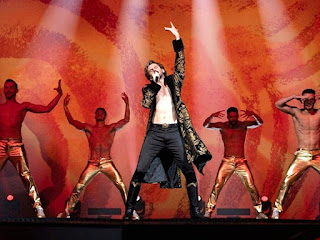
 
Lion King meets Village People? A screenshot from the fabulously overblown music video of Alexander Lemtov (Dan Stevens) performing 'Lion of Love' (©David Dobkin/Gary Sanchez Productions/Gloria Sanchez Productions/EBU/Netflix – reproduced here on a strictly non-commercial Fair Use basis for educational/review purposes only)

Add to all of this the fantastic, almost lunar Icelandic scenery that I remember so well from my own visits to this fascinating country, and some genuinely very fine songs (one, 'Husavik', a paean of praise to Fire Saga's small home town back in Iceland, was actually nominated for the Best Original Song Oscar at the 2021 Academy Awards – click here to watch Fire Saga performing it, with McAdams dubbed by My Marianne aka Molly Sandén), and you have a thoroughly zany but effortlessly entertaining movie that whether or not you're a Eurovision fan I defy you not to enjoy.

There are even a few unexpectedly touching, poignant moments amidst all of the anarchy, as the somewhat slow-on-the-uptake Lars finally comes to realise how he truly feels about his loyal, longstanding singing partner. And in spite of his insufferable air of superiority, Alexander does try his best to offer Sigrit some genuine albeit platonic comfort when she bravely faces the other contestants alone after Fire Saga's disastrous semi-final performance, which has caused Lars to flee back in shame to Iceland. A giant runaway hamster wheel was heavily involved – I'll say no more!

But do Fire Saga win the Contest? Now that would be telling! But what I will tell you is to watch the video here on YouTube for Dan 'Alexander Lemtov' Stevens's flamboyant performance of his country's song, 'Lion of Love' (dubbed by Erik Mjönes). The song is superb, and the video? As the late great Eddie Cochran would have said: "Man, that's somethin' else!' – perhaps the only time in its long history that Eurovision has ever been beaten at its own outrageous game!! You have been warned!

Best of all, however, is 'Jaja Ding Dong', Lars's slightly suggestive, non-serious ditty that in a running joke is the only song that anyone in Iceland wants Fire Saga to sing – click here to view them performing it in their local tavern. Awesome!

As a brief aside – it is only too well known that the UK has not achieved much success of late in the real ESC, but tonight we have as our representative a seriously talented singer in Sam Ryder, who has not only a very decent song ('SPACE MAN' – click here for the official music video) but also a massive TikTok following. So, who knows, we may even make it into the top ten this year, if predictions and betting odds for Sam are to be believed. So I'd like to take this opportunity to wish him the very best of British luck tonight – we'll all be rooting for you, Sam, right across the UK [in the event, Sam came second, losing out perhaps not too surprisingly, given current events, to Ukraine, but still providing us with our best result since 1997!).

Back to the movie: if you'd like a taster of what to expect from this fantastic, laugh-out-loud film, be sure to click here to watch an official trailer for Eurovision Song Contest: The Story of Fire Saga on YouTube Go on, you know you want to!

To view a complete chronological listing of all of my Shuker In MovieLand blog's other film reviews and articles (each one instantly accessible via a direct clickable link), please click HERE, and please click HERE to view a complete fully-clickable alphabetical listing of them.

 
Full sleeve from the Region 1 DVD of Eurovision Song Contest: The Story of Fire Saga (© David Dobkin/Gary Sanchez Productions/Gloria Sanchez Productions/EBU/Netflix – reproduced here on a strictly non-commercial Fair Use basis for educational/review purposes only)