Dr Karl Shuker's Official Website - http://www.karlshuker.com/index.htm

IMPORTANT:
To view a complete, regularly-updated listing of my Shuker In MovieLand blog's articles (each one instantly clickable), please click HERE!

IMPORTANT:

To view a complete, regularly-updated listing of my ShukerNature blog's articles (each one instantly clickable), please click HERE!

IMPORTANT:
To view a complete, regularly-updated listing of my RebelBikerDude's AI Biker Art's thematic text & picture galleties (each one instantly clickable), please click HERE!

IMPORTANT:
To view a complete, regularly-updated listing of my Starsteeds blog's poetry and other lyrical writings (each one instantly clickable), please click HERE!

IMPORTANT:
To view a complete, regularly-updated listing of my Eclectarium blog's articles (each one instantly clickable), please click HERE!


Search This Blog


Monday, September 23, 2024

FROM FRANKENFISH, OCTAMAN, AND A PLANET OF APES, TO A ROBOTIC WAR DOG, THE LAST LOVECRAFT, AND A WEIRD WORLD WHERE STRINGS ARE THE THINGS! - OR, REVIEWING A SCINTILLATING SIX-PACK OF SCIENCE FICTION AND FANTASY FILMS!

 
The official American DVD for Frankenfish plus two publicity posters for Battle For the Planet of the Apes and The Last Lovecraft: Relic of Chthulhu respectively (© Mark A.Z. Dippé/Columbia TriStar/Syfy / © J. Lee Thompson/APJAC Productions/20th Century Fox / © Henry Saine/Devin McGinn/Dark Sky Films/MPI Media – all three images reproduced here on a strictly non-commercial Fair Use basis for educational/review purposes only)

Time for another six-pack of mini-reviews of movies watched by me recently – or not so recently, as the case may be – all of which fall within the science fiction/fantasy film genre.
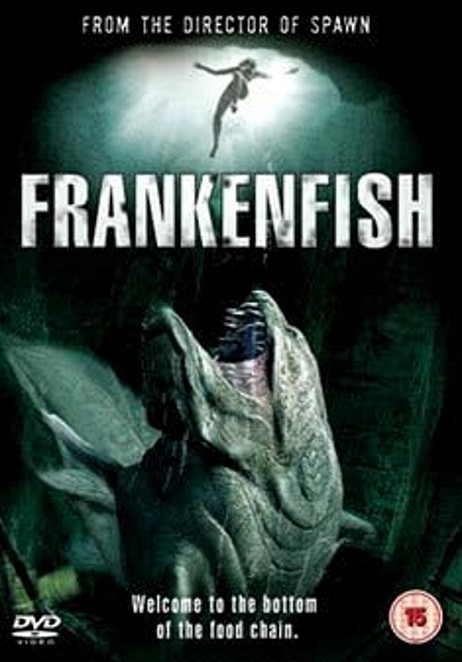


My official UK DVD of Frankenfish (© Mark A.Z. Dippé/Columbia TriStar/Syfy – reproduced here on a strictly non-commercial Fair Use basis for educational/review purposes only)

FRANKENFISH

On 16 May 2024, I watched my recently-purchased DVD of the 20-year-old TV monster movie Frankenfish. Directed by Mark A.Z. Dippé, and released in 2004 by Columbia TriStar for the TV channel Syfy), Frankenfish is a very generic MM, and is all about some huge, voracious, genetically-modified Chinese snakehead fishes Channa argus let loose into a Louisiana bayou where they wreak bloodthirsty havoc upon its alligators and human inhabitants alike. Consequently, the aptly-named Sam Rivers (played by Tory Kittle), a medical examiner, is dispatched to the besieged bayou, together with biologist Mary Callaghan (China Chow), only to discover that they have as big a battle on their hands with the locals' firmly-ingrained superstitions and faith in black magic solutions to the situation as they do with the monsters themselves – which lose no time in picking off the humans, one by one... Amusingly, whoever wrote the DVD's back-cover blurb presumably had no idea what a snakehead is and was therefore led badly astray by its name (and had apparently not even watched the movie itself, in which snakeheads are accurately described). For the blurb writer described the movie's monsters as being not only "massive, genetically-engineered, flesh-eating fish" but also as having been "scientifically bred with a deadly snake"! Now that's a monster movie I'd definitely pay good money to watch!! As for this one, the monster fishes when seen briefly out of the water are ok, but as the main storyline takes place almost entirely at night, I didn't see as much of them as I'd like to have done. But in compensation, there is a very unexpected and entertainingly chilling closing scene to look out for, featuring the ever-troublesome character Dan (Matthew Rauch). If you'd like to watch an official trailer for this movie, please click here to view one on YouTube.


German publicity poster for Octaman (© Harry Essex/Filmers Guild/Heritage Enterprises Inc – reproduced here on a strictly non-commercial Fair Use basis for educational/review purposes only)

OCTAMAN

There are movies so bad that they're really good, and there are movies so bad that they really are bad! One of the sizeable number of films that I watched during the last week of March 2024 (I was definitely in a movie-watching mood that week!), the early 1970s creature feature Octaman, falls fairly and squarely into the latter category, at least imho. Directed and written by Harry Essex (who had also previously written the screenplay for the classic 1954 monster movie Creature From the Black Lagoon), and released in 1971 by Heritage Enterprises Inc, Octaman stars Kerwin Mathews (he of title character fame in The 7th Voyage of Sinbad and The Three Worlds of Gulliver, as well as Jack the Giant Killer – reviewed by me here) and, in her final movie, Pier Angeli (she of early 1950s fame as the impassioned love interest of a certain young, ill-fated actor named James Dean – click here for my review of Dean's short but stellar film career) as a couple of scientists, Dr Rick Torres and Susan Lowry, investigating some radiation-polluted rivers and lakes in Mexico (with Jeff Morrow co-starring as a third scientist, Dr John Willard). Here they discover a couple of small but mutant land-crawling freshwater octopuses (conveniently overlooking the zoological fact that octopuses are exclusively marine), and then encounter a murderous humanoid octopus mutant, Octaman, the size of an adult human and able to walk bipedally too, but bristling with tentacles, who duly picks off most of the cast list, one by one. Seen in close-up, Octaman looks okay, but in full view he's definitely of the 'man in a rubber suit' movie monster variety (with Read Morgan being the man in question here), and made unintentionally hilarious by his array of tentacles swinging from his shoulders like the extra arms on a sweater knitted by someone's deranged auntie. It's all exceedingly silly, despite the ultra-serious performances of the acting roster, but enjoyable too, in a supremely undemanding, typical B-movie manner. If you'd like to watch a short but initially somewhat graphic trailer for this movie, please click here to view it on YouTube.


Publicity poster for Battle For the Planet of the Apes (© J. Lee Thompson/APJAC Productions/20th Century Fox – reproduced here on a strictly non-commercial Fair Use basis for educational/review purposes only)

BATTLE FOR THE PLANET OF THE APES

Back in the 1980s, I watched on TV the first four movies in the original five-movie Planet of the Apes saga (Planet..., Beneath the Planet..., Escape From the Planet..., and Conquest of the Planet...), whose concept was directly inspired by the Pierre Boulle sci fi novel Monkey Planet (1963, and which I've read). Yet for some unknown reason, I never got around to watching the fifth, concluding movie, Battle For the Planet... (directed by J. Lee Thompson, starring John Huston, Paul Williams, Austin Stoker, and Roddy McDowall as Caesar, and released in 1973 by 20th Century Fox) – until the evening of 11 September 2024, that is. I've long owned this movie quintet as a DVD box set, so that evening I decided to complete my watching of this classic sci fi series and finally discover how it all ended. Sadly, however, I was rather disappointed, finding it something of an anti-climax after Conquest of the Planet..., in which, as its title confirms, the apes conquer their human subjugators who had long enslaved them in North America, and thereby become set to take over from humans as Earth's ruling species. In my view, the series should have ended there, because the ending of Conquest of the Planet... neatly brought the four-movie storyline full circle, connecting right back to where it had all begun at the beginning of Planet. Conversely, Battle For the Planet... is little more than an adjunct to this cycle, its plot operating outside it, in which the relatively small ape community grandly dubbed Ape City now led by super-intelligent chimpanzee Caesar (who had led the successful ape rebellion in Conquest of the Planet...) is attacked by an equally modest-sized army of radiation-crazed humans (who had been living not too far away in the subterranean highly-radioactive remnants of a once-mighty human city), whom the apes ultimately destroy. But it's all very localised, very small-scale – more like Battle For a Local Neighbourhood of the Apes, in fact, rather than a Planet. This may perhaps be explained by the fact that the scriptwriter for all four of the previous movies fell ill when preparing one for this fifth movie and after withdrawing from it was replaced by two scriptwriters with no previous sci fi experience and who had never even watched any of the previous four movies. Ah well, it was still an enjoyable enough movie watch, even though by the standards of the preceding four, which flowed seamlessly each into the next, it was basically superfluous to requirements, with its ending not incorporated within the cyclical storyline collectively yielded by the previous quartet of movies. Now that I have at last watched it, however, I can move on to watch the 2001 Planet of the Apes remake starring Mark Wahlberg (which I especially wish to see as its twist ending is the one used by Boulle in his original novel, not the wholly different albeit iconic twist ending featuring the destroyed Statue of Liberty in the very first Planet of the Apes movie), and then the current quadrilogy reboot beginning with Rise of the Planet... I'd deliberately deferred from viewing all of these until I eventually watched Battle For the Planet... one day, and which now I have done. If you'd like to view an official trailer for this movie, please click here to do so on YouTube.


Publicity poster for A-X-L (© Oliver Daly/Lakeshore Entertainment/Phantom Four Films/Global Road Entertainment reproduced here on a strictly non-commercial Fair Use basis for educational/review purposes only)

A-X-L

My midnight movie watch on 14 February 2024 was the enjoyable sci fi film A-X-L, which was directed and written by Oliver Daly, who based it upon an original proof-of-concept short film made by him in 2015, entitled Miles. Co-produced and released by Global Road Entertainment three years later in 2018, A-X-L features as its titular subject a top-secret, multi-million-dollar robotic war dog empowered with highly sophisticated A.I. but also human-like empathy. A-X-L (Attack-Exploration-Logistics) was created for the US army, but escapes after being mistreated and damaged during a trial, and hides away in the desert, where he is discovered, repaired, and befriended by teenage off-road biker/machine builder Miles (played by Alex Neustaedter) and his soon-to-be girlfriend Sara (singer Becky G). A-X-L bonds with Miles, but unknown to them the military have a tracer on A-X-L and have no intention of letting him stay on the loose, determining to recapture him at any cost... The storyline thus follows the generic, tried-and-trusted 'kids and weird buddy pursued by officialdom' plot utilised down through the years in everything from the likes of E.T. and Short Circuit to countless of those popular made-for-TV movies churned out by Disney during the 1970s. However, the storyline, derivative or otherwise, is secondary anyway here to the scene-stealing CGI-rendered A-X-L, which I found very impressive. Indeed, its canine mimicry is so accurate that at times I wondered whether a real dog had been employed in some form of motion-capture capacity to create A-X-L on screen, or via rotoscoping as often utilised in movies prior to the development of advanced CGI techniques. A-X-L is an entertaining thrill-and-spills feel-good family movie, but elevated from so many others by the eye-popping visuals provided by A-X-L, both when in action and when at play. If you'd like to view an official trailer for A-X-L, please click here to do so on YouTube.


My official DVD of The Last Lovecraft: Relic of Chthulhu (© Henry Saine/Devin McGinn/Dark Sky Films/MPI Media – reproduced here on a strictly non-commercial Fair Use basis for educational/review purposes only)

THE LAST LOVECRAFT: RELIC OF CHTHULHU

On 15 July 2024, my movie was the hilarious sci fi/fantasy comedy movie The Last Lovecraft: Relic of Chthulhu, which was directed by Henry Saine (who also produced the movie's opening credits animation), and released in 2010 by MPI Media. As its title suggests, The Last Lovecraft: Relic of Chthulhu is all about the last known (albeit wholly fictitious in reality) descendant of cult fantasy writer H.P. Lovecraft. Namely, a geeky call centre worker named Jeff (Kyle Davis), who finds himself entrusted with one half of an ancient relic that if rejoined to the other half will bring forth from the ocean depths the long-submerged city of Lovecraft's ancient and colossal dread deity Chthulhu, and release him from his dungeon there to ascend and conquer humanity on the surface. Not good. So Jeff and comic-book aficionado/best buddy Charlie (Devin McGinn, who also wrote this movie's screenplay), plus super-nerdy/ex-high school acquaintance/Chthulhu expert Paul (Barak Hardley), go on the run together in a bid to keep the half-relic hidden until the rapidly-approaching star alignment during which period the relic's two halves must be rejoined if Chthulhu is to ascend has come and gone, whereupon the world will be safe once more. But the valiant relic-bearers three are being hotly pursued by Chthulhu's cult (who possess the other half-relic), including a host of humanoid Star Spawn and reptilian Deep Ones, with the ability to become huge tentacular nightmares. Who will succeed? This movie is very, very funny (but sadly under-rated), and reminds me a lot of the Simon Pegg sci fi comedy film Paul (which I've reviewed here). Highly recommended!!! Interestingly, The Last Lovecraft ends with a brief epilogue that sees the adventurous trio in Antarctica seeking the Mountains of Madness written about by Lovecraft, indicating that a sequel movie was planned, but if so, nothing has come of it so far. If you'd like to watch an official trailer for this movie, please click here to view one on YouTube.
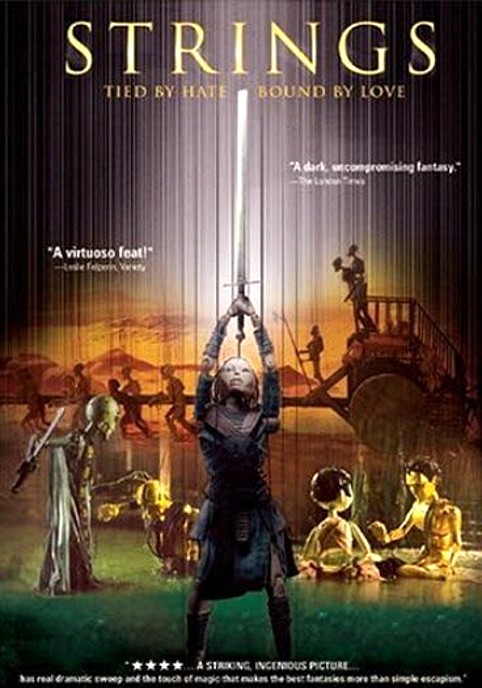


Publicity poster for Strings (© Anders Rønnow Klarlund/BOB Film Sweden AB, Bald Film/Film and Music Entertainmemt/Mainstream ApS/Nordisk Film/Radar Film/Sandrew Metronome Distribution/Zentropa Entertainments/SF Film – reproduced here on a strictly non-commercial Fair Use basis for educational/review purposes only)

STRINGS

On 6 April 2024, I watched a truly extraordinary puppet-featuring animated fantasy movie from 20 years ago entitled Strings, but which I'd only learnt about very recently. A Scandinavian-UK co-production directed by Anders Rønnow Klarlund (and upon a story by whom this film was based), and released in 2004 by SF Film, Strings is set in a fictional world where all of the humans and other organisms are marionettes, whose strings (of which they are fully aware at all times) stretch upwards to Heaven, where they are presumably controlled by an unseen divine puppeteer. Down on Earth, though, the marionettes interact with one another just like humans and other animals normally do, which in the case of the humans involves treachery, murder, and violent warfare. You'll guess from this that Strings is no cosy family fare for children, involving as it does the adult son, Hal Tara, of a seemingly slain king, The Kahro, leaving his city of Hebalom determined to exact merciless revenge upon those responsible for his father's apparent murder, and whom he seeks far and wide before discovering to his horror that he should be searching much closer to home. During his quest for answers and retribution, moreover, Hal finds that all is not what it seems or what he had always believed it to be, with regard both to his father and to the longstanding enmity existing between the Hebalonians and a rival warrior race, the Zeriths. Revelations are in plentiful supply here, that's for sure! The puppetry is truly incredible, albeit set predominantly in shadows and rain-saturated settings, and the English-dubbed version harnesses the vocal talents of such notables as James McAvoy (as Hal), Julian Glover (The Kahro), Derek Jacobi (who excels as The Kahro's scheming evil brother Nezo), Samantha Bond (Eike, Hal's mother), and Catherine McCormack (Zita, the feisty Zerith warrior maiden with whom Hal falls in love and from whom he learns the terrible truth about why her people came to hate his). A movie totally unlike any that I've ever seen before, Strings is a surreal viewing experience that I definitely recommend to anyone seeking an outré oeuvre of the cinematic kind! If you'd like to watch an official Strings trailer (albeit darker in viewing quality than the actual movie itself is), please click here to do so on YouTube.


Finally: to view a complete chronological listing of all of my Shuker In MovieLand blog's other film reviews and articles (each one instantly accessible via a direct clickable link), please click HERE, and please click HERE to view a complete fully-clickable alphabetical listing of them.


A-X-L publicity photo-shot (© Oliver Daly/Lakeshore Entertainment/Phantom Four Films/Global Road Entertainment reproduced here on a strictly non-commercial Fair Use basis for educational/review purposes only)


Friday, September 20, 2024

JACK THE GIANT KILLER (1962)

 
My official 50th Anniversary Edition DVD of Jack the Giant Killer (© Nathan H. Juran/Zenith Pictures/United Artists – reproduced here on a strictly non-commercial Fair Use basis for educational/review purposes only)

My movie watch on 24 August 2024 was a stop-motion classic from the early 1960s – Jack the Giant Killer.

Directed by Nathan H. Juran, co-produced by Edward Small, and originally released in 1962 by United Artists, Jack the Giant Killer stars Kerwin Mathews as Jack, the film's valiant young farmer hero, and he had also lately starred as Sinbad in The 7th Voyage of Sinbad, which was the first of the three iconic Ray Harryhausen stop-motion Sinbad-themed fantasy films. Indeed, because of perceived similarities, Columbia Pictures, who had released the above-named Sinbad movie, threatened to sue the makers of Jack the Giant Killer.

However, the latter avoided legal action by withdrawing the movie in its original form and re-releasing it with additional content as a film musical, the original non-musical version not being re-released for another 30 years. This latter is the version that I watched, however, courtesy of my special 50th Anniversary Edition DVD, which also contains an official folded-up poster of the movie.

Jack the Giant Killer is (very) loosely inspired by the traditional English fairy tale of the same title, but has been greatly expanded on screen, with an evil sorcerer named Pendragon (Torin Thatcher, who had also starred in The 7th Voyage of Sinbad alongside Mathews) abducting Elaine (Judi Meredith), a Cornish princess, and conjuring forth all manner of monsters in an attempt to thwart Jack's bold attempts to rescue her.

These include not only the single-horned gigantic satyr that Jack had killed earlier when rescuing Elaine but also a two-headed giant, a flying dragon, and some dragon's-teeth warriors, all vividly brought to life via stop-motion animation (as was a bizarre tentacular sea monster that battled the two-headed giant), plus a host of incandescent skeletal witches engendered very effectively on-screen by a novel process dubbed Fantascope.

Yet although very satisfactory, produced as they were by master animator Jim Danforth in one of his earliest film assignments, these did not quite match Harryhausen's spectacular creations, but Don Beddoe as a bottle-entrapped, rhyme-riddling leprechaun who assists Jack in his battles against Pendragon and his minions provides some amusing asides.

Overall, therefore, Jack the Giant Killer is a highly entertaining fantasy film for all the family to watch and enjoy, shot in glorious Technicolor, and with every word of dialogue totally coherent, not a mumble to be mis-heard anywhere. Ah, the good old days!

Worth noting, incidentally, is that in 2013 two separate Jack the Giant Killer-themed fantasy movies were released. Both featured CGI-rendered giants and other monsters, as well as incorporating notable plot elements from another Jack-entitled English folktale – Jack and the Beanstalk. One of these films, Jack the Giant Slayer, was a big-name production, starring the likes of Nicholas Hoult (as Jack), Ian McShane, Ewan McGregor, Bill Nighy, and Eleanor Tomlinson, and is set in medieval times (click here to watch an official trailer for it on YouTube). The other film, Jack the Giant Killer (aka The Giant Killer), was a straight-to-DVD 'mockbuster', starring Ben Cross and Jane March, with Jamie Atkins as Jack, and is set in modern times (click here to watch an official trailer for it on YouTube). As I own both of these movies on DVD, I plan to watch them in the near future, and am particularly intrigued to see how the version set in modern times plays out.

Returning to the 1962 Jack the Giant Killer movie reviewed by me above: if you'd like to watch the official (albeit somewhat colour-diluted) trailer for it, please click here to do so on YouTube, or click here to watch on that site the entire movie free of charge (and in far richer colours).

Finally: to view a complete chronological listing of all of my Shuker In MovieLand blog's other film reviews and articles (each one instantly accessible via a direct clickable link), please click HERE, and please click HERE to view a complete fully-clickable alphabetical listing of them.


Monday, September 16, 2024

SMALL SOLDIERS

 
Publicity poster for Small Soldiers (© Joe Dante/Amblin Entertainment/DreamWorks Pictures/Universal Pictures – reproduced here on a strictly non-commercial Fair Use basis for educational/review purposes only)

On 14 September 2024, I saw at a local market the intriguing 8-inch-tall vintage Hasbro action figure pictured at the end of this present review, a vaguely leonine character with an arrow quiver slung across his back. I learnt from the seller that he was from the late 1990s sci fi/comedy movie Small Soldiers, which I own on DVD but had never watched. So I bought the figure for £1 and the following evening I watched the movie. Let's just say that I much preferred the figure!

Directed by Joe Dante, and released in 1998 by DreamWorks Pictures in North America and Universal Pictures internationally, Small Soldiers has as its title characters a set of toys that have been rendered self-aware and with the ability to learn but also weaponised for serious battle-fighting, due to their having been inadvertently implanted with a top-grade, top-secret microprocessor intended for use in the USA's military defence programs!

Through faintly nefarious means, albeit for a good cause (to sell them at his father's ailing toy shop and thus bring in some much-needed cash), a complete set of both toy factions – the gung-ho Commando Elite soldiers, who are programmed specifically to win; and their alien but peaceful, non-aggressive foes the Gorgonites, who are programmed always to lose (with my newly-purchased action figure proving to be the lead Gorgonite character, an emissary named Archer) – come into the hands of teenager Alan Abernathy (Gregory Smith).

But it all soon gets totally out of hand, when the Commnado Elite soldiers declare full-scale war upon the Gorgonites, as well as upon any humans who try to stop them. Moreover, despite their small stature, these terrifying toy soldiers soon prove exceedingly adept at utilising full-sized – and potentially death-dealing – equipment to achieve their ends!

Alan's family and their next-door neighbours the Fimples, who include Alan's high-school love interest Christy (Kirsten Dunst), swiftly find this out to their cost, once Alan and Christy attempt to protect the hapless, helpless Gorgonites from the Commando Elite's merciless, sustained, and seemingly unstoppable onslaught.

And this is when and why it all became rather tedious for me. I'm not a war movie fan at the best of times, and the ongoing, ever more violent battles between the besieging toy soldiers and the besieged humans (and Gorgonites) holed up inside their homes seemed interminable during this movie's second half after an equally drawn-out setting of the stage for these battles in the first half. Put another way, it didn't take very long for my boredom threshold to be reached!

Having said that, I enjoyed watching how the neat twist of the ostensible heroes of this movie's toy contingent turning out to be the villains and its supposed villains proving to be the heroes played out. Certainly, the Commando Elite soldiers are thoroughly obnoxious, and become ever more so as the movie progresses, with no redeeming characteristics at all, whereas the Gorgonites, although much more sympathetic, are not given enough screen time, so the viewer finds it difficult (or at least I did) to bond with or root for them.

Happily, however, the bad guys did ultimately get their comeuppance, the good guys survived to set forth on an inevitably small-sized but scenic voyage of discovery here on planet Earth in search of their own world, and I added an interesting new movie action figure to my collection, so everything ended well.

It's just that I feel certain that Small Soldiers could have worked so much more effectively had it been a tight 45-minute featurette rather than a stretched-out 90-minute feature.

Finally, I can't bring this review to a close without mentioning that the voice cast for the toys (brought to life on screen via a combination of puppetry and CGI) was nothing if not eclectic. For it utilised not only Tommy Lee Jones but also actors from the 1967 American war movie The Dirty Dozen (including Ernest Borgnine and George Kennedy) for the Commando Elite soldiers, and cast members from the 1984 spoof rock movie This is Spinal Tap for most of the Gorgonites (but with Frank Langella as Archer), plus Sarah Michelle Geller of Buffy the Vampire Slayer TV fame and Christina Ricci from The Addams Family movies for some weaponised dolls! I told you that it was eclectic!

If you'd like to watch an official Small Soldiers trailer on YouTube, please click here to do so.

And to view a complete chronological listing of all of my Shuker In MovieLand blog's other film reviews and articles (each one instantly accessible via a direct clickable link), please click HERE; also, please click HERE to view a complete fully-clickable alphabetical listing of them.

 
My 8-inch-tall vintage Hasbro action figure of Archer, the Gorgonite emissary from Small Soldiers (photos ©  Dr Karl Shuker)


Saturday, September 14, 2024

SPRING

 
Publicity poster for Spring (© Justin Benson/Aaron Moorhead/XYZ Films/Drafthouse Films/FilmBuff – reproduced here on a strictly non-commercial Fair Use basis for educational/review purposes only)

My film watch on 14 July 2024 was a quite extraordinary movie from 10 years ago entitled Spring, and best described as a body horror/modern romance.

It was directed by Jstin Benson and Aaron Moorhead who doubled-up in various other roles too (they co-produced it, with Benson co-editing it, as well as writing its screenplay, plus Moorhead serving as its cinematographer), and released in 2014 by Drafthouse Films and FilmBuff.

Spring centres upon young American Evan (Lou Taylor Pucci) who flies on a whim from the States to Italy in order to escape his grief after his mother succumbs to cancer. While staying in a small village near Naples, he meets a mysterious young woman named Louise (Nadia Hilker) who is very adept at evading questions but is also very keen to have unprotected sex with him, so they do.

The movie's viewers, but not Evan, are then privy to some grotesque scenes in which Louise shape-shifts into bizarre, monstrous entities, during which phases she kills and devours various animals and also murders a young man who approaches her in a dark alley one evening, mistaking her for a prostitute.

After Louise abruptly breaks up with Evan, however, he unexpectedly turns up at her home to try to resolve matters, but is terrified to find her writhing on the floor in the form of a hideous multi-tentacled monster that reminded me of Greek mythology's Scylla. However, he succeeds in injecting her with a hypodermic syringe that she always keeps close by for a medical condition that she has never elaborated upon to Evan, and he watches as she gradually transforms back into human form.

During the lengthy explanation that follows, Louise informs Evan that she is a 2,000-year-old immortal entity who renews herself every 20 years, on the spring equinox of that year, by becoming pregnant and then absorbing the resulting embryo's stem cells. Just prior to each regeneration, however, her body becomes wildly unstable, causing her to metamorphose erratically into previous monstrous incarnations, as has been happening now, and is the reason why she broke up with Evan, to keep him safe from her dangerous ravages.

Evan pleads with Louise to give up her immortality and become mortal so that they can be together as a normal mortal couple – but even though she does love Evan, is her immortality too powerful a gift, or curse, for Louise to be willing or even able to sacrifice?

The special effects are brief but effective, especially the climactic tentacled monster reveal scene, which is positively Lovecraftian and  quite horrific. On the downside, there is far too much wholly gratuitous bad language, which becomes ever more grating as the film progresses. Otherwise, however, Spring is a thoroughly offbeat but engrossing romantic fantasy, quite unlike anything that I've seen before.

If you'd like to watch an official trailer for this movie, please click here to view one on YouTube.

Finally: to view a complete chronological listing of all of my Shuker In MovieLand blog's other film reviews and articles (each one instantly accessible via a direct clickable link), please click HERE, and please click HERE to view a complete fully-clickable alphabetical listing of them.


Friday, September 13, 2024

LOST TIME (aka BODY SNATCHERS)

 
My official DVD of Lost Time (© Christian Sesma/Spotlight Pictures/Ace Entertainment – reproduced here on a strictly non-commercial Fair Use basis for educational/review purposes only)

My movie watch on 7 September 2024 was the 10-year-old straight-to-DVD sci fi/horror movie Lost Time (aka Body Snatchers), and I now understand why I was able to buy its DVD recently at a car boot sale for the princely sum of 10p…

Directed and co-written by Christian Sesma, produced by Spotlight Pictures, and released in 2014 by Ace Entertainment, Lost Time stars Luke Goss, an erstwhile late 1980s/early 1990s British teeny-bop pop star who performed with his twin brother Matt in the UK boy band Bros before reinventing himself a decade later as a successful actor in the USA (including major roles in the likes of Blade II, Hellboy II, Princess of Persia, and Tekken). Here, he plays an American cop named Carter, and the movie itself opens with his girlfriend, a young woman called Valerie Dreyfuss (Rochelle Vallese, who also co-wrote this movie's screenplay as well as its soundtrack's title track), suffering from terminal cancer, and whose sister Melissa (Jenni Blong) is devotedly caring for her.

But returning home from hospital one evening, their car suddenly cuts out, a blinding light encompasses them, and Valerie passes out. When she regains consciousness hours later, however, she is horrified to discover that Melissa has vanished. Nor is she all that has vanished – so too has Valerie's cancer. For, inexplicably, she is now totally cured.

So Valerie utilizes her new-found good health by devoting every waking moment of the next four months trying to find her sister, but when not awake she experiences hideous nightmares of alien entities operating upon her. Yes indeed, we're into alien abduction territory here, explaining the movie's title, which alludes to the frequently reported loss of time experienced by alleged abductees.

A mysterious author, Dr Xavier Reed (Robert Davi), who has written a book with that selfsame title and which deals with people's experiences that are similar to Valerie's, duly attracts her attention, and after meeting him she accepts an invitation to visit his sanctuary – a retreat where such people go to find answers. So she goes, but finds a lot more there than answers – namely, the terrifying realisation that her nightmares were not dreams, but were instead visions of what will happen to her there.

Reed and his staff are all aliens in assumed human form, and are hell-bent on harvesting human DNA in search of the so-called god gene with which to save their own species from impending extinction. Trapped inside the sanctuary, Valerie faces being experimented upon by them and her DNA stolen, not to mention having via an excruciatingly painful operation a centipede-like creature inserted into the base of her spinal cord to control her mind, but boyfriend Carter is hot on her trail after she goes missing.

Will he save her, will they find her sister, will any semblance of a coherent, cohesive plot emerge, will the constant soundtrack oscillations from much-too-quiet dialogue to far-too-loud music and ear-splitting, blood-curdling shrieks at all-too-frequent intervals ever stop, and will the cameramen locate some colour film and lighting equipment after shooting most of the movie in virtual b/w and in the dark?

Luke does his best to hold together and bring some much-needed level-headedness to this rambling, shambling, flight-of-fancy folderol. But when every time that some crucial plot-explanatory dialogue is spoken it is simultaneously drowned out by a cacophonous sound effect or some equally noisy blasts of 'music' (I use that term very loosely here!), you just know that he is doomed to failure.

Worth noting, incidentally, is that the movie tantalizingly ends with a startling twist occurring in its final moments (even more startling, in fact, than the veritable angel entity who makes a highly unexpected, unheralded appearance a short time earlier in finest deus ex machina mode), intimating that a possible sequel might have been under consideration at that time, but nothing has emerged to date.

That may be for the best, however, because at least as far as I'm concerned, the only Lost Time that I experienced here was the 90 minutes or so that elapsed while I was watching this flimsiest of flicks.

Nevertheless, if for some strange reason you'd actually like to watch an official trailer for Lost Time, please click here to view one on YouTube.

Finally: to view a complete chronological listing of all of my Shuker In MovieLand blog's other film reviews and articles (each one instantly accessible via a direct clickable link), please click HERE, and please click HERE to view a complete fully-clickable alphabetical listing of them.


Wednesday, September 4, 2024

SORRY TO BOTHER YOU

 
My official UK DVD of Sorry To Bother You (© Boots Riley/Significant Productions/MNM Creative/MACRO/Cinereach/The Space Program/Annapurna Pictures/Universal Pictures – reproduced here on a strictly non-commercial Fair Use basis for educational/review purposes only)

My movie watch on 19 April 2024 was a decidedly strange but engrossing satirical sci fi comedy movie from six years ago entitled Sorry To Bother You, which wickedly lampoons the perceived evils of capitalism run wild.

Directed by Boots Riiley, released in 2018 by Universal Pictures, and set in an alternate Oakland, California, Sorry To Bother You stars LaKeith Stanfield as feckless young adult waistrel Cassius 'Cash' Green, who, desperate for money to avoid eviction for not paying his rent, takes a job as a bottom-rung telemarketer.

However, and to everyone's surprise (not least of all his own!), a gift for vocal mimicry makes Cash so inordinately successful a telesales operative that he soon attracts the attention of Steve Lift (Armie Hammer), the CEO of an enormous but highly controversial company called WorryFree.

WorryFree makes its gazillions from employing poor people via lifetime contracts, for which they receive free housing and food for life in lieu of wages, but they must work there in perpetuity. In short, a (barely) legal form of slavery – but as Cash discovers when invited by Lift to take on a very special role there for the eye-watering sum of $100,000,000 during five years in that very special position, that ain't the half of it!

No indeed, for in a truly shocking manner, Cash finds out that Lift's scientists are actively but covertly transforming the company's contracted workers into bizarre half-human half-horse monstrosities called equisapiens, because such entities will work harder and longer than normal humans. The first equisapien seen in the movie is actually played  by Forest Whitaker, wearing an animatronic horse head (see later for more details).

 
Cash and two friends encountering a couple of equisapiens in Sorry To Bother You (© Boots Riley/Significant Productions/MNM Creative/MACRO/Cinereach/The Space Program/Annapurna Pictures/Universal Pictures – reproduced here on a strictly non-commercial Fair Use basis for educational/review purposes only)

Cash, realising how he has been lulled by financial greed into this realm of horrors, plans to expose Lift's abominable actions, but Lift has already taken drastic steps to ensure Cash's compliance, Let's just say that those steps are not to be sniffed at – or, more precisely, are not to be sniffed, literally!

Darkly funny but also bitingly acerbic, and co-starring Danny Glover as Cash's older co-worker Langston (Glover had originally been penciled in for the lead role of Cash until conflicting work commitments meant that he had to decline it), Sorry To Bother You certainly appeals to my more outré cinematic tastes, and is definitely well worth a watch. It takes its title, incidentally, from the conversation opener that Cash and the other telemarketers habitually use when engaging with prospective clients over the phone.

Also worth noting is that in stark contrast to so many bizarre on-screen monsters featuring in modern-day cinema, the equisapiens were created not by CGI but by more traditional physical means, utilizing a horse body suit and an animatronic head operated out of screen shot by puppeteers, including one who specifically operated the head's eyes. Each equisapien has its own unique head (designed and built by Amalgamated Dynamics, who also created suits for Alien and Predator), but the same horse body suit is used for all of them.

If you'd like to view an official trailer for Sorry To Bother You on YouTube, be sure to click here, and for a dramatic spoiler trailer revealing the enslaved equisapiens, click here.

Finally: to view a complete chronological listing of all of my Shuker In MovieLand blog's other film reviews and articles (each one instantly accessible via a direct clickable link), please click HERE, and please click HERE to view a complete fully-clickable alphabetical listing of them.


Thursday, August 22, 2024

LIMBERING UP FOR LAMBADA MOVIES!

 
My ex-rental big box VHS videos of Lambada and The Forbidden Dance (© Joel Silberg/Cannon Pictures/Warner Bros / (© Greydon Clark/21st Century Film Corporation/Columbia Pictures – both images reproduced here on a strictly non-commercial Fair Use basis for educational/review purposes only)

On 20 August 2024, my evening's double movie-watch was definitely a nostalgia night for me, as the two musical films that I watched first became known to me in the early 1990s, when they were regularly available for hire in big box VHS video format at Blockbusters and the many other video rental shops that abounded in every town here in the UK back then. Both of them had as their at least nominal theme that sultry, sensual Brazilian dance the lambada, famed for the intimacy displayed by its dancing partners, and which became an international craze for a short time between the late 1980s and early 1990s. It even spawned a global hit song, 'Lambada', released by the French/Brazilian pop band Kaoma in January 1989. Not only that, several movies were swiftly produced on the back of this dance, to capitalize upon its popularity while it lasted (which wasn't very long, as it happened).

The most famous of these movies were the two American ones watched by me two evenings ago. However, although I was well aware of them from seeing their boxes on display in the video rental shops, I only ever got around to actually hiring out and watching one of them, Lambada (probably because it centred around a rebel biker character who rode the kind of chrome-gleaming mega-Harley that I, as a young starry-eyed biker newbie back then, could only dream about!). The other movie, The Forbidden Dance, conversely, which centred around an ostensibly feisty Amazonian tribal princess, stayed resolutely upon the rental shops' shelves. Once these shops all closed down, however, I never saw either movie for hire or sale anywhere (I'm not even sure if they were ever released in sell-thru video or DVD format), and eventually I all but forgot about them – until just a fortnight ago when, while idly browsing ex-rental big box videos listed on ebay, I chanced upon a seller who had one of each of these two lambada movies for sale. So, with fond memories of my video rental days duly rekindled, I lost no time in buying both of them straight away, and when they arrived I finally watched The Forbidden Dance after a mere 30+ year delay, and rewatched Lambada after the same length of time since originally watching it. So now, here are my compare & contrast views and reviews of thse films, which, as I subsequently discovered, were involved in as much off-screen trials and tribulations as ever occurred on-screen in either of them!


My ex-rental big box VHS video of Lambada (© Joel Silberg/Cannon Pictures/Warner Bros – reproduced here on a strictly non-commercial Fair Use basis for educational/review purposes only)

LAMBADA (aka LAMBADA: SET THE NIGHT ON FIRE)

Directed and co-written by Joel Silberg, and released by Warner Bros on 16 March 1990, Lambada (or Lambada: Set The Night On Fire, to give it the full title by which it is sometimes known in order to distinguish it from The Forbidden Dance aka Lambada: The Forbidden Dance – more about their titular turmoil later), stars J. Eddie Peck as mild-mannered Clark Kent-like maths teacher Kevin Laird at an elite Beverly Hills college by day but who secretly becomes at night a leather-jacketed Harley-riding ex-street gang member named Blade when, while revisiting his teenage downtown LA neighbourhood, he lambadas with the best (and worst!) of them at a barrio night club named No Man's Land. However, just like Superman he does this for all the right reasons, because whilst there he also teaches maths and other school subjects for free in one of the club's back rooms to a group of impoverished but eager-to-learn local youngsters in order to help them pass their School Certificate.

Unfortunately, however, Kevin's double life threatens to come crashing down around his ears when one of his Beverly Hills college students, Sandy (Melora Hardin), happens to pay No Man's Land a visit and spots him there. Worse still, as a result of seeing him in his Blade persona, she develops a serious crush on him, much to Kevin's great concern, because he is a happily-married man who has no romantic interest in her, she is in any case a minor, and her unreliable boyfriend Dean (Ricky Paull Goldin) is insanely jealous about how attracted she is to Kevin (even though it is plainly unrequited) – a highly volatile concoction that could all too readily explode Kevin's teaching career. All sorts of close shaves and comic confusion subsequently arise, but as this is fundamentally a candy-floss feel-good flick, with the kind of wildly implausible, impractical, unfeasible plot that is invariably par for the course in this genre of lightweight movie, everything turns out just fine in the end.

If you are expecting a deep, thought-provoking cinematic experience, Lambada may not be the film for you! What makes it watchable and, indeed, successful by and large as a thoroughly entertaining, enjoyable movie is the undeniable on-screen chemistry between its two leads, Peck and Hardin, plus the sizzling lambada dance scenes featuring a sizeable company of dancers in No Man's Land (there are rumours that these included a very brief appearance by a young Jennifer Lopez, but I didn't spot her). They were choreographed by breakdancer/choreographer Shabba-Doo aka Adolfo Quinones, who also co-stars as Ramon, a troublesome bad boy character within the group of downtown youngsters being surreptitiously taught at the club by Kevin/Blade. Having said that, in view of this movie's title it is surprising how unconnected the lambada dance is to the main plot, featuring in it as little more than an occasional diversion rather than a central, defining aspect of it. Nevertheless, it was good to watch this movie again after more than three decades, and I still found it enjoyable – and yes, despite now having owned two Harleys myself, I still coveted Blade's truly awesome rolling thunder machine! (The closing credits confirm that it had been loaned to Cannon Pictures by Harley-Davidson Motor Co itself, which may explain why it received so much screen time!)


My ex-rental big box VHS video of The Forbidden Dance (© Greydon Clark/21st Century Film Corporation/Columbia Pictures – reproduced here on a strictly non-commercial Fair Use basis for educational/review purposes only)

THE FORBIDDEN DANCE (aka LAMBADA: THE FORBIDDEN DANCE)

Now to my first (and currently only) viewing of The Forbidden Dance (according to its storyline, incidentally, the lambada is the forbidden dance because it was banned in Brazil for 50 years – yeah, right!). Directed by Greydon Clark, and released by Columbia Pictures on 16 March 1990 (yes indeed, the very same day as Lambada – more about this non-coincidence later!), The Forbidden Dance (aka Lambada: The Forbidden Dance aka The Forbidden Dance Is Lambada, to give it the two alternative full titles by which it is sometimes known in order to distinguish it from Lambada aka Lambada: Set The Night On Fire) stars former Miss USA Laura Harring in her movie debut as Nisa, the daughter (and hence princess) of the king of a native Brazilian Amazonian rainforest tribe whose jungle home is about to be destroyed by an American petroleum company who has purchased the tribe's land by dubious means and is now demanding their eviction. Nisa and the tribe's shaman, Joa (Sid Hauig), imbued with supernatural powers, travel to Los Angeles hoping to meet the company's chairman and call a halt to its plans for their homeland.

Not surprisingly, Nisa's valiant but naïve plan fails to achieve any success, but after unknowingly (by both parties) being hired as a maid by said chairman at his swish Beverly Hills mansion, she encounters his layabout adult son Jason (Jeff James), whose only passion in life is dancing. When he takes her to one of his elite night clubs and dances the lambada with her, he loses all interest in his fractious, brattish girlfriend Ashley (Barbra Brighton), who is not best pleased about this and plots revenge. Meanwhile, once he learns from Nisa the plight of her people and jungle home, Jason hatch a plan with her to win a dancing contest, whose prize is an appearance on national TV via a dance spot in the televised show of none other than real-life band Kid Creole and the Coconuts, thereby giving them precious screen time in which to inform America's nationwide audience about what is happening to the rainforest.

Like Lambada, therefore, this movie has a highly simplistic, unrealistic storyline, but again like Lambada, it is a very entertaining confection of comedy, confusion, and only relatively mild elements of threat and danger, culminating in the inevitable happy ending, and plenty of dancing – not to mention some priceless scenes featuring the surreal powers of shaman Joa! However, on a more serious level it also does not shy away from exposing the racism and prejudice prevalent at that time between certain segments of American society towards Hispanics. Moreover, whereas in spite of its title Lambada only features the eponymous dance almost in passing, in The Fordbidden Dance it is vey much at the heart of the plot throughout the movie, and actually features Kaoma's hit song (conspicuous by its absence in Lambada) as well as the afore-mentioned Kid Creole and the Coconuts, plus the title song 'The Forbidden Dance' sung by José Feliciano. Last, but by no means least, the movie carries a credit dedicating it to the preservation of the rainforest, which can only be a good thing, seeking to promote this vital ecosystem's conservation. So, well done 21st Century Film Corporation and Columbia Pictures!


RIVALRIES ABOUNDING!

Although Lambada was one of the first lambada-themed films off the mark as far as going into production was concerned, the perceived lucrative movie links with this exotic, erotic dance soon launched others in its wake, including most prominently The Forbidden Dance. I'm not sure how much (if any) of the following is true, but I've read in numerous sources that this latter movie was conceived, written,  filmed, and released in a mere matter of weeks, with the original intention of beating Lambada into the cinemas. However, it failed to achieve this goal, though it did succeed in being released on the very same day, 16 March 1990, as Lambada. Making matters even more contentious, The Forbidden Dance was originally entitled Lambada: The Forbidden Dance, but this was deemed one dance step too many as far as the producers of Lambada were concerned, who successfully sued to have the word 'Lambada' removed from their rival film's title, which is why it is now known simply as The Forbidden Dance (though the word 'Lambada' does appear prominently in publicity posters, video covers, etc for it).  Moreover, to eliminate any possible additional confusion between the two movies, the phrase 'Set The Night On Fire', which was originally merely a tag-line for Lambada, is often elevated nowadays to the status of official subtitle for it.

One further source of confusion, which I've seen on several websites, is the claim that Lambada is the sequel to The Forbidden Dance, which as shown here is plainly nonsensical, because the two movies were entirely unrelated, and Lambada actually went into production well before The Forbidden Dance. However, what is true is that there were initially plans for a bona fide sequel to The Forbidden Dance, provisionally entitled Naked Lambada! The Forbidden Dance Continues, but disappointing box office returns for The Forbidden Dance caused these plans to be abandoned.

Speaking of box office returns, Lambada proved the more successful of the two films, earning US $4,263,112 against the US $1,823,154 grossed by The Forbidden Dance (though clearly neither of them was a big hit). Lambada's relative success over its rival was possibly because of its more experienced lead cast members, with J. Eddie Peck in particular being at the peak of his film career at that time (he later concentrated on high-profile roles in TV blockbuster soaps, such as Dynasty, Dallas, The Young and the Restless, All My Children, etc). Incidentally, be sure to check out here my review of his previous movie, The Bite, a monster/horror film released in 1989. True, Harring not only was incredibly beautiful in every scene but also radiated charm and appeared thoroughly captivating, and James's character Jason was extremely likeable, but they lacked the overall experience and on-screen chemistry of Peck and Hardin imho. One major plus for both movies, however, is their respective soundtracks, each of them bursting with vibrant songs from its film.

Finally: I mentioned earlier that several lambada-themed movies were released during much the same period of time. Apart from the two reviewed here, others include the 1989 Turkish movie Lambada, the 1990 Brazilian/Italian movie Lambada (aka Rhythm and Passion), and the 1991 Brazilian movie Lambada starring Thiago Justino. There were also various additional lambada-themed movie projects that were planned but never produced, including Blame It On Lambada, Lambada: The Sound of Love, and even a comedy, Lambadamy, as well as the afore-mentioned sequel to The Forbidden Dance, Naked Lambada!


If you feel like engaging in some vicarious lambada action, be sure to click here to watch on YouTube an official trailer for Lambada, and click here to watch on YouTube an official trailer for The Forbidden Dance. I suppose that some may consider these movies to be guilty pleasuees, but I don't feel remotely guilty about watching them, and neither should you  both are thoroughly entertaining, which is what movie-watching is all about, being entertained!

Also: to view a complete chronological listing of all of my Shuker In MovieLand blog's other film reviews and articles (each one instantly accessible via a direct clickable link), please click HERE, and please click HERE to view a complete fully-clickable alphabetical listing of them.

 
'Clark Kent' Kevin transformed into 'Superman' Blade, and not even needing a phone booth to change in!