Dr Karl Shuker's Official Website - http://www.karlshuker.com/index.htm

IMPORTANT:
To view a complete, regularly-updated listing of my Shuker In MovieLand blog's articles (each one instantly clickable), please click HERE!

IMPORTANT:

To view a complete, regularly-updated listing of my ShukerNature blog's articles (each one instantly clickable), please click HERE!

IMPORTANT:
To view a complete, regularly-updated listing of my RebelBikerDude's AI Biker Art's thematic text & picture galleties (each one instantly clickable), please click HERE!

IMPORTANT:
To view a complete, regularly-updated listing of my Starsteeds blog's poetry and other lyrical writings (each one instantly clickable), please click HERE!

IMPORTANT:
To view a complete, regularly-updated listing of my Eclectarium blog's articles (each one instantly clickable), please click HERE!


Search This Blog


Sunday, June 9, 2024

SHUKER IN MOVIELAND MEETS FORTEAN TIMES! SHARING SOME MONSTROUSLY-ENTERTAINING CREATURE FEATURE REVIEWS!

 
Front cover of the current issue (#446, dated July 2024) of the British monthly magazine Fortean Times, featuring yours truly as its cover star! (© David Sutton/Etienne Gilfillan/Fortean Times/Diamond Publishing Limited – reproduced here on a strictly non-commercial Fair Use basis for educational/review purposes only)

My film review blog Shuker In MovieLand hits the big time! A selection of its Fortean (and especially monster)-themed creature feature reviews has been compiled by me in the form of a monstrously-entertaining front-cover-linked lead article that has been published in the current issue (#446, dated July 2024) of the iconic British monthly magazine Fortean Times, or simply FT to its worldwide array of fans.

FT via its countless contributors and readers down through the decades has been steadfastly reporting and investigating across the vast and thoroughly fascinating spectrum of mysterious phenomena ever since the early 1970s (when it started out as The News), and I am very privileged to have been contributing articles and news reports (the latter via my regular, longstanding Alien Zoo column) ever since the 1990s, concentrating upon cryptozoology and animal anomalies of every conceivable (and inconceivable!) kind.

Moreover, as readers of this present blog of mine know, I am also passionately interested in movies, particularly fantasy and sci fi-themed ones, but never more so than those that incorporate monsters and other mystery or fantastical beasts. So in my latest FT article as highlighted here, I have collated a diverse selection of my Shuker In MovieLand reviews of creature features that I have very much enjoyed watching over the years. And I hope it will encourage you to watch and enjoy them now too.

I'm not going to say anything more regarding my article's contents, so as not to spoil the surprises awaiting FT readers, but I do wish to express my sincere thanks to FT's editor David Sutton and its art director Etienne Gilfillan for making my article an FT reality, with Etienne not only doing us all proud in not only assembling the dazzling collection of illustrations accompanying its text but also creating the front cover's truly amazing associated artwork!

 
Another magazie front-cover appearance, from issue #14 (November 1997) of the now long-defunct British monthly magazine Uri Geller's Encounters, to which I contributed a number of cryptozoological articles (© Nina Pendred/Paragon Publishing Ltd reproduced here on a strictly non-commercial Fair Use basis for educational/review purposes only)

No doubt you'll recognize the very handsome chap (cough cough!) attired in best Indiana Jones accoutrements taking centre stage on the FT cover as he prepares to cinematically confront a veritable host of horrors...and that's just the audience!  or most of it. For I also wish to highlight the delightful fact that the happy little lady with the extra-large box of popcorn is none other than my dear little Mom, Mary Shuker, who always enjoyed watching monster movies with me back in the good old days. How I wish that she were still here, to know that she was now a front-cover star! She would have been so proud. Thank you so much, Etienne, for such a wonderful and very touching tribute to her.

So, be sure to seek out and purchase a copy of FT #446 if you can (it's out now!), and have a monstrously good time reading about some very varied creature features of the cryptozoological and zoomythological kind. Go on, you know you want to!

For mor information concerning FT, please click here to visit its official website.

Finally: to view a complete chronological listing of all of my Shuker In MovieLand blog's film reviews and articles (each one instantly accessible via a direct clickable link), please click HERE, and please click HERE to view a complete fully-clickable alphabetical listing of them.

 
Close-up of the front cover of FT #446, showing Mom happily selling popcorn to a truly beastly audience! (© David Sutton/Etienne Gilfillan/Fortean Times/Diamond Publishing Limited reproduced here on a strictly non-commercial Fair Use basis for educational/review purposes only)


Saturday, May 11, 2024

MOONCHILD

 
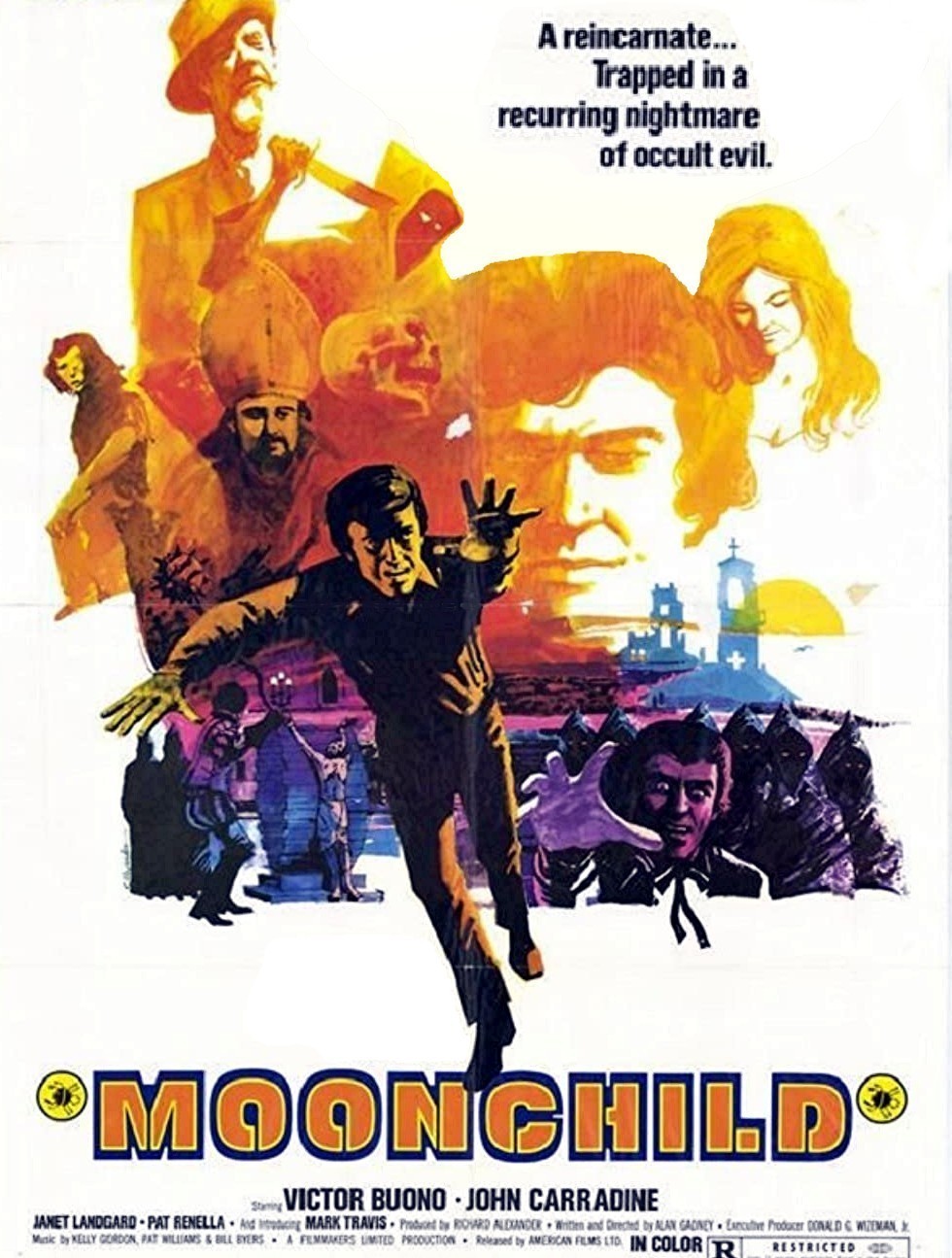
Publicity poster for Moonchild (© Alan Gadney/Filmmakers Ltd – reproduced here on a strictly non-commercial Fair Use basis for educational/review purposes only)

On 19 May 2022 I watched, and then last night rewatched, one of the strangest films that I have ever seen (and that's saying something for me!). Not to be confused with the werewolf movie of the same title released two years earlier (not that it could ever be confused with any other movie, shared title or otherwise, frankly!), this trippy, quintessentially '70s fantasy confection of great visual beauty but insuperably abstruse content is Moonchild.

Directed and written by Alan Gadney, filmed by him in 1971, and given a limited commercial release by Filmmakers Ltd in 1974 (during which its somewhat melodramatic publicity marketed it as a horror movie, which I don't consider it to be at all), Moonchild actually originated as a university student film, a project produced and submitted by Gadney for his Masters degree thesis at the University of Southern California. I'd previously read a fair amount about Moonchild before finally watching it, which was just as well, because for much of its length its plot is by no means evident, and even when events ultimately seem more lucid, it is by no means certain that they actually are. This presumably explains why I have read several different interpretations of the storyline, but here is mine.

Moonchild opens with an art student (played by Mark Travis), whose name is eventually revealed to be Gavalin (spelling?) and whose zodiac birth sign is Cancer (with Moonchild being a name often applied to Cancerians, hence the memorable title of this movie) painting on canvas a former Christian mission, now converted into a desert hotel but retaining its very imposing original architectural beauty. While painting, he is approached by an amicable but decidedly eccentric old man (John Carradine) who introduces himself as a poet and Walker of the World, or Mr Walker for short. After giving the student some ungratefully-received advice regarding his artwork, Walker suggests that they visit the mission so that the student can see its impressive appearance at close hand.

When they enter it, however, they are swiftly confronted by the hotel's very severe and decidedly unfriendly Manager (Pat Renella), who coerces the student into booking in as a guest, with Walker also booking in. The student is allocated a room whose number is 7 (which is later seen to have especial significance).

The student soon discovers that the hotel is populated by a host of bizarre, highly mysterious, secretive persons. These include a hunchbacked simpleton named Homunculus (Frank Corsentino) who serves as a lackey (and is one of the very few characters in this film to sport an actual name); a shrewish, vituperative housekeeper/maid (Marie Denn); and a good-natured, ancient-looking man who turns out to be an alchemist (William Challee) and may have created Homunculus. Most distinctive of all, however, is the Maitre D' (Victor Buono), who is a religious zealot of volcanic temperament, liable to erupt at any moment, especially when confronting the Manager, with whom he has a decidedly inimical emotional relationship. There is also an enigmatic young woman (Janet Landgard) who appears fleetingly, but whenever she is pursued by Travis, who experiences vivid flashbacks featuring the two of them in scenes of romance and sexual passion, she somehow disappears.

The student also experiences other flashbacks, in which he is a soldier and various other persons, as well as visualizing an ecclesiastical inquisition attended by red-garbed monks, plus the maid as a fanatical prosecutor, and the Maitre D' as the Grand Inqusitor, with the student and the alchemist on trial for heresy. It is here that the student – and the movie's audience – finally learns that his name is Gavalin (he had somehow managed to forget it until then). Walker is also present, recording the proceedings but also attempting to plead the student's case, only to be harshly rebuked by the Inquisitor for interceding on the latter's behalf instead of confining himself to recording the trial.

These flashbacks appear repeatedly throughout the movie, interspersed between scenes of the student at the hotel, and can be quite disorienting due to their abrupt appearances and mystifying content – until, at last, all is revealed…or is it?

Apparently, the student is trapped inside some kind of reincarnation cycle, and so too within his cycle are all of the persons at the hotel. Every 25 years, he finds himself back at the hotel, from which he duly escapes, but is soon killed, and is then reborn, over and over again, down through time, with his present life being his seventh – hence the significance of his hotel room's number. Only when his sins are purged from his soul can the cycle end – and only then will he find salvation and peace, as too will all of those trapped alongside him within his cycle. According to one review of this movie that I've read, in his first, original life the student was himself a killer, a murderer, but I personally saw no firm evidence for this in the movie, unless the reviewer was referring to the past life in which the student was a soldier?

In addition, it appears that the Maire D' and the Manager are fighting one another for the student's soul, the former upon the side of good, the latter upon the side of evil (though again I've read reviews claiming that the Maitre D' represents evil). In addition, the alchemist is denounced as a heretic because as an embryonic scientist he challenges religious orthodoxy, and the student's interest in his activities brings him into conflict with the Maitre D' too, as does his fervour for the elusive young woman, who personifies lust. And through it all, Walker records it all, and speaks in riddles, as does everyone else, for that matter, for much of the movie's length.

Finally, in the movie's eventful climax, the student breaks free of the hotel, escaping into the hills with the alchemist, who informs him that he has fled further this time than in any previous life (meaning that he has shed more sins this time?) – but the Manager is in hot, murderous pursuit! Moreover, as the reincarnation theme of the movie has by now been revealed to its audience by the characters, it's no spoiler to say that because the student has still not attained a state of total purity, he does not elude the Manager.

Instead, inevitably, the student meets his end yet again – only for the final scene to see him very much alive outside the mission, just like he was at the beginning of the movie, but this time equipped not with a canvas and easel to capture its appearance but with a movie camera instead, confirming that time (and attendant technology) has advanced quite considerably (another quarter-century) since his previous arrival there. And who should walk up and begin talking to him again? None other than Mr Walker, of course – because the student's reincarnation cycle has begun once more. But will his eighth life end in salvation for him at last? The movie has reached its end, so we never find out.

The only movie that I've ever seen which in any way reminds me of Moonchild is Malpertuis (click here to read my review of it). Both are dark fantasies infused with an almost tangibly malign atmosphere, peopled by an unfathomable company of grotesque characters, and ensconced within an otherworldly, preternatural setting ostensibly contained within our reality yet effectively delineated from it, which cycles incessantly. Indeed, some reviewers consider Moonchild to be a New Age-inspired allegory for the grand circle of life that drives our entire planet and everything that exists within it.

Best acting performance for me in Moonchild is definitely Carradine's, endowing the twinkly-eyed and somewhat loquacious Walker with the necessary mystique and verbal dexterity to yield a convincing, ever-interesting 'Keeper of Words' (one of his own description of himself). And the much-missed Victor Buono could always be relied upon to give his customary masterclass in delightfully hammy, unrestrained over-acting, with his OTT Maitre D' virtually chewing the scenery during his hyper-histrionic theological outbursts against the Manager, the student, and anyone else he happens to encounter!

The sumptuous scenes inside the mission/hotel and its architecturally spectacular exterior were reputedly filmed at the Riverside Hotel in California, And apart from a pervasive greenish lunar tinge most prominent in scenes of the student fleeing through never-ending subterranean tunnels and passages within the hotel's claustrophobic foundations from pursuing figures in sinister black robes and hoods with unseen faces and undetermined motives, the colours inside the hotel are vibrant and very diverse. As for its music, this is unequivocally late 1960s/early 1970s in style, as epitomized by its haunting, psychedelic opening theme song.

Some reviewers have variously written off Moonchild as pretentious unmitigated nonsense or impenetrable art-house folderol, and it may have been its overall rejection by audiences and critics alike at the time of its release that resulted in Gadney becoming a cinematic one-hit wonder, inasmuch as Moonchild is the first and only movie that he ever directed. If so, this is a great shame, because notwithstanding its baffling plot, I personally found Moonchild to be an immensely engrossing albeit incredibly surreal fantasy, beautifully filmed and thoroughly captivating, and I can only wonder what extraordinary movies Gadney would certainly have gone on to direct had he stayed in the world of film-making, refining his creativity and expanding his directorial experience.

I also wonder how a mere student producing a movie simply as a university project was able to enlist such a starry cast as John Carradine, Victor Buono, and William Challee. Yet like so much else concerning Moonchild, it seems unlikely that we shall ever know the answer to this mystery.

Moonchild may not be for everyone, but if like me you enjoy arcane Gothic fantasies with caliginous plots set in exquisite surroundings, then I definitely encourage you to give this undeniably weird but unjustly neglected masterpiece of the macabre a viewing – especially as if you click here you can currently watch the entire movie free of charge on YouTube.

To view a complete chronological listing of all of my Shuker In MovieLand blog's other film reviews and articles (each one instantly accessible via a direct clickable link), please click HERE, and please click HERE to view a complete fully-clickable alphabetical listing of them.

 
The student (Mark Travis) and the Maitre D' (Victor Buono) (© Alan Gadney/Filmmakers Ltd – reproduced here on a strictly non-commercial Fair Use basis for educational/review purposes only).


Tuesday, April 23, 2024

THE BRONX WARRIORS (aka 1990: THE BRONX WARRIORS aka THE RIFFS)

 
Close-up of the front cover of my EV ex-rental big box VHS video of The Bronx Warriors (© Enzo G. Castellari/Deaf International Film/Fulvia Film/EV – reproduced here on a strictly non-commercial Fair Use basis for educational/review purposes only)

After owning it unwatched for almost 40 years, last night I finally sat down and played my EV ex-rental big box VHS video of the English dub of a classic Italian action/near-future semi-sci fi movie from the early 1980s. Namely, 1990: The Bronx Warriors (aka The Bronx Warriors, The Riffs, 1990: I Guerneri del Bronx, and several other alternative release titles).

Directed by Enzo G. Castellari (who also takes a small acting role in it as the MC's vice-president), filmed in 1981, and released in 1982 by Fulvia Films, 1990: The Bronx Warriors (to give it its full title, as the year 1990 is central to its plot) belongs in some ways to the post-apocalypse survival sub-genre of science fiction movies, except that instead of the global disaster that usually features in them, here the devastation and gang rule is limited to a single borough of a single city, and has been caused not by nuclear annihilation but instead by officialdom's wholesale abandonment of said borough.

The city in question is New York City, the borough is the Bronx, and the year is 1990 – which is when, as announced in a brief preamble shortly after the movie opens, is when the NYC authorities gave up trying to fight the unrelenting crime wave that had overtaken this borough and abandoned it as a lawless no man's land. Since then, it has become a wholly feral hellhole, a ramshackle ruin of crumbling buildings and deserted homes, ruled by a diverse array of different gangs, each with its own fiercely-defended territory. And when it comes to the gangs, diverse is definitely the word to describe them.

The Riders, for instance, who take centre stage in this movie, is a no-nonsense motorcycle gang (some of its members were actually played by real-life Hell's Angels) led by the youthful albeit exceedingly tall Trash (played by Marco De Gregorio, but credited as Mark Gregory); whereas the Zombies, led by the charismatic Golan (George Eastman), zip around on roller skates in gleaming white shoulder-crescented costumes, wield deadly hockey sticks that are anything but jolly, and might have led to confusion with extras from Starlight Express – were it not for the incongruous fact that another gang, the ironically-titled Iron Men, actually do take their besequined sartorial inspiration from musical theatre (and are played by professional television dancers), but are no less violent than the other gangs all the same.

 
Trash (centre) in conference with some of his fellow Riders (© Enzo G. Castellari/Deaf International Film/Fulvia Film – reproduced here on a strictly non-commercial Fair Use basis for educational/review purposes only)

Also of serious note are the saloon-driving Tigers, led by the coolest dude this side of the Brooklyn Bridge, a kind of black Austin Powers known only as the Ogre (Fred Williamson), though he also styles himself King of the Bronx, and the other gangs pay him grudging, token respect as he is responsible for bringing into the Bronx from the outside world all manner of necessities, including food and especially weaponry – lots of it. Nor dare we forget the Scavengers, a gang of barely-human killers attired only in rags, who emerge from their subterranean hideaways to waylay anyone unfortunate enough to encounter these degenerate troglodytes who seem incapable of speech, communicating only via grunts and shrieks.

Clearly, the Bronx is not a safe place for any outsider to viait, which is why the sudden appearance there one night of a beautiful teenage girl named Ann (Stefania Girolami, the real-life daughter of director Castellari) attracts such interest – and not just from a group of Zombies who try to assault her, and from Trash who turns up in the nick of time to rescue her and take her back to the other Riders, where he swiftly falls in love with this veritable damsel in distress

For Manhattan's police and especially the exceedingly powerful president of a massive arms-manufacturing company based there named the Manhattan Corporation (MC) are soon aware of Ann's disappearance into the Bronx, thanks to a covert tagging device used by the MC called a gizmo. And because she just so happens to be the MC president's own daughter and therefore heiress to the entire company, he is determined to get her back safely, whatever it entails, and at whatever cost in money and human lives it takes.

With its core plot duly established, the rest of the movie is basically a thrilling series of set pieces initially involving inter-gang scuffles and skirmishes but followed by uneasy truces and co-operation in order to keep Ann safe once she reveals who she is and how she has fled because of her hatred of what the MC represents – its selling of weapons being responsible for untold killings and human suffering worldwide year after year. Needless to say, this is something that Ann wants no part of, but will be irrevocably linked to once she does eventually become its president.

 
Official concept artwork depicting a fraught scene featuring Trash opposing some inimical enemy bikers (but not present in the movie itself) (© Enzo G. Castellari/Deaf International Film/Fulvia Film – reproduced here on a strictly non-commercial Fair Use basis for educational/review purposes only)

Interspersed between the gangs' confrontations with one other are confrontations between the Riders (especially) and a psychotic Bronx-born mercenary named Hammer (Vic Morrow), who knows every inch of this godforsaken territory and has no scruples or conscience whatsoever in killing whosoever attempts to prevent him from recapturing Ann, having been hired and sent specifically to achieve this goal by her father. Reluctantly working alongside Hammer is another Bronx local, a deadbeat known only as Hot Dog (Christopher Connelly). Moreover, Hammer also gains a further ally when one of the Riders, Ice (John Loffredo), a treacherous, traitorous would-be usurper of Trash as leader of the Riders, volunteers to set gang against gang, which should enable the three of them during all of the undoubted ensuing mayhem to abduct Ann (and also, as Ice is secretly intending, to enable him to become supreme ruler of the Bronx when the gangs have all but exterminated each other.

As so often happens, however, the best-laid plans often fail to come to fruition, and Ice's is no exception. Let’s just say that when Hammer's actions falter, prompting the MC to send in a private army brandishing fire-throwers in addition to the usual artillery, the movie's climax is horrifically violent, with a truly apocalyptic death count, though in a last-minute twist, who is killed and who  survives may not be who you are expecting – it certainly caught me by surprise.

Overall, The Bronx Warriors is very redolent of other Italian movies of this genre that were emerging at much the same time, as well as Hollywood's cult 1979 classic The Warriors and John Carpenter's 1981 neo-sci fi thriller Escape From New York, as well as Australia's Mad Max franchise. In turn, it went on to inspire countless more action flicks in this same movie mould.  Consequently, as I'm a longstanding fan of such films there was nothing to see in it that I hadn't already seen countless times, with the albeit well-staged series of fight scenes beginning to pall after a time for me (though I can well understand why this movie attracted such fandom when first released to audiences who were far less accustomed back in the early 1980s to such superbly-choreographed spectacles).

On the plus side: despite this being a very violent movie there is scarcely any gore to be seen anywhere in it (though there may be more in uncut, unrated versions), which as far as I'm concerned is always a good thing – I'm a firm believer in the Hitchcockian approach to movie-making, i.e. gore is not more. Harnessing the human imagination can yield far greater scares and chills than anything presented fully on-screen.

 
The Ogre (actor/former American football player Fred Williamson) and Witch (actress/model/former Italian Olympic swimmer Elisabetta 'Betty' Dessy), his whip-lashing Tiger lady, luxuriating in their groovy Bronx pad (but actually filmed in Rome, Italy, whereas most outdoor scenes were indeed filmed in NYC itself (© Enzo G. Castellari/Deaf International Film/Fulvia Film – reproduced here on a strictly non-commercial Fair Use basis for educational/review purposes only)

Despite being a secondary character, The Ogre is certainly the most memorable in this movie, due to Williamson effortlessly stealing every scene that he appears in. Also arresting is Eastman as the Zombies' imposing crimson-garbed leader Golan (but named as Golem in some reviews read by me), making a pleasant change (at least by comparison) from his more (in)famous previous roles as cannibalistic serial killers (in Anthropophagus, 1980, and Absurd, 1981)! And Girolami's Ann is suitably pretty and decorous, contrasting sharply as the living Beauty against the dead, decayed, disintegrated Beast that had once been the thriving Bronx.

Conversely, although his fight scenes, motorbike riding, and stunts throughout the movie are both formidable and faultless (which is particularly noteworthy as he did everything himself, not using a stuntman double), and although I had no problem with his acting skills either (in spite of this movie being the very first that he'd appeared in), I did have a problem accepting Gregory as Trash, the all-powerful leader of a seriously tough adult biker gang.

My problem lay with the fact that Gregory had only just turned 18 (not 17, as often mistakenly claimed) when he filmed his role as Trash, and, unlike various other actors who can look much older than their real age, he really did only look 18. True he was tall, muscular, and undeniably very handsome, but he was clearly just a teenager, and as such I found it difficult to suspend disbelief in order to accept how someone like him could ever have become leader of a biker gang whose other members were all older, in some cases considerably older, than him (or at least looked it).

Perhaps it is no accident, therefore, that in publicity posters and on my video's front cover, Trash is portrayed in vibrant artwork depictions as a clearly much older, far more savage, bloodthirsty figure in full warrior mode, presumably to provide additional encouragement to viewers to watch the movie. Check out the three pictures below to see what I mean.

 
Trash, as seen from left to right in decreasing order of savagery (and in increasing order of reality) click pictures to enlarge for viewing purposes (© Enzo G. Castellari/Deaf International Film/Fulvia Film/EV – reproduced here on a strictly non-commercial Fair Use basis for educational/review purposes only)

Worth noting, incidentally, is that Gregory came to director Castellari's attention after Gregory's fiancée sent a photo of him to Fluvia Film, which resulted in Castellari requesting Gregory to attend an audition. Whatever Castellari saw there, he evidently liked very much, youthful age notwithstanding, because Gregory ultimately won the lead role of Trash over 2,000 other applicants. Yet by the end of the 1980s, Gregory was shunning the film industry limelight entirely, for reasons still unclear (though he'd begun to suffer emotionally), and slipped into almost total obscurity thereafter, tragically dying via suicide in 2013 aged only 48. One of the few films that he made before turning his back on the world at large was a Bronx Warriors sequel entitled Escape From The Bronx, which was released in 1983, and which I now plan to watch too.

Meanwhile,, despite taking such an inordinately long time to do so, I am very happy to have finally watched The Bronx Warriors, and I can confirm that for me it was certainly well worth the wait. Equally, if you are also a fan of this movie sub-genre, I feel sure that you will enjoy it too, particularly if you watch it in the context of its production and release during the early 1980s, i.e. over 40 years ago, and don't attempt to compare it directly with the effects-exploding blockbusters of today's cinematic experience. The Bronx Warriors is very much a film of its time, and therefore should be judged accordingly.

If you'd like to experience briefly the barbaric Bronx of 1990 in this action-packed alternate-timeline movie, please click here to watch an official 1990: The Bronx Warriors trailer on YouTube; or click here to watch the entire movie free of charge there.

Finally: to view a complete chronological listing of all of my Shuker In MovieLand blog's other film reviews and articles (each one instantly accessible via a direct clickable link), please click HERE, and please click HERE to view a complete fully-clickable alphabetical listing of them.

 
The full front cover of my ex-rental big box video of The Bronx Warriors (© Enzo G. Castellari/Deaf International Film/Fulvia Film/EV – reproduced here on a strictly non-commercial Fair Use basis for educational/review purposes only)


Sunday, April 14, 2024

CABIN BOY

 
Official American DVD of Cabin Boy (© Adam Resnich/Tim Burton/Touchstone Pictures/Tim Burton Productioms/Skellington Productioms/Buena Vista Pictures Distribution – reproduced here on a strictly non-commercial Fair Use basis for educational/review purposes only)

It's not often that either a Disney movie or an offbeat fantasy movie entirely escapes my attention, which makes the film that I watched last night on the British retro TV channel Talking Pictures rather special, because it is both a Disney/Touchstone movie AND an offbear fantasy movie yet was previously wholly unknown to me.

Directed and written by Adam Resnick, co-produced by Tim Burton, and released in 1994 by Buena Vista Pictures, the movie in question was entitled Cabin Boy.

Its titular character begins the movie as a petulant, thoroughly-obnoxious spoiled brat named Nathanial Mayweather (played by Chris Elliott), son of a zillionaire and newly graduated from colleage, who is meant to board a luxurious ship to take him to his father's plush hotel in Hawaii. Instead, his insulting treatment of a village local (a pseudonymously-credited David Letterman) sees him deliberately guided onto the wrong vessel.

Namely, a sleazy fishing boat whose rough-and-ready crew, skippered by the grizzly-mannered (and looking!) Captain Greybar (Ritch Brinkley), are setting far out to sea for three months in order to catch fish and have no time for a horrified Nathanial's hysterical histrionics once he discovers this awful truth.

 
Nathanial (Chris Elliott) and Trina (Melora Walters) in Cabin Boy (© Adam Resnich/Tim Burton/Touchstone Pictures/Tim Burton Productioms/Skellington Productioms/Buena Vista Pictures Distribution – reproduced here on a strictly non-commercial Fair Use basis for educational/review purposes only)
Thanks to his desperate but disastrous attempt to redirect their boat towards Hawaii, however, they all find themselves heading instead to a mysterious ill-omened sea zone named Hell's Bucket, containing an equally-dreaded island.

In revenge, Greybar and his crew make Nathanial serve them as their cabin boy, albeit with predictably preposterous results. Both en route to the island and upon arrival there, Nathanial and the crew find themselves confronting all manner of outlandish outsiders.

They include everything from a sex-starved six-armed woman named Calli (a sly nod to Ray Harryhausen's Sinbad antagonist Kali), a scowling scolding ginormous aerial cupcake (designed by Tim Burton and voiced by Jim Cummings), the fishing boat's female figurehead (Rikki Lake) who comes alive at the most unexpected moments, a belligerent iceberg monster (as in a belligerent monster actually composed of an iceberg!), and a half-man half-shark deepsea denizen named Chocki who takes pity upon hapless, hopeless Nathanial, rescuing him from assorted maritime perils, and played, incongruously, by none other than Hollywood's erstwhile song-and-dance musicals star Russ Tamblyn!

Nor is that all. Nathanial mistakenly 'rescues' from the waves what turns out to be a round-the-world swimming competitor in the shapely shape of Trina (Melora Walters), thereby disqualifying her. Unsurprisingly, Trina is initially resentful of Nathanial's well-meaning yet nonetheless calamitous action, but as the movie's romantic interest for him, she eventually falls for his goofy, bumbling charm.

 
Calli, played by Ann Magnusson (© Adam Resnich/Tim Burton/Touchstone Pictures/Tim Burton Productioms/Skellington Productioms/Buena Vista Pictures Distribution – reproduced here on a strictly non-commercial Fair Use basis for educational/review purposes only)

Needless to say, by the end of the movie Nathanial's experiences have transformed him into a sharing, caring kinda guy, and everyone lives happily ever after – except for a vengeful giant named Mulligan (Mike Starr), that is. Mulligan is the aggrieved husband of Calli, with whom Nathanial had lately travered his rite of passage into manhood.  Not surprisingly, Mulligan is hardly best pleased about this, but he finds himself belted in every sense of the word by the newly-invigorated Nathanial in a bold, unselfishly brave bid to save his fellow shipmates from Mulligan's ire.

Cabin Boy is every shade of zany imaginable (and then some!), with Elliott giving a riotously funny performance as Nathanial, amply augmented by countless sight gags and amusing asides – I loved it!

To experience a salty snippet of the maritime mayhem awaiting you in Cabin Boy, be sure to click here to watch an official trailer for this movie on YouTube.

Finally: to view a complete chronological listing of all of my Shuker In MovieLand blog's other film reviews and articles (each one instantly accessible via a direct clickable link), please click HERE, and please click HERE to view a complete fully-clickable alphabetical listing of them.

 
Confronting the iceberg monster (© Adam Resnich/Tim Burton/Touchstone Pictures/Tim Burton Productioms/Skellington Productioms/Buena Vista Pictures Distribution – reproduced here on a strictly non-commercial Fair Use basis for educational/review purposes only)


Friday, April 5, 2024

THE BATTLE OF THE MODS (aka CRAZY BABY)

P
hoto-still of Ricky Shayne as Ricky Fuller in The Battle of the Mods (© Franco Montemurro/Roxy Film/Ultra Film/GG Productions – reproduced here on a strictly non-commercial Fair Use basis for educational/review purposes only

On 6 December 2023, my movie watch was a strange little cinematic offering – a gritty mid-1960s Italian/German film musical overdubbed in English and variously entitled The Battle of the Mods or Crazy Baby upon release, but nowadays wholly obscure.

Directed by Franco Montemurro, and released in 1966, The Battle of the Mods stars 60s European music star Ricky Shayne as mod guitar player Ricky Fuller residing in Liverpool until his girlfriend is fatally stabbed one Saturday evening when the club where he is performing becomes the scene of a vicious mods vs rockers battle.

 
Close-up of one of Ricky Shayne's LPs with his backing group The Skylarks (© Ricky Shayne and the Skylarks/ARC Records/RCA Victor Records – reproduced here on a strictly non-commercial Fair Use basis for educational/review purposes only)

Only narrowly escaping with his life, Ricky flees to France and thence to Italy, to meet in Rome his wealthy English consul father Robert B. Fuller (Joachim Fuchsberger), with whom he has not so much a frosty as a perma-frost longstanding relationship, and also his father's mistress, Sonia (Elga Andersen), with whom he has a much shorter but much more sizzling one!

In addition, Ricky makes some friends in Paris, Genoa, and Rome, survives various hairy encounters with a diverse selection of continental roughs and toughs, meets plenty of pretty young women, sings a lot of relatively tuneful albeit instantly forgettable pop/rock songs (opening the movie with its raunchy alternative title song, 'Crazy Baby') while playing his guitar, and ends his jounreying with a new girlfriend, Martine (Eleonora Brown). And that's about it.

 
Italian publicity poster for The Battle of the Mods (© Franco Montemurro/Roxy Film/Ultra Film/GG Productions – reproduced here on a strictly non-commercial Fair Use basis for educational/review purposes only

Visually, The Battle of the Mods is a quintessential 1960s European musical flick, a movie sub-genre that generally appeals to me, but I found this particular example to be oddly unengaging, with its central character similarly aloof and emotionally detached.  Still, it passed 90 minutes easily enough, and at least I learnt of French-Lebanese singer/actor Ricky Shayne and his backing group The Skylarks, who collectively turned out to be a big act in continental Europe back in the day (especially in Germany), but not in the UK, which explains why I'd not previously heard of him, or them.

Lastly, Eurovision Song Contest fans may be interested to know that The Battle of the Mods features an appearance by Udo Jürgens, who had won the contest for Austria in the same year, 1966 (but just a few months earlier), when this movie was released.

 
Ricky Shayne playing guitar (public domain)

If you'd like to watch The Battle of the Mods for free on YouTube, pleae click here.

Finally: to view a complete chronological listing of all of my Shuker In MovieLand blog's other film reviews and articles (each one instantly accessible via a direct clickable link), please click HERE, and please click HERE to view a complete fully-clickable alphabetical listing of them.

 
Publicity material for Ricky Shayne and the Skylarks (© unknown to me despite online searches – reproduced here on a strictly non-commercial Fair Use basis for educational/review purposes only)