Dr Karl Shuker's Official Website - http://www.karlshuker.com/index.htm

IMPORTANT:
To view a complete, regularly-updated listing of my Shuker In MovieLand blog's articles (each one instantly clickable), please click HERE!

IMPORTANT:

To view a complete, regularly-updated listing of my ShukerNature blog's articles (each one instantly clickable), please click HERE!

IMPORTANT:
To view a complete, regularly-updated listing of my RebelBikerDude's AI Biker Art's thematic text & picture galleties (each one instantly clickable), please click HERE!

IMPORTANT:
To view a complete, regularly-updated listing of my Starsteeds blog's poetry and other lyrical writings (each one instantly clickable), please click HERE!

IMPORTANT:
To view a complete, regularly-updated listing of my Eclectarium blog's articles (each one instantly clickable), please click HERE!


Search This Blog


Saturday, February 11, 2023

CRUELLA

 
Publicity poster for Cruella (© Craig Gillespie/Walt Disney Pictures/Mark Platt Productions/Gunn Films/Walt Disney Studios Motion Pictures – reproduced here on a strictly non-commercial Fair Use basis for educational/review purposes only)

On 20 October 2022, I watched two movies. One of them was The Adventures of Pluto Nash (reviewed by me here), which I'd fully expected to enjoy, but didn't. Far more to my taste, though I hadn't expected it to be, conversely, was my second, and very different, movie watch on that same day – the Disney live-action feature film Cruella, set in London's late-1970s punk-pervading fashion world.

Directed by Craig Gillespie, and released in 2021 by Walt Disney Studios Motion Pictures, Cruella presents a newly-construed back story for one of Disney's greatest villainesses – the 101 Dalmatians' fur-obsessed nemesis Cruella de Vil. The notoriously nefarious fanatic is played with smirking, diabolical delight by Emma Stone, her spellbinding performance earning her in 2022 a Golden Globe nomination for Best Actress.

Originally created by Dodie Smith in her delightful 1956 children's novel The Hundred and One Dalmatians, Cruella first appeared on screen as a Disney character in their classic 1961 animated feature film One Hundred and One Dalmatians (in which her distinctive appearance was apparently based upon flamboyant actress Tallulah Bankhead), as well as in a straight-to-video animated sequel movie, 101 Dalmatians II: Patch's London Adventure (2002). She also stole the show in two live-action Disney films – 101 Dalmatians (1996), which was a reworking of their 1961 cartoon movie; and 102 Dalmatians (2000), presenting an all-new, totally original story – due entirely to the wholly unrestrained, fittingly psychotic, rabid portrayal of her in two outstanding performances by Glenn Close (who also served as an executive producer for Cruella). So Disney certainly has excellent form when it comes to providing superb big-screen representations of everyone's favourite fur fetishist.

Even so, I still began watching this newest Disneyfied Cruella incarnation with great trepidation, because I feared that in devising an original back story for her the Disney studio would repeat the travesty that imho they had concocted for Sleeping Beauty's wicked fairy Maleficent in their eponymous 2014 live-action/CGI feature film starring Angelina Jolie in the title role. Namely, seeking to transform an unequivocally, irredeemably evil entity into a misconstrued, misunderstood waif who'd simply had some bad press after she'd been done wrong by her lover (all of which was conspicuous only by its absence in Disney's original 1959 Sleeping Beauty animated feature!). Click here for my review of Disney's movie Maleficent.

Happily, however, I was both delighted and heartily relieved to discover that my fears were entirely unwarranted, inasmuch as this take is not taken in Cruella. Instead, we are shown a character who, even as a child, is, shall we say, difficult – and feisty, insanely so at times – albeit with a huge, innate talent for fashion design, not to mention her unique black-and-white hair that she dyes red throughout her youth to avoid unwelcome, unpleasant comments from outsiders.

Cruella's birth name is actually Estella Miller, but after her mother is killed, for which Estella wrongly blames herself, she decides that a radical reinvention of her life is in order. So she inveigles an initial invitation but subsequent formal engagement to work as a junior designer at the highly prestigious London fashion house of a ruthlessly despicable, shamelessly unprincipled, autocratic, egotistical, and thoroughly narcissistic monster of a leading designer named The Baroness – played in absolutely scintillating OTT style by Emma Thompson (who won the role over the likes of Nicole Kidman, Demi Moore, Julianne Moore, and Charlize Theron). However, she also creates a secret identity to use for future fashion design purposes of her own, separate from her work for The Baroness's fashion house, naming it Cruella (a childhood nickname), later expanding it to Cruella de Vil.

But when Estella discovers that it was The Baroness, not herself, who was responsible for her mother's death, she loses it big time, becoming thoroughly unhinged and determining to avenge her mother at all cost – by unleashing her still-cryptic yet coruscating fashion designer alter ego Cruella de Vil upon the unsuspecting fashion world in general, and the Baroness in particular.

Except, as it turns out, Estella's mother, so kind and demure (and hence entirely unlike Estella/Cruella), was not her real mother after all, Guess which ruthlessly despicable, shamelessly unprincipled, autocratic, egotistical, and thoroughly narcissistic monster of a leading designer (and therefore a wholly Cruella-comparable character) was – and still is??

 
My newly-purchased official Disney Store resin figurine of Cruella De Vil (© Wolfgang Reitherman/Clyde Geronimi/Hamilton Luske/Walt Disney Productions/Buena Vista Distribution – reproduced here on a strictly non-commercial Fair Use basis for educational/review purposes only)

Dastardly diva designer is promptly pitted against dastardly diva designer, daggers – and much else too! – are drawn, but there can only be one winner, one cut-throat cut above all others, when competing for the highest of stakes in the high-risk, hubristic, hedonistic fashion world. So who will it be?

Visually, Cruella the movie is a spectacular sight to behold, with extravagant costumes that make even the most flamboyant catwalk creations of late look positively bland and impoverished in comparison. Those in black and white are especially effective, like gothic versions of the iconic Cecil Beaton haute couture on show in the unforgettable Ascot Gavotte scene from the timeless 1960s movie musical My Fair Lady. Deservedly, therefore, in 2022 Cruella duly won both an Oscar and a BAFTA award for Best Costume Design.

Incidentally, if you've already watched this film and are wondering why Cruella is never seen with her trademark long-stemmed cigarette holder, smoking a cheroot, which was always so visible in Disney's earlier dalmatian movies, this is because since 2007 the Disney Studio has banned the showing of characters smoking in its films.

As for this movie's soundtrack – it samples snatches of an extraordinarily eclectic selection of popular songs – just about everything by everyone, in fact, from Doris Day, Judy Garland, Nina Simone, Nancy Sinatra, and Ken Dodd to Black Sabbath, The Rolling Stones, Ike & Tina Turner, David Bowie, and The Clash!

It may be over 2 hours long, but Cruella is – to steal the title of a popular TV comedy show – absolutely fabulous, with all manner of tantalising twists and turns unveiling themselves throughout the storyline. My attention never sagged, and its teasing ending left the door wide open for a sequel. Sure enough, Disney subsequently announced that a sequel is now being developed – I can't wait!!

If you'd like to venture briefly into the mad, bad, but bedazzling world of fashion à la Cruella, be sure to click here and here to watch on YouTube a couple of  devilishly delightful Cruella trailers, darling!

Finally: to view a complete chronological listing of all of my Shuker In MovieLand blog's other film reviews and articles (each one instantly accessible via a direct clickable link), please click HERE, and please click HERE to view a complete fully-clickable alphabetical listing of them.

 
Disney's original cartoon version of Cruella de Vil (albeit sans cigarette holder) from their 1961 animated movie One Hundred and One Dalmatians (© Wolfgang Reitherman/Clyde Geronimi/Hamilton Luske/Walt Disney Productions/Buena Vista Distribution – reproduced here on a strictly non-commercial Fair Use basis for educational/review purposes only)


Friday, February 10, 2023

THE 5,000 FINGERS OF DR. T (aka CRAZY MUSIC)

 
Publicity poster for The 5,000 Fingers of Dr. T (© Roy Rowland/A Stanley Kramer Company Production/Columbia Pictures – reproduced here on a strictly non-commercial Fair Use basis for educational/review purposes only)

There are some seriously strange movies out there, and speaking of which: wow, did I watch a strange movie on 2 February 2022? I most certainly did – because the film in question (visually dazzling nonetheless on Blu-Ray) was the nowadays highly divisive fantasy movie musical The 5,000 Fingers of Dr. T. Indeed, it's fair to say that if films were foodstuff, this one would be Marmite – either you love it or you hate it, there's no middle option. So I'll leave you to read this review and decide for yourself whether or not it's to my taste…

Directed by Roy Rowland and released in 1953 by Columbia Pictures, The 5,000 Fingers of Dr. T. was written (as in its story, screenplay, and even its songs' lyrics) by none other than American author/cartoonist Dr Seuss (aka Theodor Seuss Geisel) – he of such beloved and famously child-friendly books (and their respective on-screen animated featurette versions) as The Cat in the Hat, Horton Hears A Who, How The Grinch Stole Christmas, and (my own particular favourite) The Lorax.

In stark contrast, however, The 5,000 Fingers of Dr. T comes across imho as a thoroughly mad movie, and is one that has terrified generations of children following its original early 1950s release when it was a major commercial and critical box office flop.

I first saw it on TV in b/w, as a child during the late 1960s, after being warned by my mother beforehand that it was a decidedly weird film (so much so that she was initially reluctant for me to  view it at all), and I did find parts of it decidedly scary (the dungeon elevator, anyone?). Now, more than five decades later, I have finally seen it in vibrant full colour, but although it is visually sumptuous, awash with bright rainbow hues, extravagant polychromatic costumes, and spectacular ultra-surrealistic sets replete with spiraling curves and curvaceous spirals, this movie remains just as macabre as I remembered it – how anyone, let alone Dr Seuss, could ever have thought it suitable for kids beats me.

The plot of The 5,000 Fingers of Dr. T is all about a small fatherless boy named Bart Collins (played by Tommy Rettig) whose widowed mother Heloise Collins (Mary Healy) is insistent that he learn to play the piano. However, his piano teacher Dr Terwilliker (Hans Conried, in outrageously albeit hilariously OTT mode throughout) is a terrifying figure – and even more so in the nightmare that Bart experiences after falling asleep while practicing his piano playing.

In his nightmare, Bart finds himself imprisoned within the sinister Terwilliker Institute where his bombastic piano teacher is now an insane dictator who has created an enormous piano to be played by 500 enslaved children – his 5,000 fingers. And to make matters even worse, Terwilliker has hypnotized Bart's mother, who works for him at his Institute, in order for her to do his evil bidding against her own child; Terwilliker even plans to marry her, and thus become Bart's new father (all of this scenario potentially representing a subconscious dream-extrapolated fear by Bart that in real life his imperious piano teacher is exerting too much influence on his mother?).

Bart's only 'ally' against the tyrannical Dr T is August Zabladowski (Peter Lind Hayes), a plumber/repairman in the real world who often attends to plumbing jobs and general repairs around their house that Bart's mother is unable to do, and is looked upon by Bart as something of a father figure. In his nightmare, however, Bart encounters Zabladowski carrying out work for Terwilliker at the Institute, but despite Bart's beseeching he seems less willing to believe what the boy is telling him about Terwilliker's machinations and mesmerisings, and more willing simply to turn a blind eye and deaf ear to all of it, in order to ensure that his work is completed on time so that he gets paid by the terrible Terwilliker. Only after encountering the awful truth at first hand (and with most of the movie over with by now anyway) does Zabladowski finally condescend to help poor Bart in rescuing the other 499 enslaved children as well as himself and his mother.

The 5,000 Fingers of Dr. T originally ran for 2 hours but received such bad previews that it was cut to just 92 mins for its theatrical release – judging from what remains, I dread to think what horrors were deleted! (Actually, I do know of one particularly infamous example, but it's far too distasteful to mention here, in a family-friendly blog, so I won't – check it out on YouTube if you can't contain your curiosity; also, no fewer than nine of the original 20 songs and instrumental numbers were excised following the previews.)

Notable for featuring one of the weakest, most spineless father figure characters I've ever had the displeasure of watching in what is supposed to be a fun-filled kids' movie – yes indeed, Zabladowski, I do mean you! – as well as a brief appearance from a young pre-West Side Story George Chakiris as a dancer, The 5,000 Fingers of Dr. T is without doubt among the most bizarre, unsettling 'family' films that I have ever seen. Following its ill-fated premiere, when some of the audience apparently walked out after just 15 minutes, even Seuss himself referred to it (and in classic Seuss-speak no less!) as a "debaculous fiasco", and there is no mention of it in his official biography.

Moreover, in view of how dramatically it flopped when first released, I am guessing that many other viewers must have shared my misgivings, and which in turn may well explain why, when finally re-released some years later, this menacing musical was retitled, somewhat aptly, as Crazy Music – as if in a bid to cleanse it of all immediate, tainting connotations with its disastrous debut.

Speaking of music: as seen in the publicity poster opening the present Shuker In MovieLand review, when originally billed as The 5,000 Fingers of Dr. T this film musical was advertised with the tag line "Songs You'll Never Stop Singing". Hah! I pride myself as someone with an ear for a catchy tune and clever lyrics, and a memory for recalling such songs long after first hearing them – but those in The 5,000 Fingers of Dr. T (lyrics by Seuss but music composed by Frederick Hollander) evidently made no impression upon me whatsoever, because I can't recall a single line or melody from any of them.

What on earth went wrong with what must have offered such promise at its concept – a visually gorgeous family-friendly film musical devised by the unfailingly popular Dr Seuss? It should have been a recipe for movie magic, but instead it became a big-screen bomb of atomic proportions (one of which actually features in this movie – don't ask!). In my opinion, and quite apart from the indisputable facts that it lacks both comedy and cohesion, its inherent problem actually lies in its originality, i.e. in the very nature of its staging – as a live-action movie.

We've all seen animated movies in which the villains perform all manner of truly despicable, even deranged acts and activities – but they get away with them as far as not eliciting adverse audience reaction is concerned because they are only cartoon characters, and by definition we tend to suspend disbelief instantly and entirely when watching cartoons.

Live action, however, is a very different matter. What may seem merely zany and detached from reality in animated movies can appear deeply disturbing if attempted in live-action films – and what, therefore, irrefutably damned The 5,000 Fingers of Dr. T in my view is that its style of presentation on-screen is to all intents and purposes that of a live-action cartoon. This in itself was not unexpected, because the stories in Dr Seuss's books are indeed presented as cartoons, but The 5,000 Fingers of Dr. T revealed that his offbeat, somewhat subversive brand of humorous lunacy simply did not transfer well from a cartoon format into a live-action counterpart.

Remember too that this movie's plot was an original story, not an adaptation from a pre-existing Dr Seuss book – had there been such a book, the audience would have already been familiar with the movie's storyline and thence might not have been so shocked or startled by it. Perhaps, then, The 5,000 Fingers of Dr. T should have been issued in book form first, and not just to familiarize readers with it but also to test their reaction to it. For if such a book had elicited a bad response, and with unfavourable reviews too, the chances are that no movie of it would ever have been produced, thus saving time, talent, and a very considerable financial input all round.

As it was, the fallout was sufficient for Dr Seuss never to attempt another live-action feature-length movie (a few based on various of his books have been made by others since his passing in 1991), which is a tragedy. Handled differently, I feel sure that he could have created movies as memorable and spellbinding as his books and animated releases. Ironically, however, and as often happens with movies that so notoriously crashed and burned upon their original release long ago, The 5,000 Fingers of Dr. T has actually attracted quite a cult following in recent years, and is even considered something of an art film – or something, anyway!

If you wish to experience for yourself a sample of what in my opinion is an unequivocally weird but very far from wonderful cinematic curiosity, click here to view an official (albeit rather sludgy-looking!) trailer for The 5,000 Fingers of Dr. T on YouTube. Finally (and with apologies to Dr Seuss): I cannot say if you will like, you may prefer to ride a bike, but this I say (no need for thanks), as kiddie fayre this movie tanks!

To view a complete chronological listing of all of my Shuker In MovieLand blog's other film reviews and articles (each one instantly accessible via a direct clickable link), please click HERE, and please click HERE to view a complete fully-clickable alphabetical listing of them.


Thursday, February 9, 2023

RAGING ANGELS, CRYSTAL SKULLS, HUMAN CENTIPEDES, A MONSTER IN URANUS... - ENOUGH ALREADY!

 
The giant cyclopean rat monster that threatens the visiting astronauts in Journey to the Seventh Planet, as portrayed by acclaimed Swedish artist/animator and longstanding friend Richard Svensson aka The Lone Animator (click here to access my review of one of his own movies, and here to visit his fascinating official website) (© Richard Svensson/The Lone Animator)

Continuing my theme of lately-watched movies of the seriously strange kind that I began here, permit me to present without further ado a second six-pack of offbeat cinematic offerings.

 
Publicity poster for Journey to the Seventh Planet (© Sidney W. Pink/Cinemagic Inc/American International Pictures – reproduced here on a strictly non-commercial Fair Use basis for educational/review purposes only)

JOURNEY TO THE SEVENTH PLANET

My movie watch for 25 June 2022, screened on the UK retro TV channel Talking Pictures, was a low-budget but fascinating Danish-American sci fi curio from the early 1960s entitled Journey to the Seventh Planet, which was directed by Sidney W. Pink, and released in 1962 by American International Pictures. The planet in question is of course Uranus, whose name has often led (depending upon how you pronounce it!) to all manner of saucy jokes, thereby explaining no doubt why Seventh Planet was used instead within this movie's title! Anyway, it's all about the first scientific space voyage from Earth to the afore-mentioned planet, where the thoughts of the astronauts (led by Captain Don Graham, played by John Agar) are infiltrated and manipulated by a hidden, subterranean entity that has plans to invade the Earth by possessing their bodies and then controlling the minds of everyone else there. Due to this subliminal mind manipulation, the astronauts see Uranus not as the ice planet that it really is but one that is covered with lush forests resembling those of their homelands on Earth, and incongruously populated by former girlfriends, but also by whatever most terrifies them. In the case of one astronaut, his greatest fear is rats, so a gigantic cyclopean rat looms large to attack him (see the representation of this monstrous mammal by Swedish artist Richard Svensson that opens the present Shuker In MovieLand series of mini-reviews). It's all very redolent of the original Star Trek episode 'Shore Leave', as well as the classic movie Forbidden Planet. The acting is as wooden in some cases as the trees in the imaginary forest, but visually it is colourful and always entertaining. Incidentally, the original monsters created for this movie, which appear on lobby cards and publicity posters like the one presented above, never made it to the finished film, because one of its co-writers successfully lobbied to have them removed and replaced by new creations, such as said one-eyed mega-rat, a stop-motion monster produced by Jim Danforth. Click here to view an official trailer for this movie on YouTube.


Publicity poster for Little Monsters (© Richard Alan Greenberg/Vestron Pictures/Davis Entertainment Company/Licht-Mueller Film Corporation/United Artists – reproduced here on a strictly non-commercial Fair Use basis for educational/review purposes only)

LITTLE MONSTERS

Did you know that there really are monsters under your bed when you're a child? That is the premise of a very funny and highly inventive fantasy movie from the late 1980 but which I watched for the very first time on 5 January 2023 – Little Monsters. Directed by Richard Alan Greenberg, and released in 1989 by United Artists, it stars Fred Savage as lonely 11-year old Brian Stevenson who befriends the blue-skinned, highly-erratic, and very mischievous but friendly humanoid monster Maurice (Howie Mandel) that he traps under the bed of his younger brother Eric (Fred's real-life younger brother Ben). Maurice takes Brian on several extremely enjoyable visits to the alternate monster-inhabited universe existing beneath the beds of children all over America, but there is a downside to their fun and friendship – Brian discovers to his alarm that he is turning into a monster himself... Little Monsters is family-friendly fantasy at its very best, with imaginative sets for the monster realm, plus a thrilling climactic scene and an ultimately poignant ending marking the passing of childhood dreams and the onset of maturity. I thoroughly enjoyed this movie  and am very surprised at how little it is remembered today (not to mention how difficult it was to obtain in physical format). Click here to view an official trailer for this movie on YouTube.


A foreign DVD's content menu for Rock Monster, depicting the Monster and major characters (© Declan O'Brien/Syfy Channel – reproduced here on a strictly non-commercial Fair Use basis for educational/review purposes only)

ROCK MONSTER

My movie watch on 14 November 2022, courtesy of Legend TV here in the UK, was one of SyFy Channel's quirkier fantasy-themed creature features – Rock Monster. Directed by Declan O'Brien, and released in 2008 by Syfy Channel, Rock Monster is all about American student Jason (Chad Michael Collins) visiting with some friends an Eastern European village to take possession of an inherited mansion, but while travelling en route through a forest they encounter a sword in a stone – really! – and, yes indeed, Jason pulls it out in best Arthurian tradition. In so doing, however, and initially unknown to any of them, Jason's action has revitalised a gigantic rock monster containing the undead soul of an evil wizard slain by a knight 800 years ago. Said monster soon causes all manner of death and destruction in and around the village, and one of the village's inhabitants, an evil dude named Dimitar (David Figlioli) who clearly buys his clothes at a Matrix cast-off shop and possesses a blood-red keystone, is also determined to possess the sword, at any cost. This is because once the keystone is placed inside the sword's hilt and the latter raised up into the sun's light, its holder will absorb the wizard's soul from the rock monster and become both immortal and invincible. In the meantime, Dimitar controls the rock monster who does his evil bidding. Not looking good for the students – except for the crucial fact that Jason is a descendant of the selfsame knight who originally slew the wizard 800 years ago and he therefore embodies the power to repeat his ancestor's brave feat, as he alone can harness the sword's latest magical capability. Like I said, Rock Monster is a distinct oddity of a movie in which modern-day familiarity and ancient fantasy rub shoulders and share screen time often in a very uncertain, uncomfortable manner. Nevertheless, it is a fun, undemanding watch, and the rock monster is entertaining, albeit more akin to those kinds of entities found in computer games than on the big or small screen. Click here to view an official trailer for it on YouTube.


The official UK DVD of Raging Angels (© Alan Smithee/Nu Image/Chako Film International Productions/Vidmark Entertainment – reproduced here on a strictly non-commercial Fair Use basis for educational/review purposes only)

RAGING ANGELS

On 25 February 2022, only a couple of days after viewing the classic 1997 Keanu Reeves/Al Pacino supernatural/horror thriller movie Devil's Advocate (based on Andrew Neiderman's eponymous 1990 novel), I watched a much lesser-known but in some ways comparable fantasy/horror movie, Raging Angels. Directed by Alan Smithee, and released in 1995 by Vidmark Entertainment, Raging Angels features much the same premise as Devil's Advocate, except that this time it is not a firm of lawyers but a world peace organisation that is at the heart of the diabolical activities, fronted by a charismatic rock star named Colin (played by Michael Paré). Oddly, the sinister-looking character on the cover of the DVD here is not the villain (Colin) but the good guy, musician Chris (Sean Patrick Flanery), who never looks sinister like this in the actual movie. Chris has his work out trying to rescue his singer girlfriend Lila (Monet Mazur) when she is lured by Colin into some very grim goings-on, but who will succeed – Chris or Colin? Raging Angels also stars Shelley Winters and Diane Ladd, and features plenty of Heavy Metal/Glam Rock tracks along the way, not to mention a climactic sky-hosted angel-demon battle of truly animated activity, in every sense. Click here to view an official trailer for this movie on YouTube.


The official UK DVD of Crystal Skulls (© Todor Chapkanov/Origin Releasing/Odyssey Media Inc/BUFO/SyFy Channel – reproduced here on a strictly non-commercial Fair Use basis for educational/review purposes only)

CRYSTAL SKULLS

Arriving home from an appointment earlier than I'd expected on 2 August 2022, I was just in time to catch on the UK's Legend (formerly Horror) retro TV channel the sci fi movie Crystal Skulls, which I'd wanted to watch for some time. Directed by Todor Chapkanov, and released in 2014 by SyFy Channel, Crystal Skulls is all about 13 legendary ancient crystal skulls reputedly hidden in various secret locations around the world. Dying zillionaire William Hadden (played by David Rintoul) has managed to locate and retrieve 12 of them and now seeks the 13th, in the belief that when they are all united, the energy that they will release will cure his cancer. However, all does not go to plan when the 12 that he has already acquired and placed together begin emitting powerful beams of energy, resulting in an enormous electromagnetic pulse that shuts down much of Western Europe's power supplies. And when gung-ho NASA soldier Colonel Bailey (J.R. Esposito) tries to destroy them, events take an even more dangerous turn – as in the onset of the apocalypse! The world can only be saved from imminent annihilation if the 13th skull is found and placed alongside the other 12. So off sets rogue professor John Winston (Richard Burgi), armed with a book of notes that his lost father made when he had – seemingly unsuccessfully – sought the very same skull many years previously. Will he save the day – and all other days to come, for that matter? Indiana Jones trekked much the same movie trail in far greater style and spectacle, but this low-budget alternative, filmed in Bulgaria, is still a very watchable movie, and for me was well worth the wait to see it. Click here to view an official trailer for it on YouTube.


The official UK DVD of the uncut, uncensored, director's cut of The Human Centipede (First Sequence) (© Tom Six/Six Entertainment Company/IFC Films/Bounty Films – reproduced here on a strictly non-commercial Fair Use basis for educational/review purposes only)

THE HUMAN CENTIPEDE (FIRST SEQUENCE)

And finally: On 8 October 2022 I returned home from a car boot sale with a big bag full of dumped unsorted DVDs. After I went through these very welcome freebies, I discovered several that were new to me and which I decided to keep to add to my own collection. I also found one truly notorious Dutch monster movie, and in its so-labelled "Uncut, Uncensored, Director's Cut" version, no less. So, albeit not without some trepidation, based upon what I knew from having read and heard tell about this film, I watched it later that day. Directed by Tom Six, who also wrote and co-produced it, and released in 2010 by Bounty Films, this truly grotesque "mad scientist creates human monster/body horror" flick was entitled The Human Centipede (First Sequence). Yes indeed, it's that one! In it, said mad scientist, retired surgeon Dr Josef Heiter (played by Dieter Laser), abducts three young people (a male Japanese tourist and two female American tourists), drugs them, then, while they're unconscious, sews them together so that when they awaken they discover to their horror that they're now a three-segment monstrosity, linked to one another in an anus-to-mouth-to-anus-to-mouth human chain so as to yield internally a single continuous gastrointestinal tract! As a zoologist, I was probably less shocked by this notorious film than various friends who've viewed it in the past have been, especially as the infamously repellent aspects involving how this 'human centipede' feeds its three segments mercifully occurs either off-screen or are only implied via deft viewer-shielded camera angles when on-screen. Also, for me its twisted premise is in reality so profoundly ridiculous that I found it impossible to take the movie even remotely seriously anyway. Nevertheless, I shan't be viewing it again – or either of its two sequels (which are said to be far more explicit). If you want to know more about this bizarre movie, you'll have to read it up for yourself, or view the official G-rated trailer for it currently on YouTube if you so wish, but I shan't be providing a link to it here.

To view a complete chronological listing of all of my Shuker In MovieLand blog's other film reviews and articles (each one instantly accessible via a direct clickable link), please click HERE, and please click HERE to view a complete fully-clickable alphabetical listing of them.


Wednesday, February 8, 2023

BLACK LEATHER JACKET

 
Astride my first Honda CX500 motorbike during the early 1990s and  wearing my self-customised black leather jacket (BLJ) that was officially displayed at the Walsall Leather Museum's BLJ Exhibition in autumn 1993, and which was also featured in Mike Phillips's article 'Black Art', on the subject of the BLJ, published by the British monthly motorbike magazine Bike in its October 1993 issue (© Dr Karl Shuker)
 
It's been quite a while since this blog last journeyed there from MovieLand, so it's high time that I crossed the border once again to pay another of my occasional visits to TV Land – and for what better reason than to indulge my lifelong passion for all things appertaining to motorbikes, via my recalling here today a very memorable 1980s TV docu-movie that led to one of my very own motorbike jackets becoming both a star exhibit and a media star!
 
  
Full cover of my official sell-thru VHS video of Black Leather Jacket (© Nick Mead/Paul Cowan/Mick Farren/Channel 4 Television Corporation/Polygram Music Video – reproduced here on a strictly non-commercial Fair Use basis for educational/review purposes only)

As a biker ever since my late teens in the 1970s, my habitual and favourite garment of choice to wear has always been the classic black leather jacket, of the motorbike style beloved by bona fide, would-be, and on-screen bikers alike, not to mention rock stars, fashion models, punks, and rebels of every shape, size, and description.

So when while browsing in a bookshop one Sunday afternoon during the mid-1980s in the Warwickshire, England, town of Stratford-upon-Avon, world-famous as the birthplace of one William Shakespeare, I chanced upon a fairly large brand-new hardback book entitled The Black Leather Jacket, sporting an embossed, textured front cover designed to look and even feel like the real thing, and documenting the fascinating history of this truly iconic item of clothing, I lost no time whatsoever in purchasing it and reading it from cover to cover as soon as I arrived back home.

Written by English journalist Mick Farren and first published in 1985, this engrossing book reveals and extensively illustrates via a comprehensive selection of very distinctive glossy b/w photographs how its titular subject, the black leather jacket (or the BLJ, as I'll refer to it hereafter for convenience), has evolved and diversified since its origin during the early years of the 20th Century.

The BLJ's progress is succinctly chronicled from the standard unadorned predecessors worn by the likes of WW1 fighter pilots and the Gestapo of WW2, through the classic 1950s Brando/Dean rebel styles, plus all manner of self-customised be-studded and badged-to-the-hilt individualized versions worn by outlaw bikers and 1960s rockers/greasers, to the slashed and safety-pinned punk gear of the 1970s, and the somewhat emasculated 1980s fashionista formats more at home on the catwalk than the highway, as well as every conceivable variation in between. So too is its enduring intrinsic appeal, traditionally daring, dark, even dangerous, regardless of its ever-changing external form. But that's not all.

 
The front cover of the original hardback First Edition of Mick Farren's book The Black Leather Jacket that I still own today (© Mick Farren/Plexus Publishing – reproduced here on a strictly non-commercial Fair Use basis for educational/review purposes only)

In 1988, Channel 4, a terrestrial TV station in the UK, produced and screened a 60-minute docu-movie directly inspired by Mick Farren's book but simply entitled Black Leather Jacket (i.e. no The). It was directed by Nick Mead, co-written by him with Farren, and produced by Paul Cowan. Narrated by big-screen bad boy Dennis Hopper of Easy Rider fame, Black Leather Jacket stayed faithful to the contents of Farren's book but also featured clips from a number of classic movies relating in some way to the BLJ and motorbikes (such as the cult 1970s British biker/horror movie Psychomania, which I've reviewed here).

Moreover, it contained an excellent rock soundtrack too, including contributions from famous BLJ-wearing performers such as Elvis Presley, The Clash, Gun, L.A. Guns, Zodiac Mindwarp (remember them?), Velvet Underground, Kiss, and Motorhead – whose song 'Black Leather Jacket' was used as this documentary movie's title song, accompanying clips of a teenage BLJ/Levis-wearing Michael Vartan (in his on-screen debut) riding a Harley through a neon-lit city centre at night and duly dubbed Motorcycle Boy in the credits.

Knowing full well that I would definitely enjoy Black Leather Jacket just as much as I'd done with the original book, I had the foresight to video-record it for future re-watchings at home, which was just as well, because I never remember it being re-screened. Tragically, however, as was so often the case with all but the highest-quality recordable blank videocassettes available back then, the picture quality of my precious recording of it diminished with repeated viewings down through the years.

Imagine my surprise but delight, then, when just over a year ago I discovered not only that Black Leather Jacket had actually been released as an official sell-thru video but also that there was a single example of it listed at that very same time on ebay, on a Buy It Now basis. So that's what I did, and just a few days later I was able to watch and enjoy it in its original top-quality viewing state all over again. But that's still not all.

Just a few miles from where I live in the West Midlands, England, is the prestigious Walsall Leather Museum, devoted to the history of the town of Walsall's long-established leather trade and manufacturing, and during summer 1993 I learnt from a friend who worked there that they were planning to stage a temporary public exhibition devoted exclusively to the BLJ!

 
Mini-poster produced by the Walsall Leather Museum advertising its BLJ Exhibition (© Walsall Leather Museum – reproduced here on a strictly non-commercial Fair Use basis for educational/review purposes only)

As a local biker who had painstakingly customized several of my motorbike BLJs in the classic 1960s rocker/greaser style (having been inspired to do so after seeing and admiring original examples worn by various bikers featured in clips from Black Leather Jacket of London's famous biker/rocker-associated Ace Cafe and 59 Club during that decade), it occurred to me that the Museum may perhaps be interested in including one of them in their exhibition as a representation of that particular BLJ genre. So one afternoon shortly after learning about their plans, I rode there on my motorbike wearing one of them – and was delighted when they were indeed very keen to exhibit it!

 
My official invitation to the preview of the Walsall Leather Museum's BLJ Exhibition in autumn 1993 (© Dr Karl Shuker/Walsall Leather Museum – reproduced here on a strictly non-commercial Fair Use basis for educational/review purposes only)

The Walsall Leather Museum's 'The Black Leather Jacket' Exhibition ran from 4 September to 14 November 1993 inclusive, but I was invited with other contributors to an exclusive preview, and when I turned up on my motorbike (wearing a different BLJ), there on display in a tall glass showcase was my very own jacket, fully labeled and fully visible from all angles. If pride is a sin, then I sinned very extensively that day!

 
The official b/w photograph of me wearing my exhibited BLJ that appeared alongside my jacket's showcase in the Walsall Leather Museum's BLJ Exhibition, and which also appeared in Mike Phillips's article 'Black Art', on the subject of the BLJ, published by the British monthly motorbike magazine Bike in its October 1993 issue (© Walsall Leather Museum (photographer unknown to me) – reproduced here on a strictly non-commercial Fair Use basis for educational/review purposes only)

Moreover, perhaps because of how eyecatching it was, bristling all over with badges, studs, chains, and above all else its full official Easyriders back patch, it was my BLJ that attracted much of the media attention relating to the Museum's BLJ Exhibition.

 
Report from The Observer (London) for 5 September 1993 re the Walsall Leather Museum's BLJ Exhibition, and including a close-up photo of my exhibited BLJ – please click to enlarge for reading purposes (© The Observer/Guardian Media Group – reproduced here on a strictly non-commercial Fair Use basis for educational/review purposes only)

It was pictured in a number of newspaper reports (including one by none other than London's eminent weekly broadsheet The Observer, the world's oldest Sunday newspaper, founded in 1791, and in which I am referred to as "a local biker with a vivid sense of design" - love it!), as well as in a special BLJ article entitled 'Black Art' authored by motorbike journalist Mike Phillips and published in the October 1993 issue of Bike, Britain's best-selling motorbike magazine.

 
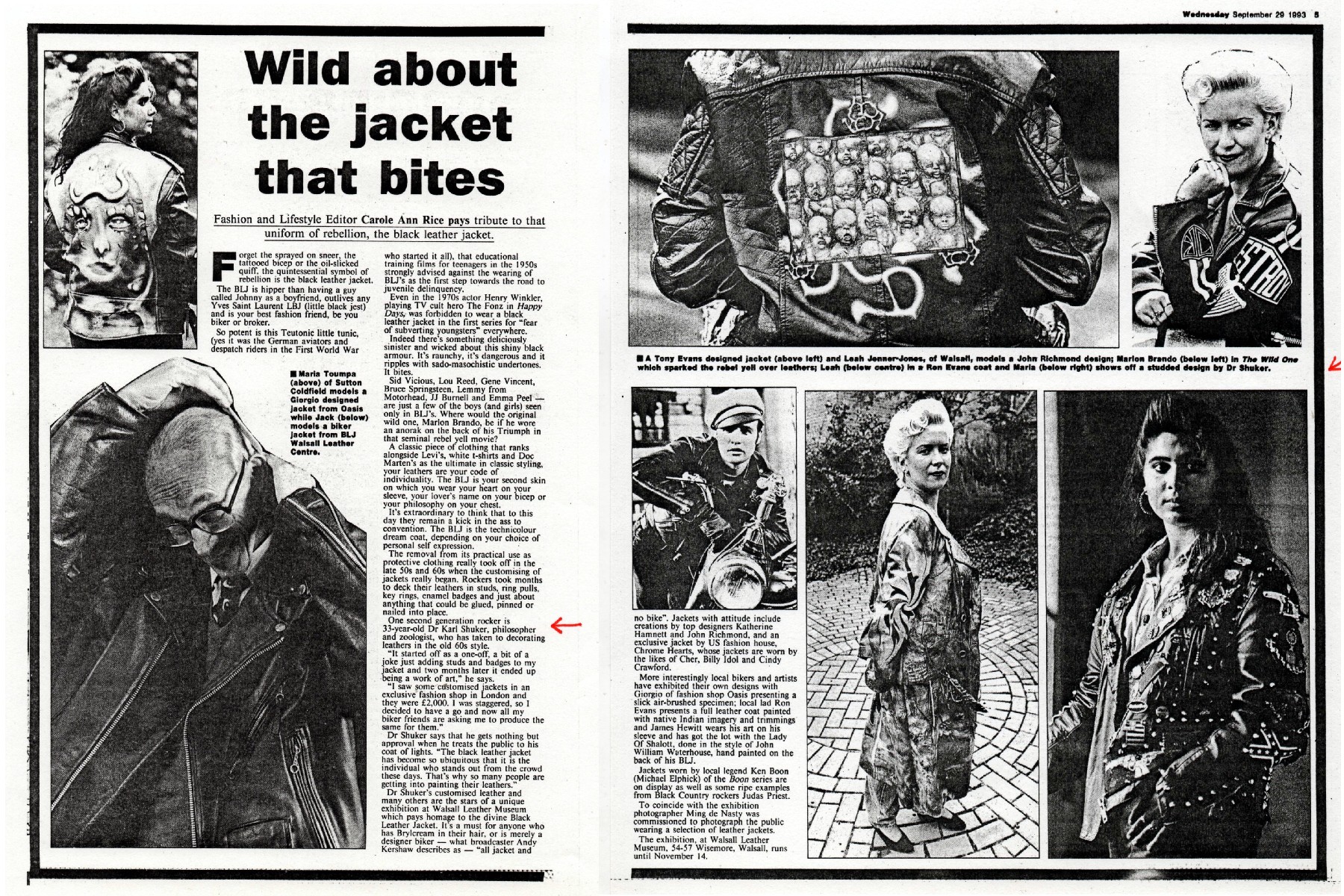
Birmingham Post newspaper's 2-page magazine supplement report for 29 September 1993 re the Walsall Leather Museum's BLJ Exhibition, which includes a name-check and quote from me (arrowed in red) on p.4 and a picture of a model wearing my exhibited BLJ on p. 5 – please click to enlarge for reading purposes (© Birmingham Post/Reach plc – reproduced here on a strictly non-commercial Fair Use basis for educational/review purposes only)

My exhibited BLJ also featured in two local TV news reports, and in one of them it was even worn by Midlands Today presenter Richard Ulridge while sitting astride a motorbike and then riding off on it, with my BLJ's Easyrider back patch fully displayed (click here to view both of these TV news reports – and my BLJ! – on YouTube).

 
Photo-still from the Midlands Today news report re the Walsall Leather Museum's BLJ Exhibition depicting presenter Richard Ulridge wearing my exhibited BLJ (© Dr Karl Shuker/Midlands Today – reproduced here on a strictly non-commercial Fair Use basis for educational/review purposes only)

If you'd like to watch Black Leather Jacket, most of it can currently be viewed free of charge on YouTube, where it has been uploaded in nine parts (but, oddly, Part 3 is seemingly missing), though the resolution quality is not great. Click here to begin viewing with Part 1.

Finally: To view a complete chronological listing of all of my Shuker In MovieLand blog's other film/TV reviews and articles (each one instantly accessible via a direct clickable link), please click HERE, and please click HERE to view a complete fully-clickable alphabetical listing of them.

 
Photo-still from the Midlands Today news report re the Walsall Leather Museum's BLJ Exhibition depicting the back of my exhibited BLJ as worn by presenter Richard Ulridge (© Dr Karl Shuker/Midlands Today – reproduced here on a strictly non-commercial Fair Use basis for educational/review purposes only)